SPECIAL UPDATE! PART TWO — “SHAPING NEIGHBORHOODS” OPEN HOUSE
Updated: Jun 8
Two meetings held last week deserve closer attention from Costa Mesa residents. Because of their importance—and how they connect—this will be a two-part update, so be sure to read both parts.
PART ONE — CITY COUNCIL “ADOPTS” A BUDGET—OR DID IT?
At the Tuesday, June 2, 2026 Regular Meeting, the Costa Mesa City Council voted to adopt a budget for Fiscal Year 2026–2027. On the surface, that may sound routine. But a closer look raises an important question: was a complete and meaningful budget actually adopted? We’ll break down what happened—and what it means.
PART TWO — “SHAPING NEIGHBORHOODS” OPEN HOUSE
The following evening, the City hosted an Open House at the Senior Center titled “Shaping Neighborhoods: Let’s Complete the Plans!” By itself, that might not have drawn much attention. However, coming on the heels of statements made at the City Council meeting—and alongside a warning from the State of California directed at cities like Costa Mesa—the meeting takes on much greater significance. We’ll walk through what was presented, what we learned, and why it matters for you.
Because this is a special update, these summaries focus on the key issues residents should understand—and where action may be needed.
JUNE 3 “SHAPING NEIGHBORHOODS” MEETING. This was another open house–style meeting, where City staff and a consultant gave a brief presentation before inviting attendees to circulate the room, review posters, and ask questions.
The meeting took place at the Costa Mesa Senior Center and was attended by approximately 35 members of the public, with some arriving late and others leaving early. Two Planning Commissioners—Angely Andrade and David Martinez—were present. Notably, no members of the City Council attended. In contrast, there were at least a dozen City staff members and about four consultants on hand.
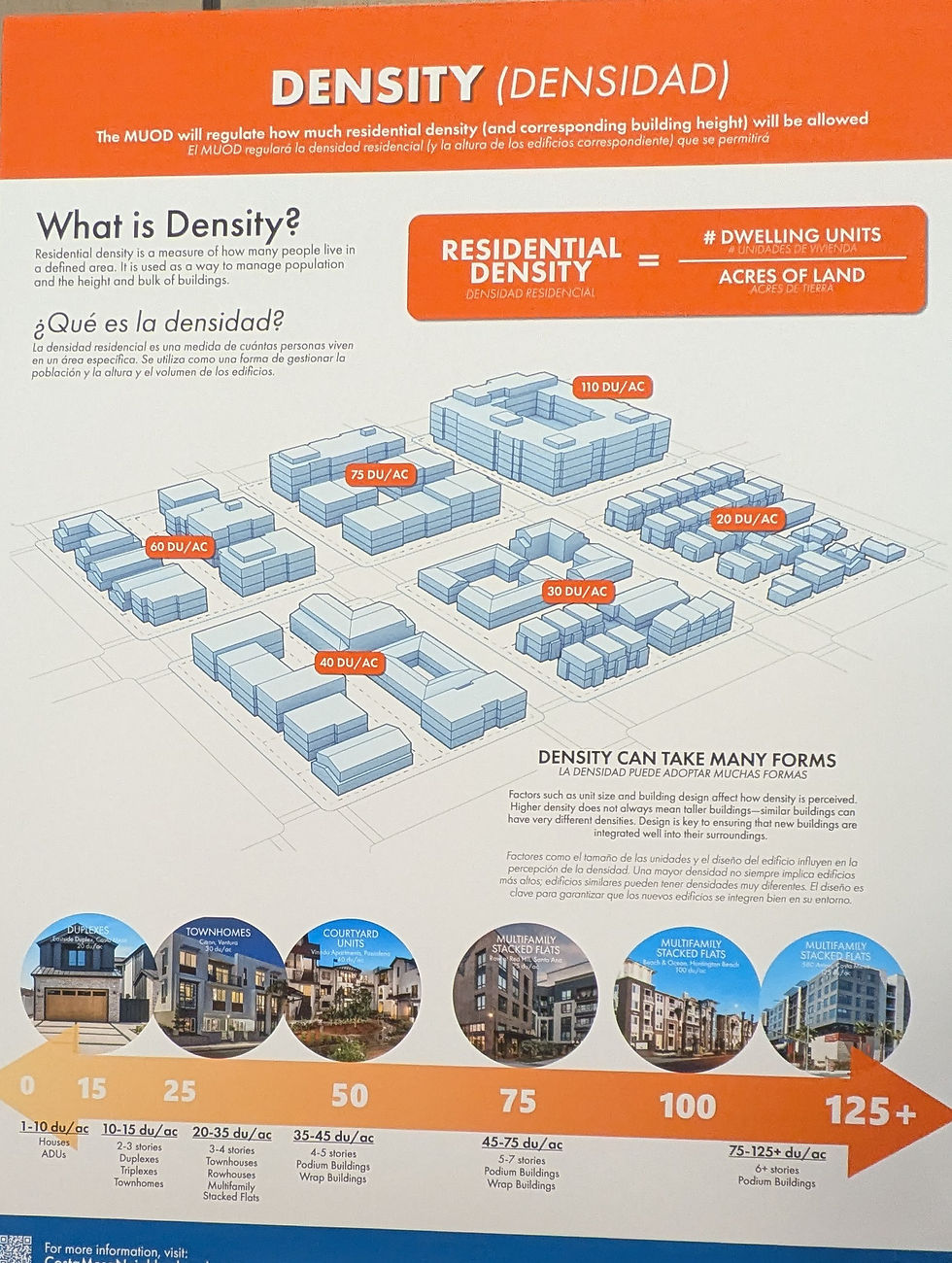
The displays included posters explaining the proposed Mixed Use Overlay District (MUOD) to be created under Measure K, along with maps showing intended upzoning across the city, new development standards, and objective design standards. Additional materials outlining updates to the Housing Element are scheduled to be released on Monday, June 8. The public comment period for both the Housing Element and zoning changes will close on June 15. JUST ONE WEEK LATER!!!
Challenges with the Meeting Format
One drawback of this open house format is that discussions tend to cluster around certain posters, making it difficult to hear both the questions from residents and the responses from Staff. This issue became particularly noticeable at the display showing the locations of Measure K sites and proposed Housing Element sites, as well as the corresponding upzoning map.

The next poster shows the proposed upzoning of those parcels:

OR DOES IT?

What the Materials Suggest
A closer look at the fine print on these materials—and at the proposed changes to the Newport Boulevard Specific Plan—raises important questions. The revisions indicate that developers who opt for utilization of the MUOD guidelines may be eligible for significantly higher residential densities.

While the City’s standard development regulations would typically allow up to 30 dwelling units per acre (du/ac), the overlay could permit densities as high as 90 du/ac. In practical terms, this could translate into buildings reaching heights of up to approximately 108 feet, subject to applicable height limits.

To better understand what this density looks like, the City provided illustrative renderings. To help you visualize what 90 du/ac looks like, it is more than twice the height of the project across from Trader Joe’s on 17th Street.
For comparison, a real-world example is a development in Attleboro, Massachusetts, built at a similar density (91 du/ac), located adjacent to transit infrastructure (trains and busways).

Clarifications from Staff
During the meeting, I asked Staff whether buildings taller than four stories would be permitted south of the 405 Freeway. Initially, I was told they would not. However, after reviewing the updated Newport Boulevard Specific Plan designations—which allow developers to opt into its provisions rather than the General Plan—it became clear that higher densities, and therefore taller buildings, may in fact be possible. Staff later acknowledged that buildings taller than four stories could occur. Much taller!
Potential Impacts
If higher-density development is allowed along Newport Boulevard and other corridors in Costa Mesa, it must be planned carefully and the impacts should be considered:
Traffic: Increased population generally leads to increased vehicle trips. Given existing constraints, including limited roadway expansion options and Newport Boulevard's one-way streets created by the 55 Freeway configuration, additional congestion and cut-through traffic on surrounding streets (e.g., Orange, Santa Ana, and Tustin Avenues) may result. Planning for public transit must be incorporated into the upzoning of the major corridors.
Bicycle Safety: While the City has made great strides in improving safety for cyclists, Newport Boulevard already has some of the most challenging (dangerous) bike conditions in Costa Mesa, an issue previously raised at the state level. Not all residents can or will rely on cycling as an alternative.
Parking: With the recent elimination of parking minimums, new developments could increase demand for street parking in nearby neighborhoods that are already experiencing shortages.
Open Space: These projects may not be required to provide substantial open space or contribute to new public parks. While concepts such as covering the 55 Freeway with park space have been discussed, they remain unfunded and conceptual. Significant financial resources would be required to make such proposals viable. While the concept of covering the 55 Freeway with park space, similar to what is proposed in Glendale over the 134 Freeway, is a nice idea, how practical is it?

There hasn’t been any funding for that project, so nothing has been built. The City would have to come up with a funding source, such as making developers contribute to a dedicated 55 Freeway park cover fund. What would it cost? A wild guess would be in the neighborhood of $10 million for starters.
Public vs. Private Space
Another question raised during the meeting concerned the shift away from minimum open space requirements toward more “publicly accessible” open areas within developments. This raises practical concerns about how such spaces will be managed and how potential conflicts between public access and residents’ quality of life will be addressed. How do you keep the public from becoming a nuisance when the public open space isn’t clearly delineated, such as a stoop at an entrance to a condo or apartment building? City staff indicated that these issues would largely fall to property owners to resolve. Oh, I see: you break it, we fix it.
Citywide Implications
These proposed zoning and Housing Element updates represent a citywide initiative, meaning their effects could be felt across multiple neighborhoods.
For those interested in reviewing the draft materials, they are available here.
💣ANOTHER BOMBSHELL! 💣
Additional Development: State Legal Alert
Shortly before the meeting, I received a legal alert from the California Department of Housing and Community Development (HCD) concerning local regulation of sober living homes. Costa Mesa was specifically referenced in the alert.
The document cautions jurisdictions against relying on certain legal interpretations, noting potential risks under California housing law and constitutional privacy protections. The closing language warns that such reliance could expose cities to liability and jeopardize housing certifications.
“Relying on the analysis of state housing laws in Ohio House could expose localities to liability under California housing law and the California Constitution’s right to privacy, along with jeopardizing localities’ housing element certifications or Prohousing designations.”
You can read the full alert here: View Legal Alert
At the meeting, I spoke with Development Services Director Carrie Tai about the alert. She indicated that the City had recently submitted revisions to the Housing Element to HCD and had not yet received feedback or approval, and she expressed surprise at the timing of the alert. I find it disconcerting that the HCD chose to send “a shot over the bow” instead of responding to the City formally.
Despite the disposition of the Ohio House federal lawsuit, there is still a State case pending. I’ve heard rumors that HCD may file a new lawsuit over the City’s failure to comply with State laws. This legal alert adds fuel to that fire.
At any rate, it doesn’t look like our Housing Element will get certified anytime soon, despite all the hopes and prayers down at City Hall.
TALKING POINTS: Returning to the proposed upzoning and Housing Element changes, here are several key issues to consider:
Where is the community vision? Measure K was intended to produce a shared vision for Costa Mesa’s future through public input. To date, that vision has not been clearly presented. Instead, what we are seeing appears driven primarily by the need to satisfy state Housing and Community Development (HCD) requirements and RHNA numbers. The result feels less like thoughtful city planning and more like solving a numbers puzzle, rather than reflecting what residents actually want for their community.
Impact on homeownership vs. rentals. Once buildings exceed four stories, they are overwhelmingly developed as rental properties rather than ownership housing. This trend shifts wealth-building opportunities away from residents and toward property owners—often large, out-of-state investment entities. Costa Mesa already has a significant imbalance, with rentals outpacing ownership roughly 60/40. The City should be considering how to incentivize more ownership housing, not deepen the imbalance.
Fiscal impacts of apartments vs. ownership housing. Apartment buildings tend to remain under long-term ownership, meaning their property tax contributions grow slowly over time. In contrast, ownership housing typically turns over more frequently, increasing assessed values and strengthening the City’s tax base. Expanding apartments without considering this dynamic may limit long-term fiscal benefits to the City.
Development realities and building scale. Given high land and construction costs, developers design projects to maximize returns. Even if the City permits buildings just over four stories, financial pressures often push developers toward larger six- to nine-story projects. These are typically high-rent developments—similar to those seen in Irvine—with rents ranging from approximately $2,000 to $5,000 per month. This raises an important question: how does this type of development improve affordability or help residents save toward homeownership?
Need for stronger affordable housing requirements. Increasing density alone does not guarantee affordability. Developers are unlikely to include affordable units without clear regulatory requirements. Cities such as Irvine and Santa Ana have adopted stronger inclusionary policies to address this. Costa Mesa should update its Affordable Housing Ordinance in tandem with upzoning to ensure that new development delivers a meaningful number of affordable units rather than primarily luxury housing.
Parks, infrastructure, and service impacts. Higher density brings increased demand for parks, roads, and public safety services. Without expanding park space, existing parks will face greater strain and higher maintenance costs. If additional tax revenue does not keep pace with these needs, funding will have to be diverted from other areas of the City’s budget.
Need for updated financial analysis. During the 2016 General Plan update, financial analysis indicated that development exceeding four stories south of the 405 Freeway could negatively impact the City’s budget. A current, comprehensive financial analysis is needed to understand the full implications of the proposed changes before moving forward.
Environmental and quality-of-life concerns. More rigorous analysis is needed, including updated traffic, parking, and air quality studies. The draft Environmental Impact Report already identifies air quality impacts that cannot be fully mitigated. Taller buildings can also affect natural airflow, potentially worsening air quality. These impacts should be carefully evaluated, including potential long-term health considerations.
Long-term development outlook. While rezoning does not mean immediate buildout, it sets the stage for future development patterns. Projects will be built gradually, influenced by economic conditions such as land costs, construction costs, interest rates, and rental markets. Although development may slow during periods of economic uncertainty, it will resume—and likely at a larger scale than seen historically.
The City is expected to release additional documents this week. Please stay tuned for updates as more details about the rezoning plans become available.
👉 Don’t sit this one out. With major zoning changes on the table and the comment period closing in just one week, now is the time to get informed, ask questions, and make your perspective known.
Review the draft materials and submit your comments by June 15.

Comments