PART ONE OF OCTOBER 2026 CITY HALL UPDATE: 🏘️HOUSING, 🏗️CITY INFRASTRUCTURE AND 🌳FAIRVIEW PARK ISSUES MOVE TO THE FOREFRONT
Costa Mesa's October meetings featured several of the year's most significant policy decisions. The City Council approved implementation of Measure K, authorized the reconstruction and financing of Fire Station No. 2, adopted a Climate Action and Adaptation Plan, updated development and user fees, and advanced several long-term infrastructure and planning initiatives. At the same time, tensions continued to build over Fairview Park, where state regulators are signaling growing frustration with the City's handling of sensitive habitat areas, and the Fairview Developmental Center Specific Plan got a rejection notice from the state.
While several meetings were canceled in October, we still had plenty of other City meetings to attend, along with a City Council candidate debate. So much happened that I have divided this report into two parts.
Here is a summary of the activity at City Hall and other meetings in October:
Council, Commission and Committee Meetings:
City Council: Three meetings were held, including a Study Session;
Planning Commission: One meeting was held; and
Fairview Park Steering Committee: One meeting was held.
Here is Part One of our report (you can find Part Two here):
OCTOBER 6 CITY COUNCIL MEETING. At this meeting, these five items were acted on, but that didn’t make for a short meeting; in fact, it lasted more than four hours:
Continuation Request—Appeal Of Planning Commission Decision to Uphold Denial of Reasonable Accommodation Request for Sober Living Home Operated by The Ohio House and Remand to Community Development Director
Adoption of Fairview Developmental Center Specific Plan, Related General Plan and Zoning Amendments, and Certification of Environmental Impact Report
Resolution Establishing Speed Limits in School Zones
“Fair Drive For All”—Fair Drive Circulation Improvements
Purchase Of Docking Stations and Drone for Police Department UAS Program
All Councilmembers were present.
City Attorney Closed Session Report. Kimberly Hall Barlow reported that the City gave direction, but no reportable action was taken.
Presentations: A proclamation recognizing Walktober 2026 was read.
Public Comment. Eight members of the public addressed the City Council on a variety of issues, including surveillance technology, neighborhood impacts from mental health and sober living facilities, noise complaints, and international affairs.
Opposition to Flock Surveillance Cameras: Several speakers urged the City Council to terminate its contract with Flock Safety, citing concerns about privacy, government surveillance, transparency, and data sharing. Speakers questioned the collection and retention of license plate, video, and audio data, raised concerns about potential misuse by government agencies, and warned that advances in AI-powered surveillance technology could threaten constitutional privacy protections.
Others criticized the City's response to public records requests and alleged a lack of transparency about audit logs and outside agencies' access to Flock data. One speaker argued that the City's original implementation of the Flock program in 2022 failed to comply with state transparency requirements and called on the Council to cancel the contract.
Noise Complaint at The 12 Gym: A resident living near The 12 Gym at 140 E. 17th Street renewed complaints about ongoing noise impacts from amplified music, instructor voices, and heavy bass vibrations. She argued that the disturbance has intensified as the gym prepares to relocate and questioned the City's handling of complaints and the accuracy of a previous noise study. She urged the City to address the issue rather than wait for the business to move.
Support for Israel and Opposition to Antisemitism: Former City Council candidate Jose Toscano reflected on his recent campaign experience and thanked supporters. He also noted the upcoming anniversary of the October 7 Hamas attack on Israel and asked the Council to consider adopting resolutions condemning Hamas, supporting Israel, and standing with Costa Mesa's Jewish community against antisemitism.
Concerns About Mental Health and Sober Living Facilities: Two Mesa Verde residents expressed concerns about mental health treatment and sober living facilities operating in residential neighborhoods. They cited a recent incident involving a resident who allegedly left a facility, damaged property, attempted to enter vehicles, and required intervention by law enforcement. The speakers said repeated disturbances, emergency responses, and safety concerns have negatively affected neighborhood quality of life and called for stronger oversight, regulation, and investigation of the facilities.
Councilmember Comments. Loren Gameros (District 2) reminded residents that the Senior Center is serving as a cooling center during the heat wave and promoted the upcoming Fire Station No. 4 Open House.
Andrea Marr (District 3) highlighted recent community events, requested an update on the City's Flock Safety negotiations, supported active transportation investments and Safe Routes to School, praised the Let's Go Costa Mesa shuttle program, thanked Staff for work on the Mixed-Use Overlay District, and promoted the upcoming Shine the Light domestic violence awareness event.
Arlis Reynolds (District 5) asked for a timeline on the Flock Safety update, praised the City's investments in walking, biking, and transit infrastructure, advocated for a City Council update on Safe Routes to School, highlighted the benefits of the Let's Go Costa Mesa shuttle, supported efforts to balance housing and business preservation in the Mixed-Use Overlay District, and encouraged attendance at the Shine the Light event.
Jeff Pettis (District 6) praised Human Options and commended Staff, commissioners, and residents for their work on the Harper Park improvement project.
Mike Buley (District 1) praised RADCAMP (Rising Above Disabilities) for its impact on individuals with developmental disabilities, called for greater Animal Services Committee involvement in shelter contracting decisions, and encouraged the City to pursue artificial intelligence and technology innovations to improve services.
Manuel Chavez (District 4) promoted the Fire Station No. 4 Open House and invited residents to the Ketchum-Libolt Park grand opening and ribbon cutting.
John Stephens (Mayor) praised RADCAMP, requested a Staff update on the Waxwing neighborhood issue, highlighted several local arts and community events, expressed support for the Adams Avenue improvement project, congratulated CMTV on its recent awards, and promoted the upcoming "Sing Along with the Mayor" fundraiser benefiting Save Our Youth.
City Manager Comments. Cecilia Gallardo-Daly invited the public to attend the Ketchum-Libolt Park ribbon-cutting ceremony on October 12, highlighting the park’s extensive improvements, including a new playground, shade structures, lighting, and walkways. She thanked Assemblymember Cottie Petrie-Norris for securing $1.2 million in funding for the project.
She also congratulated Costa Mesa TV (CMTV) for earning multiple state and national awards, praising the communications team for its dedication to informing and engaging the community.
She encouraged residents to visit the “Somos Costa Mesa” public art installation at Lions Park, created by Costa Mesa resident and city employee Ramon Guzman through a city arts grant in celebration of Hispanic Heritage Month.
Finally, Gallardo-Daly recognized Assistant Fire Marshal Nikki Johnson as the recipient of the City Manager Leadership Award.
City Attorney Comments. City Attorney Kimberly Hall Barlow confirmed that the proposed Flock ALPR agreement amendment is scheduled to come before the City Council on November 17, as Councilmember Reynolds had noted. She explained that she had originally hoped to bring the item forward in October, but a heavy workload involving numerous city projects and litigation matters prevented her from meeting the agenda deadlines.
CONSENT CALENDAR. Item 9, a Resolution Authorizing Application for Funds Under OCTA for an Orange County Enhanced Mobility for Seniors and Individuals with Disabilities Grant Program, was pulled by Reynolds. The remaining items were moved for approval by Chavez and seconded by Stephens. That motion passed unanimously, 7–0.
During discussion of Item 9, Reynolds thanked Staff for pursuing additional funding for the City's Senior Transportation Program and noted that medical ride usage has declined significantly since recent program changes. She pointed to data showing that relatively few participants are reaching the current eight-ride-per-month limit, suggesting that factors other than the ride cap may be affecting ridership. Reynolds emphasized the need to better understand why former users are no longer utilizing the service.
She also asked whether the grant funds could be used flexibly if the City determines that increasing the ride limit is not the best way to improve access, suggesting alternatives such as reducing participant co-pays.
Staff confirmed that the grant provides flexibility. While the primary goal is to expand ride availability, the funds could also reduce co-pays if that proves more effective. Staff added that using grant funds for medical transportation would free up other funding sources, including Measure M2 funds, for broader senior transportation services.
Reynolds said she intended to propose language preserving that flexibility and thanked Staff for their ongoing collection and analysis of program data.
Public Comment. None.
Motion and Vote. Reynolds moved to approve Staff’s recommendation with a modification to the resolution that would provide greater flexibility in how the grant funds could be used. Specifically, she proposed revising the final “whereas” clause to state that the EMSD grant funding would improve access to senior transportation services through expanded service levels determined by the funding received, rather than tying the funding solely to increasing the ride cap.
Reynolds explained that the change would allow the city to use the grant funds in other ways if future data show that barriers such as co-pays or other program limitations affect participation more than the monthly ride limit.
She also requested that, once a full quarter of data is available under the revised program, Staff provide an update to the Parks and Community Services Commission (PACS) so the commission can review the results and provide input on senior transportation services.
Stephens seconded the motion. The motion passed unanimously, 7–0.
PUBLIC HEARINGS: There was only one public hearing:
1. Continuation Request—Appeal Of Planning Commission Decision to Uphold Denial of Reasonable Accommodation Request for Sober Living Home Operated by The Ohio House. Senior Planner David Mendez presented an appeal involving The Ohio House, a sober living facility at 115 E. Wilson Street that has operated since 2012 within a development of five detached single-family homes.
Staff reviewed the property’s lengthy history and noted that the City denied previous reasonable accommodation requests, which both the City Council and federal courts, including the Ninth Circuit, upheld. The current appeal stems from a third reasonable accommodation request that the Community Development Director denied in 2025 and the Planning Commission subsequently upheld.
The Applicant was seeking either:
Recognition as a single housekeeping unit, which would exempt the facility from the City's conditional use permit requirements; or
Relief from the City's 650-foot separation requirement for sober living homes, allowing the facility to operate despite being approximately 500 feet from another approved sober living facility on Wilson Street.
Mendez explained that while the Planning Commission acknowledged Ohio House's positive record and heard significant public support, it ultimately concluded the request did not satisfy the City's zoning standards or the legal criteria for a reasonable accommodation.
Staff reviewed the factors used to evaluate such requests, including whether the accommodation is necessary to provide equal housing opportunities for individuals with disabilities, whether it is compatible with surrounding uses, whether similar housing opportunities already exist in the community, and whether granting the request would fundamentally alter the City's regulatory framework.
Notably, both Staff and the Applicant's attorney agreed on the recommended path forward. Staff recommended that the City Council remand the appeal to the Community Development Director for reconsideration, directing the Director to provide additional written findings on the separation requirement and operator permit conditions and to reevaluate the request under current state regulations. Staff also recommended updating the City's reasonable accommodation procedures and scheduling a future hearing to reconsider the related conditional use permit after the Director issues a new decision.

Councilmember Questions. Pettis asked Staff to clarify that the City Council was not deciding the merits of Ohio House's reasonable accommodation request, but only whether to send the matter back for additional review. Staff confirmed that the proposed action was limited to a remand and that the Council would retain full authority to independently consider the related Conditional Use Permit (CUP) at a future hearing. Pettis emphasized that the remand would simply allow further administrative review without limiting the Council's future discretion.
Public Comment. Cynthia McDonald criticized the Agenda Report for omitting a June 8 letter from the California Department of Housing and Community Development (HCD) concerning Ohio House. I argued the letter matters because HCD concluded that the City's denial of the reasonable accommodation request, as well as portions of Costa Mesa's sober living regulations, conflict with state housing and fair housing laws. I urged the Council to make the letter part of the public record, discuss its findings openly, and provide residents with greater transparency regarding the State's concerns and pending litigation. That letter can be found here:
Maxwell Buehler supported remanding the matter for reconsideration under current California law. Drawing on his experience living in a sober living home, he said such facilities play a critical role in helping individuals transition back to independent living while maintaining accountability and support. He feels Ohio House provides an important community benefit and deserves reconsideration under updated legal standards.
Motion and Vote. Stephens moved to remand the Ohio House reasonable accommodation request to the Community Development Director for reconsideration. The motion directed the Director to prepare additional written findings regarding the requested accommodation, including the City's separation requirement and operator permit conditions, evaluate the request under current state regulations, and return the matter for further review. The motion also directed Staff to update the City's reasonable accommodation provisions and schedule a future public hearing on the related Conditional Use Permit following the Director's decision.
The motion was seconded by Marr. Stephens said he had no additional comments, noting that the issues had already been thoroughly discussed.
The motion passed unanimously, 7-0.
OLD BUSINESS: There was only one item:
1. Adoption of Fairview Developmental Center Specific Plan (FDCSP), Related General Plan and Zoning Amendments, and Certification of Environmental Impact Report (EIR). This item was the second reading of the ordinance associated with the FDCSP. Principal Planner Melinda Dacey briefly recapped the FDCSP item the City Council previously approved on September 15.
She explained that the Council had already certified the Environmental Impact Report (EIR), adopted the required findings and mitigation measures, approved amendments to the Land Use Element, and introduced the specific plan ordinance. As part of that action, the Council directed Staff to:
Reduce the maximum number of housing units from 4,000 to 2,300.
Increase required open space from 14 acres to 25 acres.
Increase the minimum non-residential development requirement from 10,000 square feet to 15,000 square feet.
Require a transportation study to determine whether and when a secondary access road is necessary.
Incorporate 22 non-substantive text amendments.
Continue discussions with state agencies regarding potential Merrimac Way access and funding assistance for site remediation.
Staff also updated the specific plan to reflect Council direction regarding the proposed secondary access road. References to a potential roadway through the golf course now clearly state that the concept is only illustrative and does not commit any City golf course property to future roadway construction. Any future secondary access road proposal would require a specific plan amendment and separate City Council approval.
Looking ahead, Dacey explained that adopting the ordinance would allow the State to move forward with its disposition process and select a master developer for the site's redevelopment.
Staff recommended that the City Council adopt the ordinance as drafted, noting that the Council could also choose to incorporate the exact language from the September 15 motion and meeting minutes into the ordinance if desired.
Councilmember Questions. Reynolds asked how the City plans to keep the public informed throughout the Fairview Developmental Center process, especially since the State is leading portions of the developer selection process and the project may not return to the City until a master plan application is submitted.
Staff explained that the future master developer will be required to maintain a website with information about construction activities, but that requirement applies later in the process. In the meantime, the City will continue using the interested parties mailing list created during the specific plan process to provide community updates.
The City will continue participating in biweekly coordination meetings with State agencies and will post schedules and updates on the City's Fairview Developmental Center webpage as information becomes available.
Staff noted an interim period while the State evaluates development proposals, during which the City will serve as the primary source of public information.
Reynolds asked whether the existing fdcplan.com website would remain the primary source for project updates. She also asked if the public mailing list would remain active so residents could continue receiving notifications.
Staff said the City currently pays to maintain the website but plans to transition information from that site onto the City's Fairview Developmental Center webpage. The City webpage is already being updated with Planning Commission and City Council actions and will incorporate additional information from the project website.
Staff confirmed the mailing list will remain active, remain under the City's control, and continue accepting new subscribers.
Public Comment. A mother of a severely disabled son shared her family's struggle to find appropriate care in Orange County. She explained that her son has spent extended periods in crisis facilities and is currently placed in a group home in Bakersfield, far from his family, where she fears he is being neglected. She argued that Orange County lacks adequate housing and treatment options for individuals with severe developmental disabilities, despite repeated promises that facilities would be built locally.
The speaker urged the City and State to preserve and expand space at the Fairview Developmental Center for people with developmental disabilities, expressing concern that future development could displace this community and reduce housing and service opportunities.
Motion and Vote. Stephens moved to approve Staff’s recommendation with two modifications related to roadway access through the Mesa Verde Country Club golf course:
Add explicit language to the ordinance prohibiting construction of a road through the golf course, consistent with the Council's previously approved motion.
Remove any conceptual graphic in the Specific Plan that depicts a road through the golf course as a potential option.
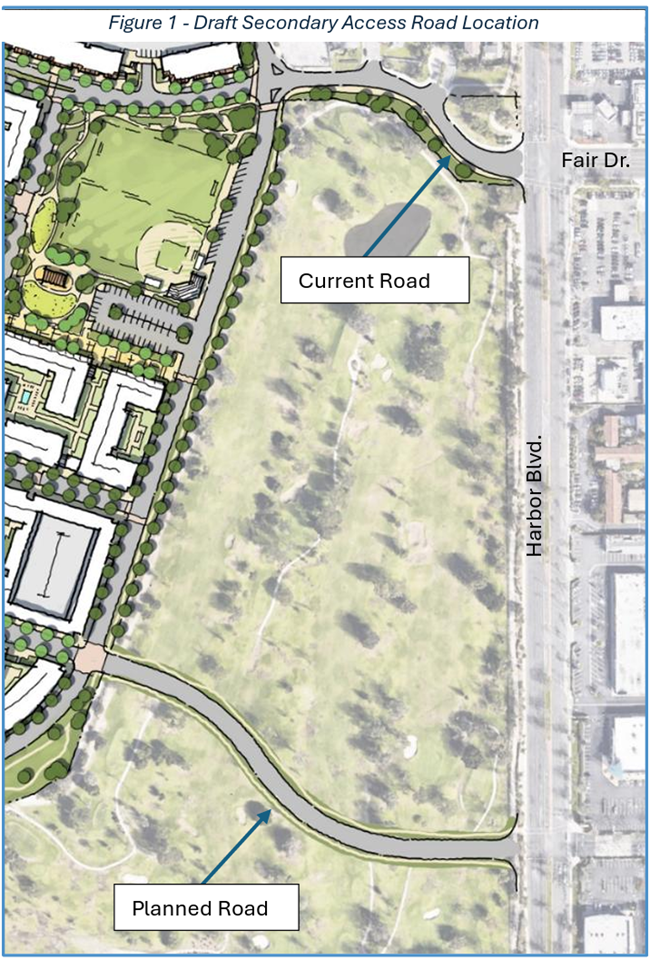
Stephens stated that the Council had already made its intent clear and wanted to eliminate any ambiguity that could later be interpreted as support for a golf course roadway. He noted that if a future need for secondary emergency access is demonstrated and alternatives such as Merrimac Way are not feasible, the applicant could return to the City Council to seek an amendment to the Specific Plan.
Chavez seconded the motion.
Reynolds thanked Staff for their extensive work on the FDCSP and the community outreach process. She noted that while much of the public discussion focused on housing units and park acreage, the plan also contains important community-building policies.
The motion carried 7-0, with all City Council members voting in favor. The approval formally incorporated the prohibition on a road through the Mesa Verde golf course into the ordinance and removed graphics depicting that option from the Specific Plan.
COMMENTARY: The reduction in the maximum number of housing units is a positive step and better aligns the project with the scale and character of surrounding Costa Mesa neighborhoods. Many residents have advocated for a more modest development footprint, and the approved Specific Plan reflects some movement in that direction.
That said, the Specific Plan establishes a framework, not a final development proposal. Because many details remain undefined, a future master developer selected by the State could negotiate a development agreement with the City that significantly expands the project's scope. The environmental review analyzed up to 4,000 housing units, and the City accepted the EIR without amending it to establish a firm cap of 2,300 units. As a result, a future developer could seek a General Plan Amendment to increase the number of units beyond what residents currently expect. Whether that occurs remains to be seen, but the City's decision to leave that flexibility in place could become a significant issue in the years ahead.
On October 30, HCD informed the City that the FDCSP still does not fully satisfy state requirements for accommodating lower-income housing. We previously reported on the letter and its implications in our article, Special Update: Housing Element Troubles Continue - HCD Flags Fairview Development Center Specific Plan.
To achieve compliance, the City must revise the FDCSP to allow qualifying multifamily affordable housing projects with at least 20 percent lower-income units by right, provide a minimum density of 20 dwelling units per acre on lower-income RHNA sites, and ensure mixed-use areas maintain a substantial residential component by requiring at least 50 percent residential floor area, allowing fully residential projects, and prohibiting entirely nonresidential development on those sites.
Costa Mesa First raised concerns about these affordable housing compliance issues in its July 1, 2026 comment letter about the draft EIR, before the final Specific Plan was released. When it issued the final EIR, the City said it would not address the matter through the EIR and suggested that the broader 4,000-unit development envelope provided sufficient flexibility to satisfy state requirements. HCD's October 30 letter suggests otherwise, making clear that additional changes are still necessary.
Notably, HCD's letter contained some of the strongest language directed at the City to date: "Failure to make expeditious progress will trigger a review of the housing element that may result in revocation of substantial compliance." That warning signals growing state frustration with the pace of corrective action and raises the stakes for the City's next steps.
SAVE THE DATE: We expect this item to return to the City Council for consideration on November 17.
NEW BUSINESS: There were four items:
1. Review of Conceptual Design for Open Parcel Adjacent to Shalimar Park. Brian Gruner, Director of Parks and Community Services, and consultants from City Fabrick presented a conceptual plan for the vacant property at 778 Shalimar Drive, which the City purchased in 2024 for $1.5 million to nearly double the size of Shalimar Park. The presentation emphasized strong community support for both park expansion and a future community center. While funding for a building is not currently available, Staff recommended creating an outdoor community space now while preserving the site for future community center development.
Community Outreach. The design was shaped through extensive public outreach, including four community workshops, multilingual mailers, surveys, social media engagement, and more than 1,700 resident votes and comments. Residents consistently requested:
More trees and shade
Natural grass
Fitness equipment
Flexible recreation space
Soccer, pickleball, and tennis opportunities
Picnic and gathering areas
Open landscaping and low fencing
The most common request was for a future community center offering after-school programs, cultural activities, educational opportunities, and community events.
Recommended Plan. After evaluating multiple concepts, Staff recommended a phased approach:
Phase 1: Develop the site as a flexible outdoor gathering space featuring a half basketball court, open lawn area, fitness equipment, shade trees, picnic areas, and landscaping.
Phase 2: Preserve space for a future community center and pursue grants and other funding sources to make it a reality.

The Parks and Community Services Commission supported the phased approach, and Staff recommended that the City Council approve the conceptual design and move forward with Phase 1 improvements while continuing to seek funding for a future community center.
Councilmember Questions. Reynolds asked whether funding is available to fully build the proposed Phase 1 improvements or only complete the design work. Staff responded that the City has about $500,000 in available funding, along with potential savings from the Ketchum-Libolt Park project, which is expected to come in under budget. Staff said those funds are sufficient to construct the interim improvements shown in the final concept, including the shade structure.
Reynolds also asked whether the design preserves flexibility for a future community center. Staff said the concept was intentionally designed to accommodate a future building and that an existing tree shown in both concepts would be preserved rather than removed.
Finally, Reynolds asked whether work on the community center design could continue before funding is secured. Staff said additional funding would be needed to advance the next phase of design but noted that future grants, appropriations, and budget allocations could provide opportunities to move the project forward. Reynolds suggested exploring a partnership with Orange Coast College, whose students have previously designed and built community projects.
Stephens asked for a rough estimate of what a future community center might cost. Staff said that, while a final price would depend on the design, a preliminary estimate is approximately $2 million.
Public Comment. Several speakers expressed strong support for both the new park improvements and the long-term vision of building a community center in the Shalimar neighborhood.
Residents and community leaders thanked Staff and the Council for their outreach efforts and investment in the park project, describing it as a long-overdue improvement for the neighborhood. Multiple speakers emphasized that while the new park is welcome, the community still needs a dedicated community center to provide after-school programs, tutoring, cultural events, community gatherings, and enrichment opportunities that were lost after the closure of programs such as La Escuelita.
Representatives from Bright Youth, local residents, and community advocates said a community center would create a safe gathering place for children and families, support cultural celebrations, and serve as a hub for education, arts, and entrepreneurship. Several speakers pledged to continue advocating for the project and encouraged the City to pursue grants and other funding opportunities.
A recurring theme was support for partnering with Orange Coast College to help design the future community center, with speakers noting the college's successful architectural projects and the opportunity to involve local students in the process.
One speaker suggested exploring grants by designing the facility to also serve as a cooling center during extreme heat events. Another urged the City to develop a plan for prioritizing community center funding through future grants, budget allocations, or the Capital Improvement Program.
Motion, Comments and Vote. Chavez moved to approve the conceptual design for the open parcel adjacent to Shalimar Park, and Reynolds seconded.
Reynolds proposed an amendment directing Staff to explore potential partnerships for the future community center design, including Orange Coast College and other interested collaborators. Chavez accepted the amendment.
Stephens supported the motion, noting that the estimated $2 million cost of a future community center seemed attainable through grants and partnerships.
The motion passed unanimously, 7-0.
2. Resolution Establishing Speed Limits in School Zones. Public Works Director Raja Sethuraman and Transportation Services Manager Paul Martin presented a proposal to reduce speed limits in residential school zones from 25 mph to 20 mph under authority granted by Assembly Bill 382. While state law does not require the reduction until 2031, the resolution would allow Costa Mesa to implement the lower limit sooner on eligible residential streets near schools.
Staff said lower school-zone speeds would create a clearer distinction from surrounding residential streets, improve safety for students, pedestrians, and cyclists, and support City goals related to traffic safety and Safe Routes to School. The changes would generally apply to residential streets within 500 feet of school boundaries, while major roadways with existing school-zone speed limits would remain unchanged for now.
Before implementation, Staff would identify eligible locations, install signage, and conduct public outreach. The Newport-Mesa Unified School District has expressed support and agreed to help communicate the changes to schools and families.
Councilmember Questions. Reynolds asked how quickly the City could implement the new school-zone speed limits. Staff said the City can produce and install the necessary signs in-house and expects the changes to be in place within a few months, potentially during a school break.
Reynolds also asked how the City would measure effectiveness. Staff said they could collect speed and traffic data before and after implementation to evaluate impacts on vehicle speeds and safety.
Regarding a possible reduction to 15 mph, Staff said state law allows lower limits in certain situations but recommended first implementing the proposed 20 mph limit and assessing its results. Reynolds and Gameros also asked about major roadways such as Victoria Street. Staff explained that the proposal applies only to residential streets, leaving Victoria Street's existing school-zone speed limit unchanged for now, while the City could evaluate future reductions if warranted.
Public Comment. Melissa, a resident who lives near Victoria Elementary School, asked the City to consider whether the school's rear entrance should also receive school-zone signage, noting that she does not believe a school-zone sign currently exists there.
The next speaker was Planning Commissioner David Martinez, speaking for himself but noting that he works as a state policy manager for Streets for All, one of the sponsors of AB 382. He supported the proposed speed-limit reductions and praised Costa Mesa for being among the first cities in Orange County to implement the change. He also suggested that Staff consider using clearer school-zone triggers, such as flashing beacons.
Mary Limongelli, a longtime Costa Mesa resident, retired nurse, and College Park neighborhood resident, urged the City to reduce speeds around College Park Elementary School from 25 mph to 20 mph. Drawing on her decades of experience caring for injured children, she described the severe and sometimes lifelong consequences of vehicle collisions involving pedestrians. Limongelli said that lower speeds would reduce the risk of injury and improve safety for students, families, and residents, while supporting the City's Safe Routes to School goals of creating safer and healthier communities.
Motion, Comments and Vote. Reynolds moved to adopt the resolution establishing 20 mph school-zone speed limits on eligible residential streets. Her motion also directed Staff to:
Collect before-and-after speed data to measure the program's effectiveness.
Conduct targeted enforcement near Victoria Elementary School.
Consider additional speed reductions if speeding remains a problem during school drop-off and pick-up times.
Send a letter to the State Assembly and Senate transportation committees after implementation to inform them of the City's actions.
The motion was seconded by Chavez.
In support of the motion, Reynolds said slowing traffic near schools is a frequent community concern and encouraged the City to implement the changes citywide at the same time rather than phasing them in neighborhood by neighborhood. She also emphasized the importance of public outreach and follow-up enforcement.
After brief discussion, the motion passed unanimously, 7-0.
3. Fair Drive Circulation Improvements—“Fair Drive For All.” Transportation Services Manager Paul Martin presented the Fair Drive for All Project, a federally funded planning and design effort to improve safety, mobility, and accessibility along Fair Drive between Harbor Boulevard and Newport Boulevard.
Staff noted that residents have frequently complained about speeding, traffic operations, and pedestrian safety on Fair Drive, particularly at the Fair Drive/Fordham Drive intersection, which serves College Park Elementary School, Wilson Park, and nearby neighborhoods.
The corridor connects several major destinations and institutions, including the OC Fair & Event Center, City Hall, Vanguard University, the Fairview Developmental Center, and the future Southern Emergency Operations Center.
To address these issues, the City secured a federal grant of nearly $700,000 to study and design improvements. The project will proceed in phases:
Phase 1: Community engagement and evaluation of potential improvement alternatives.
Phase 2: Environmental review and final design.
Phase 3: Seek construction funding to build the selected improvements.
Following a competitive selection process, Staff recommended hiring Kimley-Horn and Associates to lead the project. The total design contract is approximately $863,000, with a 10% contingency bringing the total authorized amount to $949,000. Funding is available through the federal grant and existing budget allocations.
The project will place a major emphasis on community outreach. The consultant team, supported by public engagement firm Arellano Associates, will conduct workshops, stakeholder meetings, online engagement, surveys, and outreach to groups such as the College Park neighborhood, the OC Fair, and transportation stakeholders. Potential improvements to be studied include:
Safer pedestrian crossings, particularly at Fair Drive and Fordham Drive
Traffic-calming measures to address speeding
Enhanced bicycle facilities and separation from vehicle traffic
Improved ADA accessibility
Better connections to schools, parks, neighborhoods, and community destinations
Councilmember Questions. None.
Public Comment. Ralph Taboada expressed strong support for the project, noting that speeding on Fair Drive has been a longstanding concern the Active Transportation Committee has discussed. As a frequent cyclist, he described Fair Drive as a high-speed corridor that serves as an important east-west connection to the Back Bay, UCI, and regional bike networks. While supporting the long-term project, he urged the City to implement interim improvements, such as adding green paint to bike lanes, particularly between Fairview Avenue and Newport Boulevard, to improve visibility and safety for cyclists.
David Martinez also supported the project, highlighting Fair Drive's importance as a key east-west transportation corridor. He said the project offers an opportunity to improve bicycle connectivity and create a more complete, accessible active transportation network.
Chelsea Cody-Waters, a College Park resident, urged the City to focus on three priorities: slowing traffic on Fair Drive, improving pedestrian safety at the Fair Drive/Fordham Drive intersection, and creating continuous protected bike lanes. She described frequent speeding and red-light running near College Park Elementary School and advocated for a signalized crossing at Fordham. She also emphasized the need to connect Fair Drive's bicycle facilities to Harbor Boulevard's protected bike infrastructure.
Colin praised the City's recent investments in bicycle infrastructure and encouraged continued progress. He described Fair Drive as an important missing link between existing bike facilities on Fairview Avenue, Harbor Boulevard, and the coast. He argued the corridor is overbuilt for vehicle traffic, creates safety concerns for students and cyclists, and would benefit from protected bike lanes, safer pedestrian crossings, and traffic-calming measures. He emphasized that improved bicycle infrastructure enhances mobility, air quality, public health, and community connectivity.
Motion and Vote. Marr moved to approve Staff’s recommendation, and Reynolds seconded. In support of the motion, Marr said she was excited to see long-discussed concerns about Fair Drive finally being addressed. She noted that residents of the College Park neighborhood have raised safety and traffic concerns about the corridor for many years, and she looks forward to seeing improvements that make the street safer and more accessible for all users. Marr added that Fair Drive has become a route she often avoids when walking or biking because of current conditions and said the project is an important step toward improving connections across the city.
The motion passed unanimously, 7-0.
4. Purchase Of Docking Stations and Drone for Police Department Unmanned Aerial System Program. Captain Carlos Diaz and Lieutenant Nick Wilson presented a proposal to expand the Costa Mesa Police Department's drone program by purchasing additional Skydio drones, three drone docking stations, and supporting software.
The Department's drone program began in 2019 and now includes 24 certified pilots and multiple indoor and outdoor drone platforms. During 2025-26, drones were deployed more than 400 times for missions including search and rescue, missing persons, Alzheimer's patients, high-risk warrant service, perimeter containment, critical incidents, and special events.
Staff highlighted the success of the Department's Drone as First Responder (DFR) pilot program. During a three-week trial in 2025, drones responded to 63 calls for service, with 24 calls resolved without officers being dispatched and another 39 calls providing valuable real-time intelligence to responding officers. A separate DFR program funded through the Organized Retail Theft Grant at South Coast Plaza has since logged 112 deployments, with 40 incidents resolved without officer response and an average drone response time of less than two minutes.
The proposed docking stations would let drones launch remotely from strategic locations throughout the city, providing faster response times and real-time situational awareness for officers before they arrive on scene.
Staff also discussed the future Advanced Real-Time Information Center (ARTIC), funded in part through a $1.039 million federal appropriation secured through Congressman Dave Min's office. The DFR program would eventually operate through ARTIC, integrating drones and other technologies to support emergency response, public safety, and major incidents.
To address privacy concerns, staff emphasized that:
Drone flights are logged on a public-facing transparency portal.
Flight locations, flight paths, and mission purposes are publicly available.
The City stores video through its Axon evidence management system, with robust security and audit controls.
Drones are not used for routine patrols, random surveillance, or proactive monitoring and are deployed only in response to calls for service or specific incidents.
The Department stated that the program complies with federal security requirements, FAA regulations, and California's AB 481 requirements governing law enforcement technologies.
Councilmember Questions. Councilmembers spent about 45 minutes questioning Staff about the proposed DFR program.
Gameros focused on the department's existing drone program, aircraft capabilities, evidence storage, and operational controls. Staff said Costa Mesa has used drones since 2019, currently operates DJI and Skydio platforms, stores footage in the Axon evidence system, and maintains pilot control of all drone flights. Staff also explained that the proposed drones can stream video to a future Real-Time Information Center, include thermal imaging, read license plates from the air, and have safety features such as return-to-home functionality if communication is lost.
Gameros expressed support for the program, describing it as a valuable force multiplier for both the police department and the City. He had not heard from the public, but he was already decided.
Pettis asked whether any future expansion of the program would require Council approval. Staff said major expansions or new equipment purchases would likely be subject to California's AB 481 requirements and would return to the City Council for authorization.
Reynolds raised the most extensive questions, focusing on public outreach, privacy, drone operations, deployment criteria, and community impacts. Staff acknowledged outreach had largely consisted of social media posts and said no outreach had yet occurred for the proposed ARTIC. Staff explained that the drones are not autonomous in the traditional sense, as all flights and cameras remain under human control. She also asked about flight frequency, potential docking station locations, impacts on neighborhoods, and the types of incidents that would justify deployment. Staff said drones would primarily be used for critical incidents, missing persons, crimes in progress, accidents, and other situations requiring immediate situational awareness.
Marr focused on contract and data governance issues. She questioned the use of an out-of-state purchasing cooperative, whether the City Attorney had reviewed the full Axon agreement, and whether the contract adequately addressed termination rights, data retention, privacy, and future AI use.
The City Attorney acknowledged the full agreement had not been personally reviewed, while Staff stated that drone footage would be subject to the same evidence-management rules as body-worn camera footage. Marr also expressed concern about the potential future use of artificial intelligence and the City's need for stronger policies governing data storage and surveillance technologies.
Public Comment. It was nearly 10 p.m., and finally the public was allowed to weigh in. Several residents urged the City Council to postpone the DFR vote until more public outreach, community engagement, and review of the contract terms could occur. Speakers argued that social media posts about successful police operations did not constitute meaningful public outreach and expressed concern that the proposal was moving forward without sufficient public discussion.
The primary concerns raised involved privacy, surveillance, data retention, AI technology, and third-party access to collected information. Commenters questioned how drone footage would be stored, who would control the data, whether it could be integrated with systems such as Axon or Flock, and how future AI capabilities might expand surveillance. Several speakers also warned that drones could capture images of private property, bystanders, public gatherings, and neighborhoods, generating more police calls.
One speaker expressed general support for the drone program, describing drones as a useful and less intrusive alternative to helicopters, but emphasized that all data should remain under the control of the Costa Mesa Police Department and not outside vendors.
Another commenter raised contract concerns, asking whether the City should approve an agreement before the City Attorney completed a full review of its terms.
Overall, the dominant theme of public comment was a request for greater transparency, stronger privacy safeguards, and additional public input before proceeding with the program.
Motion, Comments and Vote. Gameros moved to approve Staff's recommendation. He added a condition that the City Attorney review the contract to ensure the City has appropriate protections, including the ability to terminate the agreement and address concerns regarding data retention, data sharing, training data, future AI use, and related contract provisions. Pettis seconded the motion.
Reynolds offered a substitute motion to postpone the item and
Hold a public town hall on modern policing technologies
Develop a formal drone program policy
Establish a data security and retention policy
Review and revise the contract to address termination rights, data deletion, third-party use of data, and AI-related issues, and provide greater clarity on the total long-term cost of an expanded drone program
That motion was seconded by Marr.
The substitute motion failed 2-5, with Pettis, Stephens, Chavez, Gameros, and Buley voting “No.”
Before the vote on the original motion, Staff clarified that the motion included review of contract provisions related to termination rights, evidence retention, data sharing, use of City data, training data, and future AI-related issues.
The motion passed 5-2, with Reynolds and Marr voting “No.”
OCTOBER 13 CITY COUNCIL STUDY SESSION. All Councilmembers were present. The session focused on Phase 2 of the City's Information Technology Strategic Plan (ITSP), a five-year roadmap intended to modernize technology infrastructure, improve city operations, enhance public services, and prepare for emerging technologies such as artificial intelligence. IT Director Steve Ely gave the presentation.
Staff reported that Phase 1, approved in 2020 and implemented beginning in 2021, identified 21 technology projects. Sixteen have been completed, and five remain in progress, including the City's new Oracle Fusion financial system, a review of the police and public safety dispatch system, voice-over-IP upgrades, a GIS master plan, and a disaster recovery/business continuity plan. Staff noted that Phase 1 required no additional funding.
For Phase 2, Staff proposed a five-year plan with approximately $1.7 million annually in technology projects, plus funding for staffing and equipment replacement. The plan includes 30 priority projects and 34 additional projects that remain unfunded. Major priorities include replacing aging servers and storage systems, upgrading emergency backup power systems, implementing a citywide document management strategy, creating a citizen request management portal, developing a Real-Time Information Center (RTIC), improving capital project management software, enhancing emergency employee communications, and adding IT application support staff.
Staff also highlighted significant increases in technology costs. Since the last plan, laptop costs have increased from roughly $1,700 to $3,800 per unit, desktop computers from about $1,100 to nearly $2,000, and some server equipment could increase by as much as 300%. The City currently has approximately $9.9 million in its IT replacement fund and expects annual technology funding to grow from about $3.1 million to $3.5 million over the five-year planning period.
The presentation also outlined the City's AI strategy. Rather than building its own AI systems, the City plans to use AI features built into existing software platforms such as Oracle Fusion, Granicus, Laserfiche, network management systems, and permitting software. Staff said the City has adopted an AI policy and is working with consultants to establish safeguards and "guardrails" to protect sensitive data.
Consultant Third Wave Corporation summarized its assessment, which included management interviews, staff surveys, community surveys, workshops, and business process reviews. The consultant reported that satisfaction with City IT services improved significantly since the 2020 plan, with ratings of "excellent" and "very good" increasing substantially.
The consultant identified ten key priorities, including backup power systems, server replacements, enhanced public safety technology support, citizen engagement tools, document management improvements, RTIC planning, project management software, employee communications systems, additional IT staffing, and AI implementation.
Staff requested Council feedback on the draft plan and indicated a final version is expected to return for formal approval, tentatively on Thursday, October 29, 2026, after incorporating Council input. It did not make the agenda.
Councilmember Questions and Feedback. Councilmembers generally praised the IT Strategic Plan but focused on priorities, funding, staffing, cybersecurity, AI, and the City's permitting system.
Jeff Pettis (District 6) emphasized that improving the City's permitting process and TESSA system should be a top priority. Staff responded that TESSA improvements are important and that future application analysts will help manage software upgrades, training, troubleshooting, and vendor coordination. Staff also noted that they must replace aging infrastructure first because all software systems depend on it.
Loren Gameros (District 2) asked why so much funding is directed toward infrastructure and what benefits it provides. Staff explained that much of the City's networking equipment, servers, storage systems, switches, and cabling are well beyond their normal replacement cycle and are nearing end of life. He also asked how AI could improve TESSA. Staff said AI could help identify incomplete permit applications before submission, reducing staff review time and improving customer service. Gameros also asked about police data systems, and Staff explained that police records and evidence systems remain segregated from other City systems because of federal and state security requirements.
Mike Buley (District 1) supported the infrastructure-first approach and stressed the importance of making foundational investments before expanding software and AI initiatives. He asked how flexible the five-year plan would be as technology evolves. Staff responded that the roadmap is intended to be flexible and can be adjusted annually as priorities, costs, and technology change. Buley also raised concerns about data privacy and AI. Staff said the City is working with consultants on data governance and safeguards to protect sensitive information before broader AI deployment.
Andrea Marr (District 3) focused on prioritization, cybersecurity, staffing, customer service outcomes, and ongoing costs. She questioned why some important projects, such as advanced multi-factor authentication, are scheduled later in the plan. Staff explained that budget limitations and competing infrastructure needs influenced the sequencing, but priorities can be adjusted annually. Marr urged Staff to provide clearer prioritization criteria, identify measurable performance indicators, track customer satisfaction, distinguish between one-time and ongoing costs, and provide annual updates to Council. She also encouraged more aggressive staffing plans and stronger planning around AI governance and public-facing technology.
John Stephens (Mayor) and Arlis Reynolds (District 5) both questioned whether the City's self-imposed funding limits were constraining necessary technology investments. Stephens argued that critical infrastructure projects should be funded based on need, not a fixed annual allocation. Reynolds agreed that funding appears available and suggested Staff present a clearer breakdown of mission-critical projects, maintenance projects, and public-facing improvements. She also encouraged additional work on TESSA, citizen-facing tools, and user feedback mechanisms.
Discussion about TESSA. A significant portion of the discussion focused on TESSA, the City's permitting system. Councilmembers asked whether the system has been successful since implementation. Staff acknowledged that while TESSA is a significant improvement over the previous system, it still suffers from vendor support issues and incomplete reporting functionality. Development Services Staff said the system provides much better visibility into permit status and workflow tracking but that improvements have been delayed because vendor support from Tyler Technologies has been inconsistent. Staff said the City has hired an outside consultant to help address those shortcomings and is exploring AI tools to improve permit application review and customer experience.
Public Comment. There were two public comments. Ralph Taboada supported much of Councilmembers Marr and Stephens' comments, arguing that the City should prioritize technology needs first and then determine the required funding, rather than limiting projects to a predetermined annual budget. He emphasized that critical infrastructure such as core network switches should be funded immediately because failures could severely impact City operations. He also questioned the balance and use of funds in the City's IT replacement fund, encouraged annual reviews by both Council and FIPAC, and suggested advancing high-priority "to-be-determined" projects if funding is available.
Cynthia McDonald emphasized the importance of redundancy, backup systems, and cybersecurity based on her experience with data breaches in the legal profession. I warned that data breaches are inevitable and that robust backup and recovery systems are essential. I also encouraged the City to improve customer feedback mechanisms, noting that many private-sector websites routinely collect user surveys while the City's website does not. I praised the City's active development map, which I had discussed with Staff during the outreach process, but I said it still lacks the functionality of other cities, such as Santa Ana, where users can directly access planning and environmental documents online.
Direction Given to Staff. Councilmembers generally supported the plan but provided several areas for refinement before returning for formal approval:
Reevaluate project prioritization and, if possible, accelerate higher-priority projects.
Provide clearer distinctions between critical infrastructure projects, maintenance projects, and public-facing enhancements.
Include measurable performance metrics and success indicators for major initiatives.
Show ongoing operating costs separately from one-time capital investments.
Continue exploring AI applications while maintaining strong privacy and data-governance safeguards.
Consider additional IT staffing needs beyond the currently proposed positions.
Gather more user feedback on TESSA and other public-facing systems.
Provide annual progress reports to Council and FIPAC on implementation of the Strategic Plan.
Staff indicated they will incorporate Council feedback and return with a revised plan for future Council consideration.
OCTOBER 15 CANDIDATES FORUM. On October 15, 2026, several local nonprofit organizations hosted a candidates' forum featuring Costa Mesa mayoral and City Council candidates. We appreciate the effort these organizations made to provide this opportunity for voters, especially as fewer community forums are being offered in recent election cycles.
While not all candidates chose to participate, the forum gave residents a chance to hear directly from those who attended and learn more about their perspectives on issues facing Costa Mesa.
If you couldn't attend the forum, you can watch the recording here.
DON'T FORGET TO READ PART 2! YOU WILL BE ABLE TO FIND OUT WHAT ELSE HAPPENED IN OCTOBER BY GOING HERE.


Comments