CITY HALL UPDATE FOR MAY 2026: 💸 BUDGET, BUDGET AND MORE BUDGET! 💸
May was much less busy than March and April at City Hall, but it didn’t come without some contentiousness. The meeting schedule was lighter, but we were still reeling from the news in April that the City spent $7 million more than projected in 2025-2026.
Below is a summary of City Hall activity for May 2026.
Council, Commission and Committee Meetings:
City Council: three meetings held;
Planning Commission: no meetings held (That’s right! No meetings!);
Finance and Pension Advisory Committee: met thrice, but we only attended one meeting; and
Active Transportation Committee met once, but we did not attend that meeting because of a plumbing issue. 💧💧
MAY 5 CITY COUNCIL MEETING. The May 5 City Council meeting lasted approximately four hours. The Council considered and acted on the following items:
Review of Sober Living Home (1601 Baker Street)
Fiscal Year 2026-2027 Annual Action Plan Community Development Block Grant and Home Investment Partnerships Grant Programs
Trap-Neuter-Return Ordinance and Establishment of Trap-Neuter-Return Program for Community Cats
Ordinance Relating To Public Works Drainage
Arts Commission Annual Report
All Councilmembers were present.
Closed Session Report. City Attorney Kimberly Hall Barlow said no reportable action was taken during Closed Session, but that the City Council would return to Closed Session after the Regular Meeting ends.
Presentation: Arlis Reynolds (District 5) highlighted National Bike Month. John Stephens (Mayor) presented the proclamation to Raja Sethuramen, Public Works Director, who has overseen many changes to the bikeways in the City.
Public Comment. Fourteen members of the public spoke to the Council. Key themes included:
Support for Bike & Pedestrian Infrastructure: Speakers praised the City’s progress over the past decade, noting improvements in safety, accessibility, and quality of life. Several emphasized biking as both a transportation and equity issue, particularly for residents without reliable car access.
Surveillance and Privacy Concerns (Flock ALPR Cameras): Residents raised concerns about the City’s use of license plate reader technology, including data privacy, transparency, and potential misuse, including a local case involving a former police officer. Many urged the Council to reevaluate and possibly terminate the contract, provide clearer information on effectiveness, and strengthen oversight.
Public Safety Concerns:
Fire Risk – Fairview Park – A resident warned about high fire danger due to dense vegetation and encampments, and the lack of fire hydrants in a high-risk zone. Suggestions included installing hydrants, clearing vegetation, and implementing home “fire-hardening” programs for nearby residents.
Traffic & Road Safety – Requests to reduce speeds (especially on Newport Boulevard) and improve signage. There was an emphasis on the fatality risk of higher vehicle speeds for pedestrians.
Bike Trail Safety – Reports of unsafe conditions on trails, including large groups of e-bike riders behaving aggressively and near-collisions with cyclists. Suggested solutions included increased monitoring and possible volunteer patrol programs.
Community Engagement & Announcements: Promotion of local initiatives, including an invitation to join a ukulele club, Love Costa Mesa Day (large volunteer event with around 1,300 participants). There was recognition of community members and achievements at the OC Marathon.
Councilmember Comments. Reynolds focused on public safety, data transparency, and active transportation. She called for more information on the Flock ALPR technology practices, particularly around data access controls, potential misuse, and overall data security policies. She also suggested reviewing and clarifying the city’s broader data protection practices and improving communication on Fairview Park fire mitigation efforts. She emphasized urgent concerns about Newport Boulevard, identifying it as the city’s most dangerous corridor and noting ongoing coordination with Caltrans to implement life-saving safety improvements.
Jeff Pettis (District 6) recognized National Nurses Week and reflected on his career as a nurse. He underscored the critical role nurses play in moments of fear, vulnerability, and healing.
Mike Buley (District 1) announced he will be attending the Southern California Association of Governments (SCAG) General Assembly.
Loren Gameros (District 2) emphasized the importance of bike and pedestrian safety from a personal, family perspective and expressed appreciation for the collaborative efforts of Staff, committees, and advocacy groups supporting active transportation.
Andrea Marr (District 3) raised concerns about surveillance transparency, highlighted climate planning efforts, and gave appreciation for community initiatives. She congratulated a community member, Flo Martin, for placing second in her age group at the Orange County Marathon.
Manuel Chavez (District 4) had no comments.
Stephens highlighted the success of the recent Orange County Marathon and thanked police, fire personnel, residents, and business owners for their roles in supporting the event. He reaffirmed support for the City’s bike safety and active transportation efforts and endorsed follow-up on Fairview Park fire hazard concerns, agreeing with proposed mitigation measures and the need for further action.
City Manager Comments. Cecilia Gallardo-Daly highlighted successful partnerships, transparent planning processes, and upcoming community engagement opportunities. She emphasized a collaboration between the City and Estancia High School’s design-build program. She also announced the release of the environmental document for the Fairview Park Master Plan Update and reinforced the City’s commitment to transparency and environmental review.
City Attorney Comments. Hall Barlow reported that the federal court has dismissed with prejudice the claims brought against the City and Police Department by Mr. Veramancini, who was arrested due to his involvement in a crime. He was sentenced to prison, but escaped from custody.
CONSENT CALENDAR: No items were pulled, so Chavez made a motion to approve the items, which was seconded by Stephens. The vote was 7-0.
PUBLIC HEARINGS: There were two items:
1. Call for Review of Sober Living Home (1601 Baker Street). Senior Planner Victor Mendez presented a request for City Council review of a previously approved Special Use Permit (SUP) for a sober living home. The project would house up to six residents plus 1 live-in manager at a single-family home. This project is an unlicensed group home, so it requires a City-issued SUP. The approval process is ministerial, meaning the City must approve the permit if all objective standards are met and does not have discretion to deny it based on subjective considerations.
Operational Requirements: The facility must comply with City regulations, including a “good neighbor” policy, prohibition of drugs and alcohol on-site, and rules governing parking and visitation.
Background and Prior Approvals
January 5, 2026: Hearing Officer approved the SUP, finding it met all requirements.
February 23, 2026: Planning Commission unanimously upheld the approval (7–0), noting its decision was constrained by the ministerial process.
March 2, 2026: City Council review was requested to allow additional public input.
Under the same ministerial standard, the Council’s review is limited to whether the project complies with objective code requirements.
Public Input and Concerns Raised: At earlier stages, residents expressed concerns about:
Neighborhood quality of life.
Safety and compatibility with single-family homes.
Traffic, parking, and noise.
Proximity to other care facilities.
Councilmember Questions and Comments. Buley questioned whether existing regulations are too restrictive in limiting local discretion and adequately addressing neighborhood concerns. Staff consistently responded that state law and existing ordinances constrain the City’s authority, requiring approval if objective standards are met, and emphasizing fair housing protections.
Gameros focused on safety and accountability, asking about screening processes and safeguards. Staff emphasized enforcement through permit compliance, while the Applicant described multi-layered screening and safety measures, emphasizing its clean record. Marr felt uncomfortable with Gamero’s line of questioning and suggested going into Closed Session if that line of questioning continued. It seemed that she was trying to keep the City out of another lawsuit. It was interesting that the City Attorney didn’t make that suggestion.
Stephens asked whether reported neighborhood safety incidents were related to the project. The applicant stated that the facility has never been operational and attributed neighborhood issues to general area activity rather than their property.
Public Comment. Five members of the public spoke on the item. Residents expressed broad concern about the overconcentration of sober living and treatment facilities in Costa Mesa and their impact on residential neighborhoods. Key issues included:
Zoning and Neighborhood Character: Current laws allow multiple group or care facilities in proximity, which residents say undermines neighborhood stability despite being legally permitted.
Oversight and Compliance: Speakers questioned whether the specific property has been operating without proper approval, citing possible discrepancies and limited inspection frequency.
Safety and Quality of Life: Families raised concerns about proximity to vulnerable populations and potential risks, especially given reports of past issues at similar facilities.
Policy & Accountability: There were calls for clearer city authority, stronger enforcement, and better alignment with long-term planning goals.
Systemic Concerns: A professional noted risks such as out-of-state recruitment without return plans, which could contribute to local homelessness.
While residents support recovery services, they urged better regulation, transparency, and balanced distribution of facilities.
Applicant’s Rebuttal. Stephens challenged the applicant about evidence suggesting the project had already been operating, including contracts, certifications, and online listings. The applicant denied operating the facility without approval and stated that any references to the address in contracts or online listings were outdated or inaccurate. The applicant emphasized compliance with City requirements and indicated a willingness to cooperate with verification by City or County officials. The Applicant said certifications can be obtained in advance of approval (pre-permit). He also explained that the property had previously been used for detox and residential treatment years ago, then rented to a family.
Motion. Buley moved to reverse the Planning Commission’s decision and deny the SUP for the sober living home. The motion was seconded by Gameros. Buley acknowledged concerns about misleading information, and he emphasized that this was not his primary reason for the motion. His main concern was land use and neighborhood character. He expressed hope that denying the permit would prompt the council to revisit and strengthen existing ordinances governing these types of uses.
Substitute Motion and Vote: Stephens made a substitute motion to uphold the Planning Commission’s decision, which was seconded by Chavez. Stephens stated there was insufficient basis to deny the permit under the objective standards. He emphasized that ministerial decisions must follow established code requirements and that public safety concerns should be addressed through enforcement rather than permit denial. He warned that deviating from the city’s code—carefully developed and upheld in court—could undermine the entire regulatory framework. He stated that if violations occur, the city has the authority to revoke approval and enforce compliance.
The substitute motion passed 6-1, with Buley voting “No.”
2. Fiscal Year 2026-2027 Annual Action Plan for Community Development Block Grant (CDBG) and Home Investment Partnerships Grant (HOME) Programs. Planning Manager Anna McGill and Grant Administrator Nancy Sa presented the FY 2026–2027 Annual Action Plan for approval and submission to HUD. The Plan outlines the allocation of approximately $1.21 million in federal funds for housing and community development.
Funding Overview:
Two main sources: CDBG (community development) and HOME (affordable housing).
Funds must primarily benefit low- and moderate-income households (see chart below).
Total funding includes both new allocations and prior-year carryover funds.

Program Priorities: Funding supports:
Housing preservation and rehabilitation,
Community infrastructure and facilities,
Homelessness services, and
Public service grants and program administration.
Allocation Approach:
CDBG: supports public services, code enforcement, housing programs, and administration, with federally mandated caps on certain categories (e.g., 15% for public services).
HOME: focused on housing rehabilitation, rental assistance, and affordable housing development.
Portions of both funding streams will remain unallocated to maintain flexibility and meet HUD spending timelines.
Grant Process: Requires a public comment period and hearing. A committee reviewed public service grant applications and recommended funding for 4 of 7 nonprofit applicants.
Strategic Context: The plan is Year 2 of a 5-year consolidated plan adopted in 2025. Staff emphasized alignment with long-term housing and community development goals.
Councilmember Questions and Comments. Gameros asked why some grant applicants were not funded. Staff responded that the applications are scored using a standard evaluation system, but limited funding required prioritization.
Reynolds asked about funding reliability, unspent funds, and program eligibility. Staff confirmed HUD funds are expected to be received once the plan is submitted. Reynolds asked about Meals on Wheels losing its funding. Staff responded that Meals on Wheels was previously funded through CDBG, then switched to the general fund, making it temporarily ineligible for CDBG funding. It is not eligible under the current plan, but may regain eligibility in a future cycle depending on how it is funded. Staff is working on a funding plan going forward.
Marr asked why some funds remain unallocated, particularly approximately $241,000 in CDBG funds. Staff explained that these funds are intentionally reserved to provide flexibility for future eligible projects or to support larger capital efforts in subsequent years. Staff clarified that federal rules prohibit reallocating these funds to public service grants due to the 15% cap.
Stephens explored options to redirect funding to support the “Labors of Love” program. Staff explained that federal regulations strictly limit transfers between funding categories and that increases to public service funding must remain within the capped allocation. Use of general fund dollars is an alternative but can affect future grant eligibility. Staff noted the City could use general fund dollars to support programs instead. However, doing so could make that program temporarily ineligible for CDBG funding in future years. That is what happened to Meals on Wheels.
Public Comment. Four speakers addressed the item.
Supporters of the unfunded “Labors of Love” program emphasized its role in assisting seniors, veterans, and low-income residents with essential home repairs and maintenance.
A grants committee representative explained the competitive evaluation process and funding recommendations.
A funded organization, Dance for Joy Ministries, expressed appreciation and highlighted the community benefits of arts programming for youth.
Motion. Gameros made a motion in which he proposed to redistribute existing public service funding by:
Taking the funding allocated to the three largest recipients (about $87,147 total),
Dividing it equally into four shares, and
Adding Labors of Love (Trellis) as a fourth recipient.
This would reduce funding to the original three. The motion was seconded by Chavez, who spoke to the motion by acknowledging the careful and deliberate work of the grants committee in selecting awardees based on impact, scale, and effectiveness. He noted that Labors of Love (Trellis) is consistently supported by the council due to its unique role serving seniors and vulnerable residents.
Substitute Motion and Vote: Stephens made a substitute motion to keep the Staff’s overall funding recommendations unchanged, except to redirect $30,000 currently allocated to the senior center outreach position to Labors of Love. Chavez seconded that motion as well. Stephens said this would allow the City to fully fund all nonprofits at their recommended levels while also adding Labors of Love—without reducing other grants.
Marr asked the City Manager how the outreach worker position would be funded. Staff explained that the $30,000 only covers part of the Staff salary, and the City would need to find another funding source (likely the General Fund) for that portion. However, the position would no longer be eligible for CDBG funding next year.
The substitute motion passed unanimously (7–0).
NEW BUSINESS: Marr requested that this item be heard out of order (it was supposed to be heard after Old Business), so without objection, the Mayor moved the item forward.
1. Arts Commission Report. The Arts Commission—established in July 2022—presented its annual report and 2026–2027 work plan. Director of Parks and Community Services Brian Gruner, along with Chair Alicia Ochoa, Vice Chair Alison Mann, and Commissioner Fisher Derderian, highlighted progress on the City’s 2021–2026 Arts and Culture Master Plan. Approximately 80% of the plan has been implemented, with notable gains in programming, public art, and community engagement.
Key Accomplishments: Over the past several years, the Commission has
Expanded access to free arts programming, including the annual Art Crawl and performances at the Segerstrom Center campus.
Launched new resources such as an arts calendar, artist directory, ArtVenture exhibition, and Poet Laureate program.
Strengthened public art policies, including utility box art guidelines, exhibition standards for City facilities, and an optional mural permit program.
Partnered with Arts Orange County to develop a public art framework.
Enhanced the arts grant program by increasing awards and streamlining the application process.
2025 Highlights:
Appointed the City’s first Poet Laureate, Danielle Hansen.
Approved new utility box art installations and multiple grant recipients.
Launched the Sidewalk Poetry Project.
Advanced updates to the master plan and draft public art ordinance.
Top Priorities for 2026:
Update the Arts and Culture Master Plan to reflect current community needs.
Expand the Sidewalk Poetry Project to additional parks.
Develop a public art ordinance to create a sustainable funding structure.
Ongoing Programs:
Review mural applications (private property art).
Continue utility box art installations.
Fund local artists and organizations through grants.
Funding and Policy Recommendations: The Commission emphasized improving the funding structure rather than increasing general fund spending. Recommendations included:
Moving Staff costs out of the arts program budget,
Creating a dedicated public art fund, and
Expanding revenue sources, including increasing the cannabis tax allocation and exploring the use of hotel tax (TOT) growth.
The Commission noted that while the arts contribute significantly to Costa Mesa’s economy and identity, funding remains relatively limited. They encouraged the Council to consider strategic adjustments to better support long-term growth.
Two sample budget models were presented, showing how funds could be reallocated to prioritize grants and long-term public art.

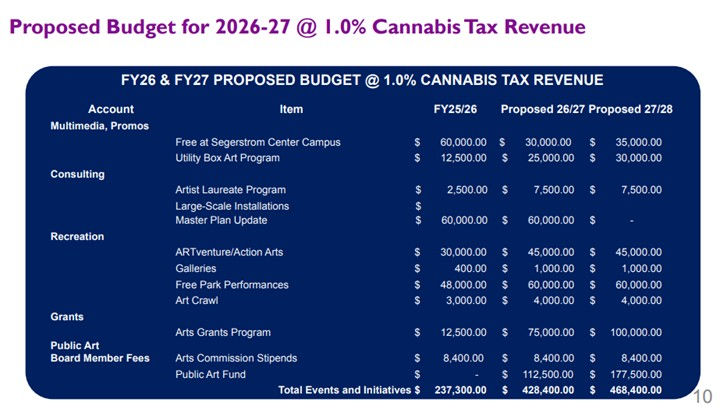
Key Message to Council: Costa Mesa already benefits significantly from the arts:
$1.1 billion tourism economy.
~$50 million in tax revenue tied partly to cultural assets.
However, investment in arts is relatively low compared to its economic impact. The Commission is asking for strategic funding adjustments and policy changes to better support and grow the city’s arts identity.
Closing Notes: The Commission highlighted strong media recognition and community momentum. They invited participation in upcoming events (Art Crawl, Unity Choir) and acknowledged the departure of their arts specialist, recognizing her major contributions.
Councilmember Questions and Comments. Councilmembers were broadly supportive but raised several concerns:
Budget Clarity and Process: Questions were raised about changes to the Commission’s proposed budget and the need for clearer communication.
Community engagement: Councilmembers noted low participation in volunteer and donation programs and encouraged stronger outreach efforts.
Funding Structure: A central issue was whether arts funding has been too narrowly tied to cannabis tax revenues. Several Councilmembers stated this was not the original intent and expressed concern that the program may be underfunded as a result.
Master Plan Alignment: Discussion highlighted gaps between the Master Plan’s vision and current funding levels.
Consultant vs. Internal Planning: There was debate over whether to use an outside consultant for the next master plan update, with Commission leadership emphasizing the value of independent expertise and outreach.
Overall, Councilmembers signaled interest in revisiting the City’s arts funding approach as part of upcoming budget discussions.
Public Comment. Five speakers expressed strong support for expanding the City’s arts programs and investment. Key themes included:
The need for greater funding flexibility and support for larger public art projects,
Recognition of the arts’ role in building community, supporting mental health, and driving economic activity,
Examples of successful programs enabled by City funding, and
Opportunities to further establish Costa Mesa as a leading arts-focused city.
Motion and Vote. Stephens made the motion to receive and file, which was seconded by Marr. That motion passed unanimously (7–0).
OLD BUSINESS: There were two items here, each of which was heard in record time:
1. Adoption of Trap-Neuter-Return Ordinance to Municipal Code and to Establish Trap-Neuter-Return Program for Community Cats. This was the second reading for this item. Lieutenant Stephanie Selinski gave a very short presentation. There were no questions from the Councilmembers and no public comment.
Motion and Vote. Stephens moved to approve the staff recommendation, which was seconded by Chavez. The motion passed unanimously (7–0).
2. Continuation of Adoption of Ordinance Relating To Public Works Drainage. The presentation was given by a new Senior Engineer, Bobby Fouladi. This item was continued from the April 21 hearing because the City Attorney discovered errors in the ordinance during that meeting and requested a continuance to amend it.
The changes were to the appeals process and related language, specifically how drainage fee reductions can be requested and approved. Developers may now request a reduction in drainage fees if they can demonstrate—through substantial evidence—that they improved site permeability. The Public Works Director has authority to approve fee reductions based on the evidence. If a developer disagrees with the Public Works Director’s decision, they may appeal to the City Council under Section 1575.
Again, there were no Councilmember questions and no public comment.
Motion and Vote. Marr moved to approve the item, with Reynolds making the second. The motion passed unanimously (7–0).
MAY 7 FINANCE AND PENSION ADVISORY COMMITTEE SPECIAL MEETING. The meeting was called to order at 4:01 p.m. All Committee members were present except Sean Healy.
Also in attendance were City Manager Cecilia Gallardo-Daly, consultant Kingsley Okereke (former Finance Director for the City of Garden Grove), and City Staff from most of the departments. No Council Liaisons attended.
Because this was a Special Meeting, there was only one item on the Agenda, which was the Fiscal Year 2026-2027 Proposed Operating Budget and Capital Improvement Program. A presentation was given by Staff.
Committee Member Questions/Comments. Questions from the Committee members were wide-ranging:
Is there a five-to-ten-year estimate of sales tax receipts (No)?
Will the Capital Asset Needs (CAN) fund be replenished for last year’s skipped payment (Yes)?
What are we doing about the pension liability (this came from new member Jordan Johnson; Staff explained the Fireside Fund)?
Are the salaries and benefits fully funded so there aren’t surprises like we had this year (Yes)?
Does the budget still anticipate vacancies (Yes)?
Does the budget reflect the maintenance suggested by the facilities audit (No, because Staff is awaiting City Council direction)?
Is there a dollar amount and interest rate for the Fire Station #2 bond (No, but the amount will be determined around July)?
A request to include a graphic about property taxes and property turnover.
A request to try to provide actual numbers on utilities and not have overruns (Staff is trying to “right size” this and other budget items).
A request to move legal fees into the City Manager’s budget.
Public Comment. I commented on the elimination of a park ranger position when there are so many issues with people violating the laws/rules in Fairview Park. Rick Huffman commented on a disparity between revenues and expenditures in the presentation.
No vote was taken as this item would be returning to the Committee the following week. Unfortunately, we were unable to attend that meeting and there are no minutes available at this time.
MAY 12 CITY COUNCIL STUDY SESSION. All Councilmembers were present, except for Arlis Reynolds (District 5). The session focused on the Fiscal Year 2026-2027 Proposed Budget. (Note: We covered the adopted budget separately here:
Overview. Consultant Kingsley Okereke introduced the budget, which he and department heads presented. It covered strategic priorities, economic outlook, revenues, expenditures, and the path to adoption.
🌎 Economic Outlook: The economy remains uncertain due to inflation, fuel costs, geopolitics, and low consumer confidence. However, local sales activity is stable, supporting short-term revenues. Prolonged uncertainty could impact future sales tax revenue.
🏗️ Total Budget Overview: Total proposed budget equals $244.9 million, which is ~9% ($20M) increase over prior year. Key allocations:
💰 Revenues and Expenditures:
Revenue growth is projected between 2%–10%, led by sales tax (~10%), with more modest overall growth (~3%).
The budget is built on a base-budget approach with cost controls, including position freezes and attrition savings.
Spending totals $244.9M (+9% or +$20M), with key allocations to:
$109.3 million (55%) to public safety,
~$22 million for infrastructure (parks, streets, transportation),
$12 million planned for Fire Station #2 renovation (via financing), and
$1.3 million for housing and homelessness programs
A citywide fee study is underway.

🔄 Key Investments:
Infrastructure and capital projects (~$34M CIP), including Fire Station #2 rebuild.
$1.3M for housing and homelessness.
Continued funding for IT, equipment, and pensions ($2M increase in CalPERS).
👥 Staffing and Vacancies:
Assumption of a fully staffed police department and efforts to fully staff the fire department.
14 positions frozen; ~38 vacancies (6% rate).
Some roles were eliminated or reclassified.
Vacancy savings used for budget flexibility.
🗓️ Budget Process & Oversight: Adoption targeted for early June.
FIPAC (Finance Advisory Committee) review underway.
Council requested:
Opportunity for FIPAC to present directly.
Clear summary of FIPAC recommendations.
Council Discussion Highlights:
Arts & Culture:
Funding drops from ~$416K to ~$242K.
Hiring of an arts specialist delayed pending a new 5-year plan.
Council expressed concern about a potential pause in programming.
Budget Accuracy and Risk:
Concerns raised about underestimating costs (utilities, legal, landscaping) and overly optimistic revenues (especially tourism).
Staff described this as a “transition year” with mid-year adjustments expected.
Public Safety & Overtime:
Police fully staffed; fire nearing full staffing.
Overtime remains difficult to predict and often exceeds budget.
Infrastructure and Transportation:
Council requested clearer data on project outcomes (traffic, safety, congestion).
Projects follow a “complete streets” approach.
Reserves: Financial position remains stable with a balanced budget and no reserve draw
Public Comment: Seven speakers highlighted three main concerns:
Arts funding: strong support for fully funding the arts specialist role.
Budget assumptions: skepticism about cost estimates and revenue projections.
Park safety: opposition to reducing park ranger staffing.
Key Takeaways from Councilmember Comments:
Broad support for funding arts Staff and maintaining arts programming.
Emphasis on fiscal discipline and prioritizing core services.
Recognition of improved budget transparency and collaboration.
Continued concerns about staffing gaps, park safety, and long-term sustainability.
Bottom Line: The proposed budget is cautiously optimistic, balancing moderate revenue growth with economic uncertainty.
Key priorities include public safety, infrastructure investment, and financial stability, while concerns remain about budget accuracy, arts funding, and staffing levels.
MAY 19 CITY COUNCIL MEETING. At this meeting, the items acted on were:
Agreement for Unleaded Fuel with Merrimac Petroleum
Award of Maintenance Services Agreement for Janitorial Services to CCS Facility Services–pulled from the Agenda (not heard)Agreement To Provide Shelter Operations At The Costa Mesa Bridge Shelter
Update on SB 707 and Adopt Council Policy for Disruption of Telephonic or Internet Service during City Council Meetings
All Councilmembers were present; Mike Buley (District 1) participated remotely due to a contagious illness.
City Attorney Closed Session Report. Kimberly Hall Barlow said there was no reportable action taken.
Public Comment. Nine members of the public addressed the City Council. Key themes included a call for fairness and balance in City priorities, ongoing concerns about homelessness and public safety, frustration with rising living costs—particularly electricity rates, and requests for improved City planning and responsiveness.
Additional details on individual comments are provided below:
Recognition of Youth Achievements. Jay Humphrey applauded the City for recognizing young athletes. He urged the Council to also honor academic achievements, emphasizing the importance of education and equitable recognition across disciplines.
Homelessness Progress and Home Sharing Program. Betsy Densmore commended the City’s progress in addressing homelessness. She introduced a “Home Sharing” program, which pairs homeowners—particularly seniors—with renters, offering benefits such as affordable housing, companionship, and assistance with daily tasks. She encouraged the City to help promote and expand awareness of the program.
Rising Electricity Costs. Multiple speakers expressed concern about increasing energy costs:
Southern California Edison rates were described as significantly rising, placing a financial burden on residents.
Speakers noted that nearby Anaheim, which operates a public utility, has lower rates, highlighting a disparity.
Some argued the current system appears to prioritize utility profits over consumers.
Requests included that the City support state legislation and adopt resolutions advocating for energy affordability.
Public Safety and Homeless Encampments. A resident described unsafe conditions near the Santa Ana River Trail, including an incident where debris struck their home. The speaker attributed delays in road repairs to the presence of a nearby encampment. They requested:
Stronger enforcement of anti-camping laws.
Increased police presence.
Faster infrastructure repairs and protective measures.
Law Enforcement Policy Concern. A caller raised concerns about local law enforcement officers holding secondary employment with federal immigration agencies. The speaker urged the City to prohibit such dual employment, especially if pending state legislation does not address the issue.
Summer Program Registration Issues. A parent criticized the City for opening summer program registration too late—approximately two weeks before the end of the school year. They compared this unfavorably to neighboring cities that offer several months’ notice. Additional concerns included:
Limited program availability, with spots filling quickly.
Cancellation or relocation of a children’s running program at Fairview Park.
Councilmember Comments. Jeff Pettis (District 6) stated that the reported incident involving debris from the roadway was serious and concerning, and he expects staff to investigate, address the nearby encampment, and complete necessary road repairs.
He thanked Costa Mesa Fire and Rescue for the Fire Ops 101 program, describing it as a valuable, hands-on experience, and praised Love Costa Mesa Day and ongoing community beautification efforts. He also reiterated his strong support for arts and enhancing the city’s visual appeal.
Pettis raised concerns about the approval process for recent public art/street art projects, asking:
Whether a formal, written approval process exists,
If all Councilmembers are notified in advance, and
Whether there was public input or Arts Commission involvement.
He suggested projects of this scale warrant greater transparency and Council awareness, and asked whether the Arts Commission could become a nonprofit to streamline project delivery.
Lastly, Pettis questioned whether traffic safety standards—including visibility, slip resistance, durability, and impacts on traffic controls—were evaluated, citing community concerns about safety and long-term quality.
Mike Buley (District 1) expressed appreciation for City services and Staff, and emphasized his interest in regional planning and future infrastructure challenges. He strongly supported the Fire Rescue 101 program, noting it gave him a deeper appreciation for the professionalism, rigor, and physical demands of the department, and thanked his assigned captain.
Buley also shared takeaways from a Southern California Association of Governments (SCAG) conference, highlighting discussions on AI applications in government and regional transportation planning, including preparation for the 2026 World Cup and 2028 Olympics. He underscored the importance of continuous learning and regional coordination.
Loren Gameros (District 2) emphasized a compassionate, service-oriented approach to homelessness, focusing on correcting misconceptions with data. He noted the issue is personally significant, as the shelter is located in his District, and praised staff for their leadership and care for unhoused residents.
Gameros pushed back on the idea that shelters attract more homelessness, citing data showing that few unhoused individuals locally are from Costa Mesa, and stressed that providing services reflects responsibility and compassion—not an invitation. He reaffirmed that people experiencing homelessness need support and housing solutions.
He also urged remembrance and respect on Memorial Day.
Andrea Marr (District 3) expressed support for City Staff, public safety professionals, and community events, emphasizing the importance of ongoing training and preparedness and a positive outlook on City improvements.
She shared reflections on her Navy service aboard an aircraft carrier in response to a comment from the mayor.
Marr praised the Fire Ops 101 program as both engaging and highly professional, noting it deepened her appreciation for the extensive training firefighters undergo and their need to stay current with evolving standards. She added that this training is actively applied, including during recent wildfire response efforts.
She highlighted strong participation in Walk and Roll to School Day, acknowledged the success of Love Costa Mesa Day, and expressed support for a recent public art installation in her district.
Marr also provided updates on key projects:
The skate park expansion will more than double in size, add new features (such as a pump track), and remain largely open during construction.
The TeWinkle Lakes project is progressing, with the first lake nearing completion (liner installation underway).
Arlis Reynolds (District 5) focused on community engagement, infrastructure, safety, and sustainability, while expressing strong appreciation for City staff. She supported resident-driven improvements, particularly traffic calming and neighborhood enhancements.
She praised Love Costa Mesa Day as a highly successful, community-wide event and thanked staff, organizers (including Trellis), and volunteers. She also echoed support for the Fire Ops 101 program, noting it provided both an engaging experience and a deeper appreciation for firefighters’ skills and training.
Reynolds shared highlights from a police bike unit ride-along, noting the valuable perspective it provided. She also recognized Public Works staff during Public Works Week, emphasizing their creativity, problem-solving, and dedication in maintaining infrastructure despite aging equipment, and called for better public awareness of their work.
In response to public comments, she expressed concern about rising electricity costs and requested Staff review relevant legislation and return with a draft resolution supporting energy affordability.
She shared takeaways from a sustainability and urban agriculture conference, encouraging exploration of fruit tree planting and expanded urban gardening in public spaces and development projects, and plans to share ideas with the City’s sustainability team.
Reynolds also promoted Bike Month and the upcoming “Ride of Silence” event honoring cyclists, noting ongoing road safety improvements. Finally, she supported creating a formal traffic-calming program to address strong resident demand, suggesting a more streamlined and potentially community-supported approach.
Manuel Chavez (District 4) thanked attendees, including students observing the meeting, and focused on responsiveness to resident concerns, support for public safety, and community engagement.
He asked staff to follow up on the Adams Street safety concern (debris and road conditions), regardless of jurisdiction, stressing the importance of resolving the issue.
Chavez praised the Fire Ops 101 program, noting it deepened his appreciation for the professionalism, detail, and wide range of services firefighters provide, particularly medical response, and strengthened his confidence in the department.
He congratulated local students receiving scholarships and awards, highlighting pride in their role as future community leaders.
Finally, he invited the public to the Shalimar Park groundbreaking, emphasizing the extensive community input, planned amenities (including multi-use sports courts and new equipment), and the project’s significance as a long-awaited improvement.
John Stephens (Mayor) emphasized community pride, service, and remembrance, while highlighting progress on key City initiatives.
He promoted the Memorial Day ceremony at Harbor Lawn Cemetery, encouraging residents to attend and honor those who made the ultimate sacrifice, noting he would be out of town.
Stephens highlighted a two-thirds reduction in homelessness over two years, crediting Staff, the homeless services team, the Police Department, and Council support and funding, and underscoring the importance of the City’s temporary shelter and coordinated approach.
He acknowledged the Adams Avenue bridge safety concern raised by a resident and directed Staff to investigate and address the issue, noting the City has the resources to respond.
Stephens praised the Les Miller Awards and Love Costa Mesa Day as successful community efforts and highlighted the skate park expansion, thanking partners and staff.
He also promoted the “Sing Along with the Mayor” fundraiser supporting Love Costa Mesa and announced the meeting would adjourn in honor of two community leaders:
Judy Ware, a pioneering recycling and waste management leader and longtime City partner.
Karen Orsini, a dedicated volunteer and mentor who supported families and youth.
City Manager Comments. Cecilia Gallardo-Daly focused on public engagement in planning, fire safety, environmental stewardship, and recognizing staff excellence.
She announced the release of the draft Environmental Impact Report (EIR) for the Fairview Developmental Center Specific Plan, with public comments accepted through July 1 at 5 p.m. via the City’s planning staff.
She also noted the City is entering the final phase of the “Neighborhoods Where We All Belong” initiative, inviting residents to review and comment on draft zoning and General Plan updates from May 18 to June 15. (Find them here) (Find the draft Housing Element changes here)
Gallardo-Daly provided an update on weed trimming and mowing efforts at Fairview and Canyon Parks, explaining that enhanced efforts—coordinated with City biologists—aim to reduce fire risk while protecting sensitive habitats.
She recognized Senior Planner Michelle Halligan as Employee of the Month (May), highlighting her leadership on major planning efforts, successful community outreach, and ability to meet key state deadlines, as well as her community service supporting foster care programs.
City Attorney Comments. Hall Barlow reflected on the importance of honoring military service and sacrifice, particularly those who were lost at sea or remain missing in action. She shared the example of the USS Thresher submarine tragedy, in which all crew members were lost and never recovered, to underscore the significance of remembrance. She encouraged the community to observe Memorial Day with reflection and respect for fallen service members.
CONSENT CALENDAR. No items were pulled. Reynolds moved approval of the Consent Calendar items, which was seconded by Marr. That motion passed unanimously, 7–0.
PUBLIC HEARINGS: None.
OLD BUSINESS: None.
NEW BUSINESS: There were only three new business items because the Award of Maintenance Services Agreement for Janitorial Services to CCS Facility Services was pulled from the Agenda.
1. Agreement for Unleaded Fuel with Merrimac Petroleum. Deputy Public Works Director Patrick Bower presented a request to approve a new agreement with Merrimac Petroleum for the supply and delivery of unleaded fuel. The City operates 12 fuel storage tanks serving fire stations, police facilities, City Hall, and other sites, along with fuel for emergency generators. This contract supports daily operations and emergency readiness.
The current contract expires on June 30 and cannot be renewed. Staff recommended using a County of Orange cooperative purchasing agreement, which provides a cost-effective and efficient procurement method.
Term: July 1, 2026 – June 30, 2031 (5 years)
Annual not-to-exceed amount: $700,000
Councilmember Questions and Comments. Marr inquired about bulk fuel discounts and storage capacity. Staff explained the City likely lacks sufficient storage to independently purchase fuel in larger quantities, and expanding capacity would be costly and impractical. However, through the County agreement, the City already benefits from bulk pricing. Staff added that rising costs reflect market trends, not contract structure.
Reynolds asked about fuel costs and fleet electrification. She noted fuel spending (over $600,000 annually) has remained relatively stable despite price increases. Staff reported the City has expanded its electric/hybrid fleet from about 15 to nearly 50 vehicles (roughly 20% of a 250-vehicle fleet), with continued plans to expand where feasible. Reynolds requested a more detailed electrification plan, including long-term cost savings and integration into budgeting and sustainability efforts.
Public Comment. None.
Motion and Vote. Marr moved to approve the staff recommendation, which was seconded by Chavez. The motion passed 7-0.
3. Agreement To Provide Shelter Operations At The Costa Mesa Bridge Shelter. Neighborhood Improvement Manager Nate Robbins presented a request to approve a new operator for the Costa Mesa Bridge Shelter. The current contract with Mercy House expires June 30, 2026. Staff recommended awarding a 3-year contract to Volunteers of America Los Angeles (VOALA), with two optional one-year extensions, at an annual cost not to exceed approximately $2.07 million, including a potential 5% cap on salary-related adjustments.
The contract includes limited flexibility to adjust staffing if shelter capacity changes, though most costs remain fixed due to operational needs
Background: Over the past five years, the Bridge Shelter has developed into a comprehensive system of care, providing:
Housing navigation and placement.
Assistance obtaining identification and documents.
Financial housing support (e.g., deposits, furnishings).
Medical, dental, and behavioral health services.
Job training and employment assistance.
Connections to rehabilitation and public benefits.
City staff now handle case management, improving service quality and coordination.
Procurement Process: The City issued a Request for Proposals (RFP) and received three qualified submissions:
1. VOALA (ranked 1st)
2. Mercy House
3. HIS-OC
While all met requirements, staff determined VOALA offered the strongest overall proposal.
Key Advantages of VOALA:
Cross-trained staffing model, increasing flexibility and coverage.
Ability to provide in-house supportive services, including:
Enhanced Care Management (ECM) and Community Supports (CS),
HDAP assistance for disabled clients accessing Social Security benefits, and
Expanded veterans' services.
Internal quality assurance oversight.
Experience operating 17 shelters, including a similar facility in Garden Grove.
VOALA’s model consolidates multiple services under one provider, simplifying coordination compared to the current multi-provider approach.
Cost and Financial Impact: VOALA’s proposal is approximately $316,000 less annually than the current contract, with an estimated $1.5 million in savings over five years. Mercy House’s proposal exceeded current costs; HIS-OC’s lower bid excluded some administrative expenses. Many supportive services included in VOALA’s proposal are reimbursed by external funding sources (e.g., State programs, CalOptima), meaning they do not increase City costs.

Organizational Capacity: VOALA is a large, established nonprofit with extensive staff and resources. It currently operates 17 shelters and has demonstrated the ability to scale and deliver comprehensive services.
Councilmember Questions and Comments. Pettis asked how VOALA’s veteran services differ, specifically whether they help connect veterans to Veterans Administration (VA) programs (e.g., HUD-VASH, medical services) or offer anything beyond basic referrals. Staff responded that the main value is in strong outreach and connections:
Familiarity with available veteran programs, and
Established relationships to help link veterans to services.
The VA system itself is already well-developed, so the focus is on access and navigation, not creating new services. Pettis noted that some veterans may be reluctant to identify themselves or seek VA services. Agreed that proactive outreach and relationship-building are key.
Stephens tried to clarify what the City asked for in the RFP and whether the additional services highlighted for VOALA are extra, redundant, or already being paid for. Staff explained the RFP was primarily for shelter operations, but it also invited vendors to propose innovative ways to enhance services. VOALA included additional supportive services as part of their proposal. Mercy House only handled operations; the City had to piece together extra services (case management, etc.) from multiple outside providers. VOALA can bundle operations plus many additional services under one provider, simplifying coordination.
The extra services VOALA provides are not new costs to the City. These services are reimbursed by outside entities (e.g., State programs, CalOptima), not funded directly by the City, so switching to VOALA does not increase City costs for those services.
“Program costs” in the budget (e.g., laundry supplies, bedding, snacks) are basic shelter operating expenses, not the additional supportive services. The extra services (case management, benefits help, etc.) are separately reimbursed.
Some services VOALA offers are already being provided, but through multiple vendors. Others, such as certain disability programs, veteran-focused pathways, and quality assurance, are new or expanded. The advantage of VOALA is consolidation (“one-stop shop”) and added capacity.
Reynolds requested that Staff clarify what revenue helps offset shelter costs, how full the shelter typically is, and whether operator costs adjust based on actual bed usage. Staff explained there are four main funding/revenue sources helping support shelter operations:
Orange County Health Care Agency grant:
Originally about $4.8 million, now $5.2 million, to add 15 behavioral health beds.
This funding allows the shelter to increase from 85 beds to 100 beds max capacity.
It also brings in about $972,000 per year in reimbursements, meaning those 15 beds are essentially fully funded, including services, furniture, detox connections, and one of the four case managers.
State behavioral health funding secured through Assemblymember Cottie Petrie-Norris:
About $1 million to mirror those 15 beds, creating 30 total behavioral health beds.
This money does not directly offset the City’s operating budget in the same way, but it does pay for things like furniture, housing deposits, and client services needed to move people into permanent housing.
Newport Beach contract:
Newport Beach has 20 exclusive beds and pays the City about $100,000 per month.
It can also use up to five additional per diem beds at $163 per day each.
Irvine contract
Irvine uses beds on a per diem basis only.
Staff says Irvine has had as many as eight people at one time, currently has five, and brings in roughly $25,000 per month.
Staff indicated that these are the four main revenue sources, though some past grants have expired and the City continues to look for new funding opportunities.
Reynolds asked about the Shelter vacancy rates. Staff reported that over the past 12 months, the shelter averaged about 70 guests. Before that, occupancy had been closer to 80–90. More recently, with the addition of Irvine placements and good outreach work, occupancy has increased to around 80–85 guests. Staff added that being at 100% full is not ideal because more people can create more operational challenges. If the shelter is full, someone ready to come in from the street may be turned away, and that missed opportunity could mean they do not return for months or years. Therefore, Staff views 80–85 occupancy as a healthy operating level.
Reynolds asks whether the operator contract can “ratchet” up or down like the food contract does. Staff explains there is a big difference between:
Food service (Bracken’s): very flexible, can adjust with about two weeks’ notice, and costs change quickly because pricing is per person per day.
Shelter operator contract: much less flexible, because staffing cannot realistically be raised and lowered every couple of weeks.
Instead, operator cost changes are based more on the maximum capacity policy set by Council, not on month-to-month occupancy. For example:
If the City Council permanently reduced the shelter’s maximum from 100 beds to 85 beds, the operator could reduce staffing somewhat.
But this would need to be a high-level policy decision, not a temporary monthly adjustment.
Staff noted that the biggest savings from reducing maximum capacity would come from program costs, such as snacks, laundry, fuel for the shuttle, and other operating supplies.
Staffing savings would exist, but would be more modest, because staffing cannot fall below certain minimums. Staff estimates a reduction from 28 to around 25 staff if capacity drops from 100 to 85.
Bottom line: Reynolds confirmed that the shelter has meaningful outside funding and partner revenue helping offset costs; the shelter is not usually full, and current utilization around 80–85 is considered good; and the operator contract is based more on the maximum capacity the City wants available, rather than actual daily or average bed usage.
Note that some beds are not used because they are upper-level bunks, and some individuals, such as the elderly or disabled, cannot access them.
Buley asked about the contract term. Staff confirmed the proposed agreement with VOALA is 3 years guaranteed, with two optional one-year extensions. He then asked about a maximum 5% potential salary increase and how many staff it would affect. Staff explained that VOALA’s staffing costs are about $1.3–$1.6 million annually, mostly tied to the shelter. A full 5% increase would be roughly $80,000 across all salaries. Staff noted VOALA has not increased staffing costs in the past two years at other shelters, instead shifting resources internally. The 5% cap is intended as a contingency (“safety net”), allowing flexibility without returning to council approval each time.
Public Comment. The only public comment came from Eric Richardson, Director of Housing for VOALA (Volunteers of America Los Angeles), who introduced himself and thanked the council for reviewing the proposal. He highlighted VOALA’s 10 years of experience in Orange County, emphasizing its leadership in veterans’ services, including being the largest provider of supportive services for veterans and their families and working closely with the VA. He explained that VOALA brings additional resources into shelters, including veterans’ programs and prevention/outreach services, with funding largely coming from the VA and county programs. He also noted his leadership role as chair of the county’s veterans housing group.
Richardson invited councilmembers to tour the Central Cities Navigation Center in Garden Grove to see a similar shelter VOALA operates. He praised Costa Mesa’s existing shelter as high-quality and a model compared to others he has seen.
Finally, he addressed staffing, noting:
VOALA aims to provide annual staff pay increases, but hasn’t been able to in the past few years due to funding constraints.
The program under discussion would involve about 27 staff.
Motion and Vote. Marr made a motion to approve the Staff recommendation, which was seconded by Reynolds. Chavez, who hadn’t asked any questions, decided to say why he opposed the motion. He acknowledged that VOALA appears to be a strong and capable provider, but he expressed hesitation about supporting the contract change due to his deep loyalty to Mercy House. Mercy House was the City’s original partner when Costa Mesa first undertook homeless services. It worked alongside the City through difficult early stages. Because of that history and trust, Chavez said he does not feel comfortable supporting another provider, regardless of VOALA’s qualifications. He made a substitute motion to award the contract to Mercy House out of recognition for its past work, though it did not receive a second.
Chavez’s position was driven less by concerns about VOALA and more by loyalty, trust, and appreciation for Mercy House’s longstanding partnership and role in building the city’s homeless services program.
The motion carried on a vote of 6-1, with Chavez voting “No.”
4. Update on SB 707 and Adopt Council Policy for Disruption of Telephonic or Internet Service during City Council Meetings. The City Clerk, Brenda Green, explained that SB 707 updates the Brown Act and requires the City Council to adopt new policies to improve public participation, accessibility, and meeting transparency.
Key Points:
Hybrid meetings now required: The City must provide remote participation (audio/visual). Costa Mesa already complies by using Zoom since 2020, including features like multi-language closed captioning.
Technology disruption policy: The Council must adopt a policy for handling internet or broadcast failures:
Pause (recess) meetings for at least one hour while attempting to restore access.
Meetings can resume once service is restored or after one hour.
Closed session may continue if allowed.
Managing disruptions: The law clarifies the Council’s authority to warn and remove individuals engaging in disruptive behavior, whether in person or online.
Public outreach requirements: Cities must expand efforts to reach underrepresented and non-English-speaking communities. Costa Mesa already:
Conducts community outreach and workshops.
Offers Spanish-language resources, including a dedicated webpage.
Provides interpretation services at meetings.
Language access: Since Costa Mesa meets the threshold, it must:
Provide Spanish translation of agendas and web content.
Continue Spanish interpretation at meetings (already in place, with extended speaking time for translation).
Teleconferencing updates: New rules allow more flexibility for remote participation, including for:
Disabilities,
Emergencies, and
Just cause” situations like illness.
Accessibility (ADA compliance): Meeting content must be accessible to screen readers, and the City upgraded equipment to ensure compliance and support Spanish translation features.

Other Updates:
Social media rules still prohibit councilmembers from responding to each other on official matters.
Expanded reporting requirements for executive compensation.
Requirement to provide Brown Act materials to new officials.
Staff recommended the Council adopt the required technology disruption policy and acknowledge the SB 707 updates, noting that Costa Mesa is already largely compliant and ahead of many cities.

Councilmember Questions and Comments. None.
Public Comment. A speaker raised a concern about fairness for Spanish-speaking participants during public comments. They noted that with the current setup, speakers use their allotted time, but interpreters may not have enough time to fully translate everything afterward.
They recommended adopting simultaneous translation (real-time interpretation)—similar to what is used in courts or depositions—so that:
The speaker’s full comments are conveyed within their speaking time, and
All audience members can hear the complete message without delays or omissions.
Motion and Vote. Chavez made a motion to receive and file the item, which was seconded by Stephens., who said he’d never seen simultaneous translation. Well, Mr. Mayor, watch a United Nations meeting sometime. 🙄
The motion passed on a vote of 6-0, because Buley left the meeting early. I hope he is aware of the changes to the Brown Act and makes an attempt to follow the law. 🙄

Comments