CITY HALL UPDATE FOR JULY 2026: A MONTH OF CONTROVERSY, PLANNING, AND MAJOR POLICY DECISIONS
Updated: Aug 31
Although only a handful of meetings remained after the City's higher-profile July events, they produced some of the month's most consequential discussions. We have already provided reports on the following events in July:
JULY 16, 2026 LAWSUIT FILED BY THE STATE OF CALIFORNIA AGAINST THE CITY CAN BE FOUND HERE.
JULY 23, 2026 FAIRVIEW DEVELOPMENTAL CENTER SPECIFIC PLAN TOWN HALL: FROM DRAFT TO DECISION AND JULY 27, 2026 PLANNING COMMISSION MEETING CAN BE FOUND HERE.
Here is a summary of the remainder of City Hall activity for July 2026.
Council, Commission and Committee Meetings:
City Council: One meeting was held;
Planning Commission: One more meeting held;
Pension and Finance Committee: one meeting held (but we did not attend due to our Colorado vacation)
While that leaves only two meetings in our report, it doesn’t mean they came without controversy. In particular, the City Council’s decision on Flock Safety Automated License Plate Reader system led to a long night, and when midnight came, a decision was made to hear the final Agenda item the next day.
Here is our report:
JULY 13, 2026 PLANNING COMMISSION MEETING: All Commissioners were present, except for Rob Dickson (District 5).
Aside from approval of the Minutes of the June 22 meeting and vacation of two rights-of-way on East 19th Street, the Commission considered two action items:
Conditional Use Permit to Allow a Proposed Amusement Center (Indoor Trampoline Park) Within an Existing Shopping Center Tenant Space At 2200 Harbor Boulevard, Unit P-110
Proposed Amendments to Title 13 (Planning, Zoning and Development) of Municipal Code to Update Land Use Classifications for Various Nonresidential Uses
Public Comment. None.
Commissioner Comments. David Martinez (District 5) shared several upcoming community events. He praised the City’s recent community events, including Bike Month, Pride Month, the Measure K/Housing Element Open House, and Fish Fry.
Angely Andrade (District 4) encouraged residents to attend upcoming meetings.
Johnny Rojas (District 2) commended the city and event organizers for the recent July 3 celebration at the fairgrounds and expressed enthusiasm about the return of the OC Fair, highlighting its value as a major community event and local asset.
CONSENT CALENDAR: The items on the Consent Calendar were (1) approval of Minutes of the June 22 meeting and vacation of two rights-of-way on East 19th Street. Jon Zich (District 1) pulled Item 2, a proposed excess right-of-way vacation adjacent to 296 E. 19th Street.
Martinez moved to approve the balance, with Jeff Harlan (at large) seconding, and the motion carried by a 6-0 vote, with Dickson absent.
Zich asked whether the excess right-of-way along East 19th Street represented the original planned width of the roadway before it was later reduced in scale, and whether the City might need this land in the future given anticipated growth and additional residents.
Staff confirmed that the right-of-way reflected the historical width of the street and stated that there are currently no plans to widen East 19th Street. Because there is no anticipated roadway expansion, Staff considered it appropriate to vacate the unused right-of-way and return it to the adjacent property owner.
He asked whether the Active Transportation Committee’s review indicated any future plans for bike lanes on 19th Street. Staff explained that traditional bike lanes are not planned for this segment. Instead, the corridor is designated for a Class III bikeway, meaning bicycles and vehicles will share the roadway using shared-lane markings (sharrows).
Zich noted that other properties along 19th Street appear to have similar rights-of-way adjacent to them and asked whether those property owners could also seek vacation of the unused land.
Staff confirmed that other properties may have similar situations and that the City only initiates the process when a homeowner or resident requests it as part of a project or property improvement.
He asked whether the City has notified other eligible property owners that the opportunity exists. Staff stated that, to their knowledge, the City has not proactively notified property owners. The City’s practice is to wait for property owners to approach the City with a request, which Staff then evaluates on a case-by-case basis.
Zich asked whether the City anticipates any future use for the remaining rights-of-way that it continues to own. Staff said they could not say “never,” but that it is highly unlikely the City would need those areas in the future.
Motion and Vote: Martinez moved to approve the item, which was seconded by Zich. The motion passed unanimously.
PUBLIC HEARINGS: There were two public hearings:
1. Conditional Use Permit (CUP) to Allow a Proposed Amusement Center (Indoor Trampoline Park) Within an Existing Shopping Center Tenant Space At 2200 Harbor Boulevard, Unit P-110. Assistant Planner Justin Arios presented a request for a CUP to allow JumpStart Trampoline Park in the former Party City space at 2200 Harbor Boulevard. The proposed indoor amusement center would occupy an existing tenant space within a 190,000-square-foot shopping center that includes Planet Fitness, Aqua Tots Swim School, and other retail and service businesses.
The family-oriented facility would offer open jump sessions, birthday parties, group events, private rentals, trampoline courts, dodgeball and airbag areas, slides, toddler play areas, party rooms, and concessions. Hours would be 10:00 a.m. to 8:00 p.m. Sunday through Thursday and 10:00 a.m. to 10:00 p.m. Friday and Saturday, with staffing ranging from 3 to 12 employees. Only light concessions would be offered, and no alcohol would be permitted.
Staff found the project consistent with the General Plan and zoning regulations. Pursuant to AB 2097, the City cannot impose minimum parking requirements on the project. One public comment letter was received from Newport Rib Company, which supports the project.
Applicant Presentation: Representatives of JumpStart Adventure Parks expressed enthusiasm about opening in Costa Mesa by the end of the year. They emphasized the facility's family-focused mission, safety protocols, and confidence that the shopping center provides ample parking despite the project's exemption from minimum parking requirements.
Commissioner Questions. Zich asked about the project's four-month review timeline and the City's permitting process. The applicant said the process was efficient and praised Staff's responsiveness and professionalism.
Andrade asked why JumpStart chose Costa Mesa. The applicant cited the area's concentration of young families and limited competition from similar facilities.
Public Comment: One of the owners called in to speak in support of the project.
Motion and Vote. Martinez moved to approve the item. Andrade seconded the motion. The motion passed 6-0, with Dickson absent.
2. Proposed Amendments to Title 13 (Planning, Zoning and Development) of Municipal Code to Update Land Use Classifications for Various Nonresidential Uses. This item was previously reviewed at the June 22 meeting but was continued after the Planning Commission requested additional revisions. Planners Amber Gregg and Martina Carone presented updated zoning code amendments intended to modernize land use regulations, improve clarity, reduce case-by-case interpretations, and support reinvestment and adaptive reuse of commercial properties.
The Commission had previously reviewed 11 proposed amendments and requested further analysis on fitness facility classifications and Floor Area Ratio (FAR) definitions.
Fitness Facility Classifications: To address concerns that the original fitness category was too broad, Staff proposed three categories:
Small Fitness Studios (up to 2,500 sq. ft.): Personal training and small-group instruction; permitted by right with operational standards; parking requirement of 4 spaces per 1,000 sq. ft.
Fitness Studios (2,500-15,000 sq. ft.): Yoga, Pilates, martial arts, and group fitness classes; permitted by right with operational standards; parking requirement of 10 spaces per 1,000 sq. ft.
Physical Fitness Facilities (over 15,000 sq. ft.): Larger fitness centers; would continue to require a Conditional Use Permit (CUP) due to potential parking and operational impacts.
Staff noted the new classifications would provide clearer, more objective standards while distinguishing smaller facilities from larger fitness centers.
Floor Area Ratio (FAR) Definition: Staff also revised the FAR definition to:
Clarify floor area calculations for nonresidential development.
Exclude operational support and utility areas that do not significantly contribute to occupancy or activity.
Clarify treatment of storage and accessory spaces.
Continue excluding garages and carports.
The revisions are intended to better reflect the actual intensity of development rather than counting all enclosed space equally.
Staff received three public comment letters, all in support of the proposed amendments.
Commissioner Questions. Martinez conducted a detailed review of the draft ordinance and identified several technical issues. He recommended revising the amusement center definition to reference "amusement center" rather than "active entertainment" in the exclusion language and asked whether the e-sports arena definition should explicitly reference "e-sports." Staff agreed with both revisions.
He questioned whether personal service definitions covering services provided to "individuals" included pet-related services; Staff confirmed they do because the service is ultimately provided to the owner. Regarding a single reference to the "Community Development Department," Staff explained that the City is in the process of renaming the department and code references will be updated as sections are amended.
Martinez also questioned a parking calculation that applied different rates to the first 25% and remaining 75% of floor area, noting that the formula always resulted in four parking spaces per 1,000 square feet. Staff agreed and recommended simplifying the standard to four spaces per 1,000 square feet. Staff further clarified that this parking requirement applies only to accessory food and beverage services associated with health clubs, fitness studios, physical fitness facilities, skating rinks, and active entertainment uses.
Martinez asked why bicycle parking credits are limited to one vehicle parking space. Staff responded that bicycle parking regulations were outside the scope of the amendment but could be reviewed separately in the future.
He then focused on the proposed fitness studio categories and parking requirements, asking how Staff determined the 2,500-square-foot threshold and the proposed parking ratios of four spaces per 1,000 square feet for smaller studios and ten spaces per 1,000 square feet for larger studios. He noted that parking demand data presented for Planet Fitness appeared significantly lower than the required parking supply. Staff explained that the revised categories were developed in response to Commission and public feedback, informed by other cities' standards, International Traffic Engineers' guidance, and prior Costa Mesa parking adjustment requests. The 2,500-square-foot threshold was selected because many local fitness studios exceed the 2,000-square-foot threshold used elsewhere.
Staff emphasized that the amendment's primary purpose was to simplify the approval process rather than comprehensively revise parking standards, noted that health clubs already use the ten-spaces-per-1,000-square-feet standard, and stated that applicants may still seek parking reductions through a Minor Conditional Use Permit.
Zich expressed concern that:
The proposed parking requirements may still discourage fitness businesses.
Even if entitlement requirements are streamlined, parking requirements could continue to prevent projects from moving forward.
He questioned whether:
The small-fitness category should extend beyond 2,500 square feet.
The ranges between categories were appropriately sized.
Staff explained that the major benefit of the amendment is that fitness facilities between 2,500 and 15,000 square feet would become permitted by right, rather than requiring a CUP. Facilities larger than 15,000 square feet would remain subject to CUP review because of their greater potential impacts. Parking standards were intentionally left largely unchanged during this targeted code update.
Commissioners discussed possibly expanding the "small fitness studio" category to a larger square footage threshold to better support small businesses.
Zich devoted substantial attention to the proposed revised definition of gross floor area. He supported excluding from Floor Area Ratio (FAR) calculations areas such as elevator shafts, stairs, mechanical rooms, electrical rooms, and similar building-support spaces. However, he objected to language that appeared to exclude certain storage areas based on whether they generated trips or occupancy. His concern was that:
FAR should remain a straightforward physical measurement of building size.
Excluding business storage areas could effectively allow larger buildings while reducing open space.
The proposal appeared to mix building size calculations with trip-generation considerations.
Staff explained that:
The proposed change was intended to remove areas that do not contribute to occupancy, customer activity, employee activity, or trip generation.
FAR is used in Costa Mesa as a tool to regulate development intensity based in part on anticipated traffic generation.
Many support spaces such as janitorial rooms, utility rooms, walk-in coolers, and similar service areas do not contribute meaningfully to occupancy and were the types of spaces Staff intended to exclude.
Harlan sought clarification on whether the primary purpose of the exemption was based on:
Occupancy, or
Trip generation.
Staff clarified that the focus was on areas that do not generate intensity or trips.
After additional discussion, Staff proposed a revised gross floor area definition that better separated:
The overall building-size calculation, and
The list of spaces excluded from that calculation.
Zich indicated that the revised wording better reflected his concerns and said he supported the new version.
During discussion, Zich and others suggested increasing the size limit for the small fitness studio category. Staff later confirmed that Curl Fitness occupies approximately 22,000 square feet, placing it in the larger physical-fitness-facility category under the proposed code structure.
By the end of the discussion, several commissioners expressed support for the revised gross floor area definition, most of the modernization amendments, and increasing the upper limit of the small fitness studio category from 2,500 square feet to 5,000 square feet.
Public Comment: Ralph Taboada supported allowing larger small-fitness facilities and making it easier for gyms to open in Costa Mesa. A speaker representing LAB Holding supported the amendments, saying they would help small businesses.
Motion and Vote. Martinez moved to approve the item, but included a series of revisions to the draft ordinance, including:
Revising the gross floor area definition and replacing the existing definition with the version presented by Staff.
Correcting references and definitions for amusement centers and e-sports arenas.
Clarifying that references to the Development Services Department mean the Community Development Department.
Simplifying the accessory food and beverage parking calculation to 4 spaces per 1,000 square feet.
Correcting grammatical and formatting errors and removing duplicate language.
Clarifying that only active entertainment uses are limited to 15,000 square feet, while larger amusement centers are allowed under the separate classification.
Increasing the maximum size of a Small Fitness Studio from 2,500 square feet to 5,000 square feet, with the Fitness Studio category beginning at 5,000 square feet.
Zich seconded the motion. Each of them spoke in support of the motion. The motion passed unanimously, 6-0, recommending approval of the zoning code amendments, as modified, to the City Council.
OLD BUSINESS: None.
NEW BUSINESS: None.
JULY 21 AND 22 CITY COUNCIL MEETINGS. At these meetings, only two items were acted on:
Flock Safety Automated License Plate Reader (ALPR) Report and Presentation
City Ballot Initiatives for Business License Reform and Transient Occupancy Tax
This meeting took over SEVEN hours! It ran so late that it had to be continued to the following afternoon to complete. All Councilmembers were present.
City Attorney Closed Session Report. Kimberly Hall Barlow said there was direction given during the Closed Session, but did not elaborate on what that was. The Closed Session Agenda listed labor negotiations and several lawsuits, including the Ohio House cases.
Announcements: Mayor John Stephens announced that new language accessibility services are available at the City Council meetings:
Live closed captioning is available on the center monitors in the room.
Monitors on the left side display Spanish captions, while monitors on the right side display English captions.
QR codes placed throughout the chambers allow attendees to access translations on their mobile devices.
Through the QR code, attendees can select additional languages beyond Spanish.
The goal is to make council meetings more accessible and enjoyable for everyone.
He also announced that public speakers who do not speak in English will get six minutes of public comment; three minutes for their comments and three minutes for translation. Stephens thanked the City Clerk team for advocating for these translation services and recognized the CM TV team for their support, praising them as an award-winning team.
He also announced that the ROCKS (Recreation on Campus for KidS) program will continue operating at all nine school sites after the City reversed a previously considered reduction. During budget discussions, Staff had evaluated the program and considered alternatives, but later determined that the alternative programs were not available.
As a result, the City decided to maintain the ROCKS program at all existing locations. Registration opened that day.
The Mayor thanked community members who raised concerns about the issue, noting that their feedback helped bring attention to it and led to the decision being reconsidered before the meeting. He then reminded public speakers that they would have three minutes for comments, with visual and audio signals indicating when one minute remained.
Presentations: There were presentations in recognition of the Costa Mesa Little League Teams.
Public Comment. There was a wide range of topics for public comments:
Street Safety and Traffic Collisions (Flo Martin): She praised the city's Public Works Department for efforts to improve street safety. She noted that vehicle, pedestrian, and cyclist collision numbers have declined significantly in recent years, dropping from hundreds of crashes per month to a much lower level.
Concerns About Housing Growth and Infrastructure (Larry Jones): He expressed concerns about state housing requirements that could add thousands of new residential units. Jones argued that increased housing would worsen traffic, parking shortages, and pressure on roads, utilities, and public safety services. He raised concerns about traffic violations, e-bike safety, road diets, and the displacement of businesses by residential development. He questioned whether existing infrastructure, including water, sewer, and electrical systems, can support future growth and said residents' quality of life could suffer.
ROCKS Program Communication Issues (Brandice Leger): She spoke about confusion surrounding the recently reconsidered ROCKS program. She said parents, commissioners, City Councilmembers, and school board representatives were initially unaware of the proposed changes and received little information. Leger criticized the communication process and urged the city to ensure better coordination and transparency in the future. She thanked city leaders for ultimately preserving the program.
Worker Safety Concerns at the Hilton Hotel: A Hilton employee described what she characterized as unsafe working conditions, including excessive heat in the laundry area, equipment leaks, and maintenance issues. She said employees were hesitant to report concerns due to fears of retaliation. She asked City leaders to visit worker areas of the hotel and pay closer attention to employee safety issues.
Support for Waterway and Habitat Protection (Cristian Garcia Arcos). He urged the council to listen to advocates working to address environmental concerns affecting local waterways. He highlighted concerns about pollutants and carcinogens, emphasized the importance of protecting habitats, and encouraged support for restoration efforts.
Creek Team Environmental Advocacy (Coby Silverpainer and Michael Rio): These representatives called for reducing pesticide use in Orange County waterways. They argued that pesticide use harms wildlife habitats, endangered species, and water quality. The speakers said environmental restoration and flood management can coexist and noted potential economic benefits from healthier waterways. They stated that state agencies have active violation cases involving Orange County Public Works and urged Costa Mesa to support efforts to protect and restore local creeks and waterways. They asked the city to work collaboratively toward long-term environmental solutions.
Councilmember Comments. Andrea Marr (District 3) held her comments due to the anticipated length of the meeting.
Arlis Reynolds (District 5) thanked residents for their comments and highlighted the city's safe streets efforts, noting reductions in traffic collisions and injuries and praising the Public Works Department.
She acknowledged concerns about communication and decision-making around ROCKS discussions, emphasizing the need for clearer processes moving forward.
Reynolds also addressed creek-related issues, thanking local advocates and expressing support for a city resolution regarding work on the Santa Ana River despite the project being outside of the City's jurisdiction.
She provided an update on the Randall Preserve, noting that the advisory committee has completed its recommendations and that planning for public access, safety, and circulation is ongoing.
Finally, Reynolds promoted a free bike repair event at the Donald Dungan Library hosted by the Costa Mesa Alliance for Better Streets.
Jeff Pettis (District 6) reflected on his recent Eastside Exchange community event at Jordan Park, where he met representatives from Project Independence and expressed appreciation for the organization's work supporting people with developmental disabilities.
He also highlighted the city's July 3 celebration, thanking the Police Department for helping ensure a safe and successful event, and said he was honored to participate in the opening of the OC Fair, a longtime personal tradition.
Pettis invited the public to attend the upcoming Fairview Development Center Town Hall, emphasizing that residents will have the opportunity to share their views and provide public input on the project.
Mike Buley (District 1) praised Parks and Community Services Staff, public safety personnel, and volunteers for supporting Costa Mesa's summer events. He highlighted strong attendance at the July 3 celebration, encouraged residents to support local businesses at the OC Fair, and promoted the Concerts in the Park series as a valuable community gathering. He concluded by thanking all city staff and partners who help make these events possible.
Loren Gameros (District 2) thanked Parks and Recreation Director Brian Gruner and his Staff for their responsiveness and leadership, noting Gruner's willingness to reevaluate and address concerns surrounding Flock. He meant "ROCKS" not "Flock."
He also praised the Parks and Recreation Department for successfully managing major community events, including the July 3 celebration and Concerts in the Park series.
Finally, Gameros reminded residents to stay safe during the heat and encouraged those in need to use the city's cooling stations and seek assistance from public safety personnel if necessary.
Manuel Chavez (District 4) had no comments.
Stephens thanked residents, including the Creek Team, for their public comments and said he would follow up with Staff on concerns raised about the Hilton.
He praised the success of the July 3 community celebration, thanking Staff, public safety personnel, community partners, and event organizers for making it a safe and successful event.
Stephens also announced he would attend the next council meeting remotely while traveling and noted he would miss the upcoming Fairview Developmental Center Town Hall due to a work commitment but would receive a briefing afterward.
City Manager Comments. Cecilia Gallardo-Daly had no comments or report.
City Attorney Comments. Hall Barlow also had no report.
CONSENT CALENDAR. No items were pulled from the Consent Calendar. Reynolds moved to approve all Consent Calendar items; that motion was seconded by Chavez. That motion passed unanimously, 7–0.
PUBLIC HEARINGS: None.
OLD BUSINESS: None.
NEW BUSINESS: This is where the fun began! There were two items:
1. Flock Safety Automated License Plate Reader (ALPR) Report and Presentation. Police Chief Joyce LaPointe introduced the discussion by emphasizing the department's commitment to using technology that is lawful, effective, transparent, and aligned with community values. She acknowledged public concerns about privacy, surveillance, data collection, and system access, stressing that Flock may only be used for legitimate law enforcement purposes and that misuse is not tolerated.

Summary of the Costa Mesa Police Department's Presentation: Police staff, including Captain Carlos Diaz and Lieutenants Jared Barnes and Jake Jacoby, provided an overview of the city's Flock ALPR program. Costa Mesa has used license plate reader technology for more than 15 years and adopted Flock in 2022. The city currently operates 46 cameras on major roadways. Officials emphasized that the system:
Does not use facial recognition.
Does not intentionally photograph drivers or passengers.
Does not collect names or personal information.
Is not used for immigration enforcement or traffic citations.
Does not share data with federal agencies or agencies outside California.
Transparency and Oversight: The department highlighted its public transparency portal, which includes camera locations, department policies, and information about the program. Access to the system is restricted to authorized personnel and requires multi-factor authentication. Officers must document a legitimate law enforcement reason before conducting searches. Data is retained for 365 days, which the department said helps investigators solve crimes that may not be reported immediately.
Public Safety Benefits: Police officials argued that Flock has become an important investigative tool by:
Quickly identifying stolen vehicles and wanted suspects.
Assisting in criminal investigations involving theft, burglary, robbery, assault, sexual assault, attempted homicide, and homicide.
Improving coordination with neighboring law enforcement agencies.
They reported that Flock has contributed to more than 100 significant cases over the past year and has assisted in recovering stolen property worth millions of dollars.
Case Examples: Police presented case examples involving a homicide investigation, a missing adult with dementia, and a sexual assault and kidnapping case, each of which involved Flock-assisted investigations.
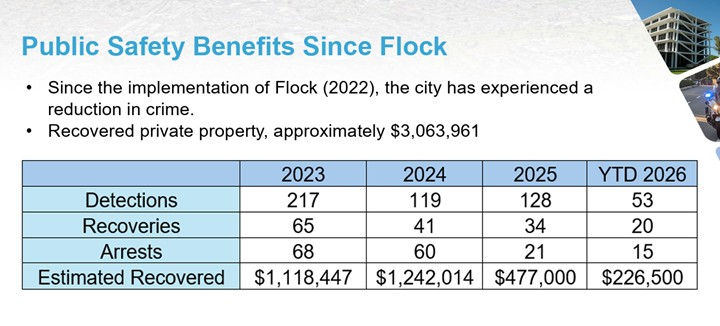
Let’s be honest about one thing: Flock cameras don’t prevent crimes; they help the police locate vehicles.
Addressing Privacy Concerns: The presenters acknowledged community concerns about privacy, data sharing, and misuse. They explained that:
Data may only be accessed for legitimate law enforcement purposes.
City follows California law (SB 34) governing ALPR systems.
Flock can only disclose data when legally required, such as through court orders.
According to the PD, Costa Mesa's Flock data has not been shared by Flock with outside entities.
Misuse Incident: The department addressed a previously reported case involving a former Costa Mesa officer who improperly used the system for non-law-enforcement purposes. Officials stated that the officer was investigated, criminally prosecuted, pleaded guilty, and that the department subsequently strengthened auditing and oversight procedures.
Recommendation: The presentation concluded with a recommendation that the City Council continue the Flock program, citing its value as a public safety and investigative tool. Police staff also suggested considering stronger contractual language related to data security in the city's agreement with Flock.
Councilmember Questions and Comments. The Councilmembers asked questions for more than an hour. Here is a summary of questions and answers:
Reynolds asked about reporting, oversight, and data security for the Flock ALPR program.
Police staff said they could provide regular public reports with information such as arrests, recoveries, missing persons cases, audits, violations, and corrective actions. They explained that any significant legal, policy, or system changes would undergo administrative and legal review, and that the Council could potentially revisit the program before the current contract expires.
In response to questions about safeguards, Staff said stricter access controls were implemented following a prior misuse incident, audit tools now help identify unusual activity, and user permissions are reviewed regularly. Staff said they did not know how many external users statewide could access Costa Mesa data but reported no evidence that Flock uses the City's data beyond agreed services and no known system breaches affecting Costa Mesa.
Gameros asked questions about Flock's data practices, contract terms, and system operations.
Police representatives said no Flock representative was present and noted that federal agencies such as ICE or DHS could have separate agreements with Flock but would not have access to Costa Mesa's data through the City's system. The City Attorney stated that data disclosures must comply with legal processes and can be challenged if inappropriate.
Police staff reiterated that Costa Mesa's cameras collect only license plate and vehicle information and do not use facial recognition or capture audio or message content. They also clarified that the City owns its ALPR data, while Flock retains ownership of its software and technology.
Additional responses included that damaged cameras are replaced by Flock at no additional cost, cameras are solar-powered, and the program costs approximately $151,000 annually, with a grant funding 15 additional cameras in 2024. Staff was unable to answer some questions regarding camera shutters and equipment removal in other jurisdictions.
Staff also explained that AMBER Alert vehicles are linked to law enforcement databases and can generate alerts when detected by the system.
Buley inquired about privacy, data access, and contract protections related to the Flock program.
Staff explained that there is generally no expectation of privacy in public spaces or on public roadways. They said third parties may obtain Flock data only through lawful processes such as subpoenas, warrants, or court orders, and are subject to California privacy protections.
Police representatives noted that a previous misuse incident was self-discovered and reported by the department. Staff also stated that future contract renewals would provide opportunities to strengthen data protection and disclosure provisions.
Marr asked about data sharing, access, retention, and contract provisions related to the Flock program.
Staff said Costa Mesa can disable data sharing with specific agencies and has done so in response to reported violations (El Cajon). They explained that statewide data sharing supports investigations involving suspects who travel across jurisdictions and noted that California agencies can no longer share Flock data outside the state.
Police representatives stated that Costa Mesa does not use audio-detection features, approximately 170 employees have access to the system, and users must provide a law enforcement justification for searches. They also said all alerts are verified to reduce false matches.
Staff explained that the City selected a 365-day retention period because some crimes are not reported immediately and noted that requests for City-owned data are generally referred back to the City. The City Attorney added that contract provisions related to software updates, notifications, training data, anonymized data, and other language could potentially be strengthened during future negotiations.
Chavez asked about user access, auditing, and operational use of the Flock system.
Staff said that approximately 170 authorized users have access and that broad access is appropriate when paired with strong oversight and weekly audits. They noted that investigators use the system frequently, often multiple times per day, while patrol officers primarily use it to help locate vehicles connected to criminal investigations.
Stephens asked about Flock's investigative value, privacy implications, access controls, and accountability measures.
Staff explained that the system helps locate suspect vehicles across California through participating agencies and supports coordination with other law enforcement departments. The City Attorney noted that courts have generally found no reasonable expectation of privacy on public roadways.
Police representatives stated that Costa Mesa's cameras capture only vehicle images and license plates, not facial recognition data. They said user access could be reduced without affecting the system's effectiveness, that no information has been shared with ICE, and that any misuse of the system would result in an administrative investigation and discipline. Staff added that weekly audits are conducted and documented within the Flock system.
Public Comment. There were about 75 public comments that lasted around three hours. At about halfway through the comments, the Mayor decided to take a 15-minute recess, and when the Council returned to the chambers, a motion was made to cut the remaining speakers’ comment time to two minutes.
Chavez and Gameros voted “No”, but the ayes (Reynolds, Marr, Pettis, Stephens. and Buley) carried it.
During the public comment period, numerous community members, local organization representatives, students, and professionals spoke overwhelmingly against renewing or maintaining the city's contract with Flock Safety for automated license plate readers (ALPRs).
The primary arguments presented against the Flock Safety contract include:
Immigration and Federal Data Sharing: Speakers voiced serious fears that ALPR data is shared (directly or via side-door searches with other agencies) with federal entities like ICE, DHS, and Border Patrol. Residents noted that this creates an environment of fear and chronic vulnerability for immigrant families, disrupting daily life (e.g., driving to work, school, or the grocery store).
Privacy Violations and Mass Surveillance: Commenters argued that the technology acts as a 24/7 "dragnet surveillance" system that tracks law-abiding citizens without warrants or probable cause. Speakers raised concerns that the cameras capture vehicle fingerprints, people's faces, body types, and locations near sensitive areas like playgrounds and bike paths.
Misuse and Security Vulnerabilities: Multiple speakers cited specific local and national incidents of abuse, including a former Costa Mesa police officer who pleaded guilty to using law enforcement tools (including Flock) to stalk his ex-partner and wife. Others cited reports of broader system data leaks, insecure live streams, and unauthorized searches by outside agencies.
Disproportionate Impact on Specific Neighborhoods: Community members highlighted that cameras appear heavily concentrated in predominantly Latino and lower-income neighborhoods (such as Shalimar), making residents feel targeted and monitored rather than protected.
Alternative Resource Allocation: Many requested that the city redirect the $150,000+ annual Flock budget toward root-cause community investments, including youth programs, mentorship, mental health support, housing, and foot/bicycle police patrols to build genuine trust.
Lack of Proven Crime Prevention: Speakers questioned the efficacy of ALPRs, noting that studies show minimal impact on overall crime rates compared to the severe erosion of civil liberties and community trust.
By the end of public comment, nearly five and one-half hours had passed since the meeting started.
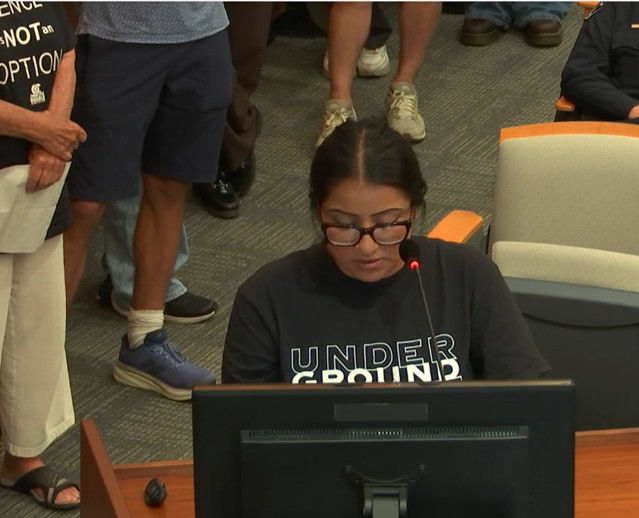
This photo only shows a portion of the people lined up behind this speaker. There were others that followed, and just as many on the other side of the chamber.
Motion. Gameros moved, with amendments from Marr, to continue the Flock ALPR program while directing Staff and the City Attorney to renegotiate the contract and return it to the Council for approval. Key elements included:
Reducing data retention from 365 days to 45 days (amended from the original 21-day proposal).
Requiring review and revision of provisions related to data sharing, third-party disclosures, subpoenas, and court orders, including notification to the City of data requests.
Strengthening protections against the sale, exchange, or release of City data.
Prohibiting new system capabilities or software upgrades without City notification and approval.
Removing or revising contract provisions related to customer-generated data, anonymized data used for training, and other unclear sections.
Adding data destruction procedures and protocols.
Exploring limits on authorized users, improved audit reporting, and reviewing camera locations and deployment.
Returning a revised agreement to the Council for future consideration before contract renewal.
Councilmembers Discussion: Gameros said he did not support the contract as currently written but viewed Flock as a valuable public safety tool. He argued the City should retain the technology while imposing stronger safeguards, tighter controls, and greater oversight.
Marr supported retaining the program while strengthening privacy protections. She proposed numerous contract amendments, called for public audit reporting, reducing the number of authorized users, and shortening data retention. She also suggested the City develop broader policies governing technology, AI, and data privacy.
Reynolds offered a substitute motion to terminate the Flock contract immediately, but it failed for lack of a second. She said public comment and her research led her to conclude the privacy risks outweighed the benefits. Reynolds expressed concern about government collection of residents' location data, vulnerabilities in the system, and the lack of public review when the original contract was approved. She voted against the final motion.
Buley supported the motion, describing it as an effort to balance public safety with civil liberties. He emphasized the importance of accountability, privacy protections, and public trust while recognizing the system's public safety benefits. He also asked that Staff return with comprehensive recommendations before the next contract renewal.
Stephens supported the motion, praising the Police Department's use of the technology while acknowledging residents' privacy concerns. He said the proposed revisions demonstrated the Council was responding to public input, expressed concern over certain contract provisions and Flock's absence from the meeting, and agreed that stronger safeguards were needed.
Chavez supported the motion, stating that while the community clearly lacks trust in Flock, the technology has helped solve serious crimes and provide closure to victims' families. He said he was uncomfortable with the current level of user access and believed changes were necessary, but was not prepared to eliminate the program before attempting to negotiate stronger protections.
Vote: The motion passed 6-1, with Reynolds voting “No.” Staff indicated they would return with proposed contract revisions, potentially by Fall 2026 for Council consideration.
It was nearly midnight.
2. City Ballot Initiatives for Business License Reform and Transient Occupancy Tax. Before the presentation, Marr expressed concern about making a significant policy decision late in the evening, stating she was uncomfortable voting on an issue with long-term implications for the City while fatigued. She asked whether a special meeting could be scheduled and sought clarification regarding the available procedural options.
Staff explained that the City faced statutory deadlines related to ballot measure materials and voter registrar requirements. The City Attorney advised that, rather than scheduling a special meeting, the Council could continue the current meeting to a later date while still meeting those deadlines.
Councilmembers discussed whether to proceed with the item that evening or continue it to a later date.
Chavez and Stephens supported moving forward, while a majority favored postponement.
Motion and Vote: Marr moved to continue the item to 4:00 p.m. on Wednesday as a continuation of the regular meeting. Reynolds seconded the motion. The motion passed 5-2, with Chavez and Stephens voting “No.”
The meeting resumed the next day at 4:00 p.m., and the item was heard. All Councilmembers were present. City Manager Cecilia Gallardo-Daly kicked off the presentation. She turned it over to Staff, who gave a 45-minute overview of the details of the proposed fee increase.
Staff presented follow-up information requested by the Council after the June 9 study session, including revised business license tax proposals, updated public opinion polling, a five-year financial outlook, and infrastructure funding needs.
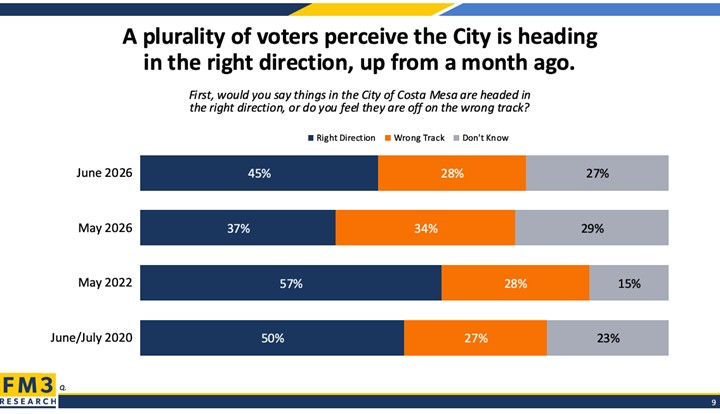
Community Survey Results: FM3 Research conducted a new survey of 407 likely Costa Mesa voters in June 2026. Results showed:
63% support for the proposed business license reform measure, compared to 53% support in a previous survey.
Support increased to 68% after voters received factual information about the measure.
Even after hearing opposition arguments, support remained at 58%, above the simple majority needed for passage.
Voters were more likely to support the measure when they understood the City's financial needs and that the proposal would primarily affect larger businesses rather than residents.
FM3 concluded that the measure appeared viable if accompanied by voter education and stakeholder outreach.
Transient Occupancy Tax (TOT): Staff reported that concerns from hotels, Travel Costa Mesa, and members of the business community suggested a TOT increase could hurt Costa Mesa's competitiveness. As a result:
Staff recommended against pursuing a TOT increase; instead they recommended focusing on business license reform.
Staff also reported that enforcing TOT collection from short-term rentals could potentially generate about $500,000 annually, though implementation and enforcement would cost approximately $100,000 per year.
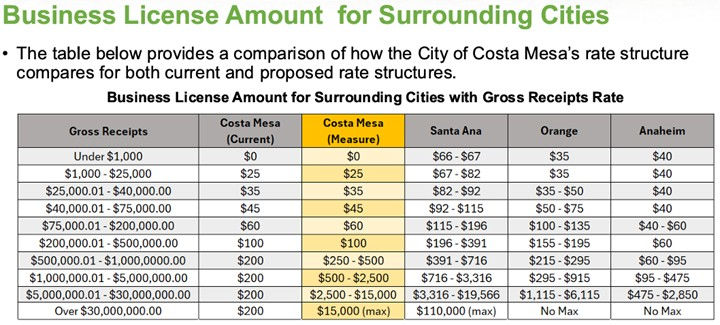
Business License Reform Proposal: Staff revised the proposal based upon Council feedback to protect small businesses. Key elements include:
Businesses with $500,000 or less in annual gross receipts would see no change in their business license tax.
About 72% of Costa Mesa businesses would be unaffected.
Businesses above that threshold would pay $0.50 per $1,000 in gross receipts, reduced from the previously proposed $0.60 rate.
The maximum annual tax would remain $15,000.
The proposal is projected to generate approximately $5.6 million annually, an increase of about $4.6 million over the current structure.
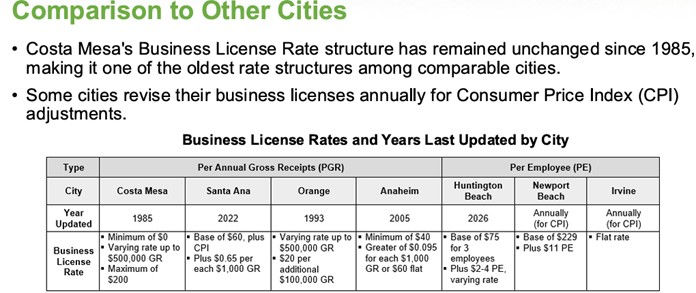
Staff noted that Costa Mesa's business license system has not been updated since 1985 and that the proposed rates would remain generally competitive with neighboring cities.
Five-Year Financial Outlook: Finance Staff reported that City revenues are projected to grow by roughly 3% annually, while expenditures are projected to grow by about 4% annually.
Projected General Fund deficits include:
FY 2027-28: approximately $1.9 million
FY 2028-29: approximately $4.2 million
FY 2029-30: approximately $4.9 million
FY 2030-31: approximately $4.9 million
Staff emphasized that these projections only reflect current service levels and do not include additional infrastructure investments identified in recent assessments.
Infrastructure and Capital Needs: Staff reviewed several major assessments that identified ongoing funding gaps:
Facilities Needs Assessment: approximately $5 million annual shortfall for facility maintenance and upgrades.
Pavement Management Plan: approximately $3.2 million annual shortfall to maintain and improve street conditions.
Parks Needs Assessment: approximately $1 million annual funding gap for park and playground improvements.
IT Strategic Plan: approximately $11.3 million in currently unfunded technology projects over the next five years.
Staff estimated that approximately $11.5 million in additional annual funding is needed to maintain existing infrastructure and service levels.
Staff Recommendation: Staff recommended that the Council:
1. Place the Costa Mesa Fair Business License Reform Small Business Protection Measure on the November 3, 2026 ballot.
2. Consolidate the election with the statewide general election.
3. Authorize ballot arguments, rebuttals, and preparation of an impartial analysis.
4. Receive and file the report regarding the potential TOT measure.
The City Attorney noted that placing the measure on the ballot required a two-thirds vote of the City Council (five votes).
Councilmember Questions and Comments. The City Council has considered this item several times before, so the questions were fewer this time. Buley led off by asking about SB 122, the statewide sales and use tax that took effect in January, specifically:
How much revenue is it expected to generate statewide?
Will any of that revenue flow to the City?
Could Staff provide at least a rough estimate of the City's share?
Staff responded that it does not yet have revenue estimates, including a ballpark estimate. The City is working with its legislative/public affairs team and consultants to determine projected impacts. Staff committed to returning to Council with information once estimates become available.
Reynolds asked about the budget need versus the proposed measure, specifically, how the City's structural budget gap is projected to reach approximately $4.8 million within five years under current operations. She cited that additional proactive investments in facilities, parks, and infrastructure would require approximately $11.5 million annually. However, the proposed ballot measure would generate about $4.6 million annually, covering only a portion of identified needs.
Staff said that her understanding was correct.
She responded to a public comment regarding restaurants and other businesses with potentially low profit margins by asking what analysis was conducted on impacts to those businesses. Was the Chamber of Commerce consulted?
Staff discussed the proposed revenue measures with the Chamber of Commerce, particularly business license reform. The Chamber understood the City's rationale for updating rates, but it did not provide guidance on which business types might be disproportionately affected. The Chamber offered its meetings as forums for City outreach and business education before the election.
Staff did not conduct a detailed industry-by-industry profit margin analysis.
Reynolds asked what happens if the measure passes and the City later discovers that certain business categories are disproportionately impacted; can the City reduce rates for those groups?
The City Attorney said, yes, it can. Voter approval would establish the maximum authorized rates but would not prevent the City from:
Lowering rates for certain revenue categories.
Creating separate rates for specific business types.
Similar business-specific classifications already exist in the City's code.
She asked if the City has enough data to identify specific types of businesses within each gross receipts category.
Staff responded, Yes. Registered businesses are categorized in the City's system. Staff could identify categories such as restaurants and other business types.
Marr asked why the ballot language states that the measure is being implemented "without taxing residents."
The City Attorney and Staff said that the tax applies only to businesses and business registrations. Residents are not directly subject to any increased tax. Staff believed it was important for voters to understand who would and would not be directly taxed.
She asked whether businesses could pass increased costs on to consumers.
Staff acknowledged that it is possible. Small businesses are largely shielded from increases, which helps minimize impacts on residents. Many businesses facing higher fees are large companies that Staff believes are better positioned to absorb the costs. The $15,000 annual cap also limits the magnitude of the increase.
Marr asked whether Staff analyzed impacts on industries with different profit margins.
No industry-specific analysis was conducted. The measure is based on gross receipts and follows the City's existing framework. Staff intentionally avoided altering established classifications to which businesses are already accustomed.
She asked whether a sunset date or expiration period was considered.
No, Staff did not consider including a sunset provision.
Stephens asked about the possibility of including a Consumer Price Index (CPI) adjustment:
How would it work?
Was it analyzed?
Staff considered a CPI adjustment at the request of the Finance and Pension Advisory Committee (FiPAC), but concluded it was unnecessary because business tax payments naturally rise as gross receipts increase through inflation or growth.
A CPI adjustment could potentially be applied to the $15,000 cap, but that was not analyzed or included. Adding such a provision would require changes to the proposed ordinance and ballot language. Staff felt future voters could address the issue if inflation substantially eroded the cap's value.
Stephens asked how Council should handle authorization of individuals to write ballot arguments supporting the measure.
The City Attorney said if the Council wants Councilmembers designated as potential authors of ballot arguments, they should be identified in the motion. Designation gives Councilmembers the option to write the argument but does not require them to do so. The City cannot officially solicit supporters, but community members may independently author arguments.
Councils sometimes reserve authorship in the event no adequate supporting argument is submitted.
Reynolds asked whether Council should create a committee or otherwise organize supporters.
The City Attorney responded that no committee is needed. Individual Councilmembers may discuss the matter with supportive community members outside the meeting process. If multiple arguments are submitted, the City Clerk applies statutory priority rules to determine which argument is used.
The consultant said that survey results showed local small business owners had very high favorability ratings among residents. The consultant suggested that supporters outside of government may be viewed as more credible messengers for a ballot argument than elected officials themselves.
Public Comment. There was one public comment. Cindy Brahs, a Costa Mesa resident and small business owner, stated that she authored the public comment letter previously referenced by Councilmember Reynolds. She expressed concern that the proposed business license reform would significantly impact many small businesses, particularly restaurants. The key points she raised were:
Restaurants would be heavily affected: Brahs argued that restaurants are a major business category within the $1 million to $5 million gross receipts range and would face substantial increases under the proposed fee structure.
Large percentage increases: She stated that businesses currently paying the $200 flat fee could see increases ranging from approximately 700% to 1,250%.
Disagreed with the characterization that small businesses would be largely unaffected: She cited the federal Small Business Administration's definition of small business and argued that many businesses in the affected revenue categories would still qualify as small businesses.
Concern about thin restaurant profit margins: Brahs emphasized that restaurants often operate on margins of only 3% to 5%, making them particularly vulnerable to increases based on gross receipts rather than profit.
Gross receipts tax concerns: She argued that tying business license fees to gross receipts disproportionately impacts low-margin industries because the tax does not account for profitability.
Lack of restaurant involvement in outreach: Brahs said restaurants were not adequately represented during community outreach and noted that although she received the city's survey, she was unclear about how to provide additional feedback.
Potential economic impacts: He warned that increased fixed costs could discourage businesses from operating in Costa Mesa, potentially leading some businesses to relocate, delay investments or hiring, or close altogether.
Brahs urged the Council to consider:
1. A lower rate for small businesses, particularly those in the $1 million to $5 million gross receipts range.
2. A reduced tier or cap for low-margin industries, such as restaurants.
3. Additional outreach and engagement with restaurants and other small businesses before placing the measure on the ballot.
Overall, her comments focused on the disproportionate impact the proposed business license fee increases could have on restaurants and other low-margin small businesses, and she encouraged the City to refine the proposal and expand stakeholder engagement.
Motion. Stephens moved to approve Staff's recommendation as read into the record by the City Attorney regarding placement of the business license tax measure on the ballot. Chavez seconded the motion. As part of the motion:
The Council did not reserve the right for Councilmembers to author or sign ballot arguments supporting the measure. Therefore, the portion of the resolution that would have designated Councilmembers as potential argument authors was removed.
During discussion, the motion was amended to reflect the understanding that a future Council would retain authority to:
Adjust rates downward if warranted.
Create business-type-specific classifications or exemptions if the measure passes and impacts on certain industries become a concern.
The maker and seconder also agreed to a request that Staff return in the future with a more detailed analysis of Transient Occupancy Tax (TOT) collection and enforcement related to short-term rentals.
Discussion: Stephens stated that:
The City's business license tax has not been updated in 41 years.
The proposal simply allows voters to decide whether the tax structure should be modernized.
The City is facing ongoing budget pressures and struggles each year to balance its budget.
Large businesses currently pay disproportionately low business license fees, regardless of their size or revenue.
Many major corporations and large professional firms operating in Costa Mesa pay only the current $200 fee, which he described as outdated and unreasonable.
Updating the fee structure is a responsible fiscal action because costs have increased substantially over four decades while the tax has remained unchanged.
If the measure passes and specific industries are adversely affected, future councils could adjust rates downward.
Chavez called the proposal a stewardship issue and argued that:
The City recently had to make budget reductions to maintain a balanced budget.
Delaying revenue adjustments for more than four decades has created financial pressures.
Residents ultimately experience the effects of budget constraints through impacts on programs, infrastructure, and services.
The measure is proactive and intended to avoid future fiscal difficulties seen in other cities.
The proposal is reasonable and should be presented to voters for consideration.
Marr expressed concern about the testimony from local businesses, particularly restaurants, and wanted to ensure that future councils will have flexibility if the measure passes. She questioned whether future councils could:
Create exemptions or alternative treatment for certain business types, such as restaurants.
Phase in the increased cap over time if desired.
The City Attorney confirmed that future councils would retain authority to make downward adjustments and create business-type distinctions or exemptions within the voter-approved framework.
Marr also requested that Staff return with a more detailed analysis of short-term rental TOT collection and enforcement, which was accepted into the motion.
Pettis stated he would not support the motion because:
The City currently has a balanced budget and growing revenues.
The projected challenges stem more from increasing expenditures than from an immediate revenue crisis.
He believes the City has not fully explored spending reductions or operational efficiencies.
A permanent tax increase should be a last resort after cost-saving measures have been exhausted.
In his view, the City faces a structural spending problem rather than an urgent revenue problem.
Reynolds said she would support the motion, while noting concerns about impacts on certain industries. She stated that:
Additional analysis on business-specific impacts would have been helpful.
Costs have increased substantially over 41 years, making some adjustment reasonable.
Some businesses, particularly restaurants and other tourism-related businesses, may operate on very tight margins.
Future councils should have business-category data available if changes become necessary after voter approval.
The proposed measure would address only a portion of the City's identified funding needs.
Vote: The motion passed 5-2, with Pettis and Buley voting “No.”
CONTROVERSY! Since the meeting, the Measure has been labeled Measure C by the County. The measure's official title, "The Costa Mesa Fair Business License Reform, Small Business Protection Measure," is being portrayed by some as unfair because it does not explicitly state that it raises business license taxes. Voters will reportedly see only an argument in favor of the measure in the ballot materials and no argument against it because opponents failed to submit an argument by the deadline.
Former State Senator John Moorlach stated that he believed August 6 was the relevant deadline and prepared an opposition argument after July 30. When he contacted the City Clerk, he was informed that no opposition argument had been filed, but that he had already missed the July 30 submission deadline.
Orange County Registrar of Voters Bob Page cited California Elections Code Section 9286(b), which allows shorter argument submission periods when a local election is consolidated with another election.
The Howard Jarvis Taxpayers Association reviewed the situation and concluded that the compressed schedule appears unusual but does not appear illegal on its face. The seven-day submission period alone is likely insufficient to demonstrate a legal violation.
The opposition's central claim is not that the process was necessarily illegal, but that it was unfair and insufficiently transparent, resulting in voters receiving only the pro-Measure C argument in their ballot materials and therefore not seeing both sides of the debate before casting their votes.
There is never a dull moment in Costa Mesa!


Comments