CITY HALL UPDATE FOR AUGUST 2026: HOUSING, SURVEILLANCE, AND THE FUTURE OF COSTA MESA TAKE CENTER STAGE
We only attended a handful of meetings in August, but there were some important decisions made.
We have already written about the August 10 Planning Commission meeting. You can find that report here.
Here is a summary of the activity at City Hall in August:
Council, Commission and Committee Meetings:
City Council: One meeting was held;
Planning Commission: One more meeting (a Special Meeting) was held;
Pension and Finance Committee: one meeting held
Here’s our report:
AUGUST 4 CITY COUNCIL MEETING. At this meeting, six items were acted on:
Ordinance Amending Title 13 (Planning, Zoning, And Development) of Costa Mesa Municipal Code Updating Land Use Classifications for Various Non-Residential Uses
Continuation Request of Revisions to Consolidated Master Fee Schedule
Parks and Community Services Commission Annual Report
Award of On-Call Sidewalk Repair Project
Signal Modernization for Systemic Safety Improvements
Amendment to Agreement for Construction Management and Inspection Support Services for Adams Avenue Bicycle Facility Project (from Harbor Boulevard to Fairview Road)
Prior to the start of the Closed Session, City Attorney Kim Hall Barlow requested that an additional item be walked onto the Closed Session Agenda. That item also appeared on the Regular Session Agenda under the Consent Calendar, the City’s Response to Orange County Grand Jury Report-State Housing Mandate. That item was also acted upon by the City Council in the Regular Session.
All Councilmembers were present, with Mayor John Stephens attending remotely from Africa.
City Attorney Closed Session Report. Kimberly Hall Barlow reported that there was discussion on the items on the Closed Session Agenda, but no direction was given, and no reportable action was taken.
Presentations: None.
Public Comment. There were 18 members of the public who spoke, with public comments lasting about 40 minutes. The comments were dominated by strong opposition to the Flock Safety license plate reader program, with speakers repeatedly urging the Council to cancel the contract rather than modify it. Other issues raised included ethics and conflicts of interest, animal shelter contracting, privacy rights, and wildlife and safety concerns at Lions Park. The tone of many comments reflected frustration that previous public input on the Flock issue had not changed the Council's decision.
Calls for an Ethics Policy. The first speaker urged the City Council to adopt a formal ethics policy, particularly for future councilmembers. She argued that Councilmember Chavez, who works as an aide to an Irvine councilmember, should not have voted on an agreement involving Irvine's use of beds at the Costa Mesa Bridge Shelter. She also questioned whether that Councilmember could represent Costa Mesa's interests independently and said the City appeared "ethically challenged."
Animal Services Contract Concerns. Steve Smith, who is running for City Council and is a member of the City’s Animal Services Committee, encouraged the Council to begin the request-for-proposals process soon for animal shelter services. He noted that the current contract with WAGS ends in December and warned that waiting until September to begin the process could leave insufficient time to secure a provider and ensure continuity of animal care.
Opposition to Flock Safety and ALPR Surveillance. Most speakers criticized the Council's recent decision to continue the Flock Safety contract. Common themes included:
Claims that the original Flock program was implemented without the public hearing required under California Senate Bill 34.
Frustration that more than 70 speakers at a previous council meeting had urged cancellation of the contract, yet the Council voted 6-1 to continue it.
Assertions that the Council ignored overwhelming public opposition and failed to represent constituent views.
Concerns about privacy, mass surveillance, civil liberties, and data sharing.
Warnings about potential misuse of collected data by law enforcement agencies or federal immigration authorities.
Repeated arguments that ALPR systems have not been proven to reduce crime.
Demands that the Council terminate the contract entirely rather than amend it with additional safeguards.
References to possible legal challenges against the City over the program.
Several speakers also cited reports of misuse of the Flock system, including allegations involving a former Costa Mesa police officer who used the database to track personal acquaintances, and broader examples from other jurisdictions.
A number of speakers connected Flock technology to larger concerns about government surveillance, constitutional rights, policing practices, immigration enforcement, and civil rights.
Privacy and Constitutional Rights. One speaker formally delivered written notices to City officials asserting that surveillance programs violate constitutional privacy rights. She demanded that the City identify the constitutional authority for such surveillance and cease actions she characterized as infringements on residents' privacy.
Lions Park Wildlife and Safety Issues. Two speakers raised concerns about recent vegetation removal at Lions Park. They argued that:
The removal of a cactus habitat displaced wildlife.
Exposed animals were being chased by off-leash dogs.
The City created new safety hazards by removing habitat and allegedly using poisons.
Leash laws are not being adequately enforced.
They requested increased animal control enforcement, temporary fencing around disturbed habitat areas, restoration of vegetation, and an end to the use of poisons.
Broader Political and Social Concerns. Some speakers linked the Flock debate to broader national and international issues, including:
Surveillance technology and its use by governments
Civil liberties and constitutional protections
Immigration enforcement
The war in Gaza
Concerns about authoritarianism and democracy.
These speakers argued that surveillance systems can be abused and urged the City not to participate in what they viewed as a growing surveillance infrastructure.
Councilmember Comments. Arlis Reynolds (District 5) thanked residents for their input on the Flock camera system and said that, while she sees its value for law enforcement, she has growing concerns about the technology's vulnerabilities and potential for abuse. She encouraged continued public engagement and requested clarification on the council's previous action and possible SB 34 issues. She also:
Requested an update on concerns raised about Lions Park and emphasized enforcing leash laws.
Praised city communications highlighting Public Works projects like storm drain cleaning and graffiti removal.
Encouraged residents to attend the Costa Mesa Historical Society's 60th anniversary celebrations.
Highlighted Costa Mesa Mutual Aid's ongoing support for families affected by immigration enforcement and encouraged donations.
Supported efforts to improve e-bike safety through free community education and collaboration among transportation advocates.
She concluded by thanking those working to improve Costa Mesa.
Jeff Pettis (District 6) thanked Staff, police, and fire personnel for organizing the Fairview Developmental Center community town hall and praised residents for their engagement and knowledge on the issue.
He emphasized that community members want meaningful input in the redevelopment process and expressed concern that technical planning and zoning explanations can sometimes dismiss or overshadow residents' concerns. Pettis said residents deserve a stronger voice in decisions about the project.
Using traffic as an example, he noted that many residents are worried about the impact of approximately 4,000 planned housing units and do not find assurances based solely on traffic studies to be satisfactory. He urged the City and agencies involved to listen carefully to public concerns and ensure residents feel heard throughout the process.
Mike Buley (District 1) thanked Travel Costa Mesa, Staff, and community partners for quickly organizing a visit from representatives of the Chinese Olympic Committee, who were scouting local facilities ahead of the 2028 Olympics. He also encouraged residents to enjoy the OC Fair and its events, noting it as one of Costa Mesa's signature attractions.
Regarding the Flock camera system, Buley acknowledged it is a complex and challenging issue and said he was encouraged by the high level of public participation. While reserving most of his comments for when the matter returns to the council agenda, he expressed strong support for free speech and public engagement in the democratic process.
Loren Gameros (District 2) recognized and congratulated longtime firefighter Justin Horner on his promotion to Battalion Chief, and also praised the progress of Costa Mesa Fire & Rescue recruits as they complete academy training focused on truck company operations and firefighting skills.
Regarding the Flock camera system, Gameros said he is listening closely to community concerns and acknowledged that it is a difficult issue. He said the City Council is working collaboratively with the City Attorney, police department, and Flock representatives to make the best decision possible.
He also reminded residents that the city is experiencing a heat wave and encouraged anyone needing relief to use local cooling centers, including the Senior Center, or visit City facilities in an emergency.
Andrea Marr (District 3) thanked students and scouts for attending the meeting and emphasized the importance of civic participation, listening to different viewpoints, and democratic engagement.
She praised Staff for the Fairview Developmental Center Specific Plan meeting, saying it helped answer community questions and clarify what aspects of the project can and cannot be changed. She noted that the project will return to the City Council for further public input because of its significant impact on future housing development in Costa Mesa.
Marr also expressed support for revisiting an ethics policy and called for a formal system to track campaign contributions and recusal requirements, noting recent changes in state law and the need for greater accountability.
Finally, she shared her excitement about Costa Mesa's potential role in the 2028 Olympics, particularly the opportunity to host international teams and visitors, which could benefit local hotels and facilities.
Stephens had no comments.
Manuel Chavez (District 4) thanked residents for their public comments, particularly on the Flock camera issue, and reminded the community that the topic will return as a future council agenda item. He encouraged continued public participation and emphasized the value of civic engagement.
He shared an update on community outreach related to the future of a vacant City-owned lot next to the new Shalimar Park in District 4, noting that residents have expressed interest in ideas such as a community center and additional green space.
As a housekeeping matter, Chavez announced a new council meeting procedure in which members will use the request-to-speak feature to help manage discussions more efficiently.
He concluded by requesting that the meeting be adjourned in memory of his friend, Rosa Elena Muñiga-Cano, who recently passed away from lung cancer.
City Manager Comments. Cecilia Gallardo-Daly recognized several City employees for their outstanding service and achievements:
Lindsay King, Payroll Coordinator in the Finance Department, received the City Manager's July Leadership Award for her professionalism, reliability, positive attitude, and commitment to supporting employees and departments.
Justin Horner was congratulated on his promotion to Battalion Chief. A Costa Mesa firefighter since 2005, Horner has served in several leadership roles, most recently overseeing EMS operations, and was recognized for his dedication and service.
Police Lieutenant David Casares was honored on his retirement after 30 years with the Costa Mesa Police Department. The City Manager highlighted his extensive career in patrol, investigations, SWAT, leadership, and professional standards.
City Attorney Comments. Hall Barlow had no report.
CONSENT CALENDAR. Item 7, the Response to Orange County Grand Jury Report-State Housing Mandate was pulled by Buley and Marr. The remaining items were moved for approval by Marr, which motion was seconded by Reynolds. That motion passed unanimously, 7–0.
Buley pulled the Orange County Grand Jury report on state housing mandates from the consent calendar to give it greater public attention and help educate residents about its relevance to ongoing housing issues, including the Housing Element, RHNA requirements, and the Fairview Developmental Center Specific Plan.
Buley asked Staff and the City Attorney to explain the role of the Grand Jury, how its reports are developed, and how its findings can influence future public policy. He noted that, while grand jury reports do not directly change legislation, they can serve as persuasive documents that inform policymakers and legislative discussions.
He then highlighted several findings from the report that he believed reflected the realities local governments face, including:
The growing number and complexity of state housing mandates.
A lack of transparency and accessibility in the RHNA allocation process.
The difficulty of meeting housing targets in built-out cities with limited land and infrastructure constraints.
Residents' desire for local planning decisions to reflect community priorities such as neighborhood character, safety, environmental protection, and open space.
The high cost of affordable housing development and the reliance on subsidies and development incentives.
Buley praised Staff's responses to the report, noting that the City agreed with many of the findings. He said the report validated concerns he has heard from residents and echoed challenges the City faces in balancing state housing requirements with local quality-of-life considerations.
He concluded by expressing appreciation for both the Grand Jury's work and the City's response, stating that housing issues consume a significant amount of the Council's and Staff's time and that the report deserved public discussion rather than routine approval on the consent calendar.
The report, which includes a lengthy bibliography of documents the Grand Jury reviewed, here.
Public Comment. David Martinez expressed disagreement with both the Orange County Grand Jury report on housing mandates and the City's proposed response to it. He argued that grand juries are composed of volunteers rather than subject-matter experts and said he did not believe the report accurately reflected the views of the broader community.
Martinez recommended that the City's response be shortened to simply state whether the City agrees or disagrees with each finding, rather than including detailed commentary. He disagreed with several of the report's conclusions and characterized the report as generally opposing additional housing development.
He emphasized that Costa Mesa has approved housing-related initiatives, including Measure K and rezoning efforts, and stated his belief that increasing housing supply is necessary to improve housing affordability. He concluded by urging the City to revise and simplify its response to the Grand Jury report.
I find it amusing that Mr. Martinez has been a volunteer himself, and his Planning Commission position only pays a small amount, so it is basically volunteer work too. Should we question his expertise? The reality is that the Grand Jury is comprised of applicants that have to pass a screening process, and while they may not have expertise in all areas, they are supported by the District Attorney’s Office, which provides research and advice.
Cynthia McDonald challenged Martinez’s criticism of the Orange County Grand Jury, noting that grand jurors often bring substantial experience and expertise, including former elected officials, and should not be dismissed simply because they are volunteers.
I supported the City's decision to agree with the Grand Jury's findings and explain its reasoning, arguing that the report accurately reflects the challenges cities face in meeting state housing mandates. I pointed out that the state requires cities to meet RHNA housing targets but does not provide sufficient funding to help developers build affordable housing, particularly in built-out communities where land is scarce and expensive.
I expressed concern that the state's lawsuit against Costa Mesa has put the City in a difficult position. I argued that as long as the lawsuit remains unresolved, the City will be unable to obtain a compliant Housing Element, which could jeopardize eligibility for important grants and funding. To move forward, I suggested separating the sober living home ordinance dispute from the Housing Element certification process so that the City can regain compliance while the legal issues are addressed separately.
Motion, Comments and Vote. Marr moved to approve the City's response to the Orange County Grand Jury report with several amendments to strengthen the City's position on housing mandates and RHNA requirements. Her proposed changes included:
F6: Adding language that the RHNA planning cycle is too short to adequately address major circumstances outside a City's control, citing the Fairview Developmental Center project as an example of a complex issue that cannot realistically be resolved within the State's timeline.
F7: Emphasizing that the state's housing element review process went far beyond assigning housing targets, requiring the City to respond to an extensive number of programs, ordinances, and policy issues. Marr argued that the scope of state oversight was excessive and should be reflected in the City's response.
F9: Expanding the response to highlight Costa Mesa's existing affordable housing efforts, including partnerships with Jamboree Housing, permanent supportive housing projects, and the City's Housing Trust Fund.
Stephens seconded the motion. In supporting her motion, Marr noted that Costa Mesa has faced significant pressure from the State, including litigation and criticism from state officials over its housing policies. He argued that the City's response should not only acknowledge challenges with the RHNA process but also document the substantial work Costa Mesa has already undertaken to comply with housing mandates. Stephens stressed that Costa Mesa faced unique burdens, including Measure K, the Fairview Developmental Center planning process, and State demands to revise multiple local ordinances, and that the City's response should fully reflect those circumstances.
Buley expressed support for Councilmember Marr's motion and responded to criticism that the Grand Jury report was anti-housing. He said that was not his interpretation of the report.
According to Buley, the report's message was not "don't build more housing," but rather that the current state housing system and regulatory framework make it extremely difficult to build housing and achieve affordability goals. He argued that excessive requirements and barriers are hindering housing production and making it harder for projects to move forward, ultimately undermining the state's objective of increasing affordable housing.
Reynolds expressed support for the motion and the proposed additions to the City's response to the Orange County Grand Jury report.
She emphasized the importance of highlighting examples where the State's housing compliance system has not functioned as intended, including a situation in which Costa Mesa became temporarily ineligible for low-income housing funds, jeopardizing a City-supported affordable housing project and nearly resulting in the loss of 70 very low-income senior housing units.
Reynolds said she was initially concerned that the Grand Jury report might conflict with Costa Mesa's strong commitment to addressing housing needs. However, after reviewing Staff’s response, she praised Staff for striking a balance between acknowledging the City's pro-housing efforts and documenting the challenges and constraints imposed by the state's housing process.
She reiterated her support for expanding the response to include more details about those challenges while also highlighting the City's ongoing work to increase housing opportunities and improve affordability for residents.
The motion passed unanimously.
PUBLIC HEARINGS: There were two public hearings:
1. Ordinance Amending Title 13 (Planning, Zoning, And Development) of Costa Mesa Municipal Code Updating Land Use Classifications for Various Non-Residential Uses. Amber Gregg, Contract Project Manager, and Martina Caron, Planning Manager, gave the presentation about a limited-scope update to the City's Zoning Code, aimed at modernizing regulations that have remained largely unchanged since 1997. She emphasized that commercial business models have evolved significantly over the past 25+ years, making portions of the code outdated. The proposed changes are intended to:
Support modern and evolving business types.
Improve clarity in zoning regulations
Reduce reliance on case-by-case interpretations
Encourage reinvestment and adaptive reuse of existing commercial buildings
Streamline the development review process while maintaining regulatory standards
Gregg stressed that this is not a comprehensive zoning code rewrite, but a focused effort addressing:
The top 10 economic development-related zoning issues, and
A modification to the floor area ratio (FAR) definition.
How the Amendments Were Developed. Staff identified priorities by:
Reviewing the most common entitlement and zoning applications
Analyzing why certain projects required public hearings
Identifying outdated or unclear regulations
Researching emerging commercial trends
Gathering feedback from business owners and the community
The amendments were reviewed by the Planning Commission at several meetings, then recommended for approval on July 13.
Key Proposed Updates. The amendments focus exclusively on commercial uses, with no residential changes proposed.
Areas addressed include:
Personal service businesses
Artist studios
Active entertainment uses
Event centers and assembly uses
Fitness studios
Food halls and ghost kitchens
Electric vehicle charging facilities
Sports clubs
Commercial kitchens
The goal is to make these uses easier to establish and review while maintaining standards for compatibility and impacts.
Regulatory Changes. Two significant regulatory modifications are proposed:
Height Deviations. These currently require a variance process. The proposed change would allow minor height deviations through a Minor Conditional Use Permit, simplifying approvals.
Floor Area Ratio (FAR) Definition. Updated to better exclude areas that do not contribute to the intensity of a building's use.
Parking Requirement Updates. Staff also reviewed parking standards and proposed:
Eliminating outdated minimum parking requirements that disproportionately affect small commercial tenants.
Updating parking standards using transportation and parking demand data where appropriate.
Streamlining the Approval Process: A major objective is reducing unnecessary Conditional Use Permits (CUPs). Currently, many commercial uses require:
Planning Commission review, and
Public hearings.
Under the proposed amendments:
More uses would be permitted by right, meaning businesses could proceed through the standard permitting process without a public hearing.
Common approval conditions that were repeatedly applied through CUPs have been incorporated directly into the Zoning Code.

Councilmember Questions and Comments. The Councilmembers asked questions for more than an hour. Here is a summary of questions and answers:
Reynolds asked what the City's broader plan is for keeping the zoning code updated in the future rather than waiting decades between revisions. Staff explained that the Planning Department's goal is to conduct approximately two to three zoning code updates each year, subject to staffing and workload availability.
Buley focused on whether the amendments would reduce unnecessary bureaucracy for low-impact businesses and how "permitted by right" approvals work. Staff responded that the proposal is specifically designed to move many compatible business uses out of the CUP process and into administrative approval, provided they comply with all zoning requirements. Once those requirements are met, approval is generally automatic and does not depend on a discretionary public hearing process.
He also asked what happens if a neighboring property owner, a nearby business, or another interested party objects to a business that is approved "by right?" He wanted to know whether there is any mechanism to challenge or question such an approval.
Staff explained that a use that is permitted by right only needs to comply with the requirements of the zoning ordinance. If the proposed business fits within the applicable use category, and meets all zoning standards and requirements, then it is entitled to approval.
Public Comment. None.
Motion, Comments and Vote. Marr moved to approve the zoning code amendments as recommended by Staff and the Planning Commission, with second by Reynolds. The motion passed unanimously, 7-0.
2. Continuation Request of Revisions to Consolidated Master Fee Schedule. The public hearing was opened, and a motion was made by Chavez to continue the item, which was seconded by Gameros. That motion also passed unanimously, 7-0.
OLD BUSINESS: None.
NEW BUSINESS: There were four items:
1. Parks and Community Services Commission Annual Report. Parks and Recreation Director Brian Gruner introduced the Parks and Community Services Commission's annual report, explaining that the Commission meets monthly to advise on parks, recreation programming, fees, special events, tree appeals, and park-related capital improvement projects (CIPs). He noted that the commission's primary focus over the past year was to:
Create more meaningful opportunities for commissioners to contribute to policy decisions.
Improve commissioner education and understanding of City operations.
Ensure recommendations are data-driven, thoughtful, and informed by community input.
Chair Kelly Brown and Vice Chair Shayenne Wright then presented the Commission's accomplishments and priorities. They highlighted a significant cultural shift within the Parks and Community Services Commission. Commissioners described moving from a largely advisory role focused on individual agenda items to a more strategic, data-driven role that:
Uses objective evaluation frameworks
Reviews financial sustainability
Prioritizes long-term planning
Expands community outreach
Tracks outcomes after recommendations are implemented
Provides more substantive policy guidance to City Council
The Commission expressed pride in its progress and indicated that future priorities will include capital improvement funding recommendations, community gardens, dog park opportunities, fee sustainability, enhanced community engagement, and continued modernization of park-related policies.
The Commission plans to study:
Park ordinances
Tree removal policies
Memorial donation programs
Public tree requests
This effort mirrors the broader citywide interest in updating older regulations. The Commission also identified several topics for future study, including:
Joint-use agreements with Newport-Mesa schools
Access to school properties in park-deficient areas
Contracts for landscaping, tree maintenance, and park maintenance services
Follow-up reviews of major programs such as senior transportation
Additional training on City finances, budgeting, and economic analysis
Commissioners stressed that better-informed Commissioners can provide stronger recommendations to City Council.

Councilmember Questions and Comments. Pettis asked about any potential changes to Concerts in the Park, noting that the event is very popular. He wanted assurance that the Commission would not make major decisions about Concerts in the Park without broader Council involvement and significant public input.
Chair Brown assured him that the Commission would not make unilateral decisions on such a significant issue. Any consideration of changes would include public engagement and community feedback. She explained that the Commission's interest is less about moving or eliminating Concerts in the Park and more about exploring ways to expand access to similar music and cultural events in other areas of Costa Mesa to promote equity and serve more neighborhoods.
Reynolds asked about the Songs in the Canyon event, noting that the event has been well received and has sparked interest from residents in other parts of the city who would like similar programming in their neighborhoods. She discussed an aspirational goal of:
Expanding access to community events such as concerts, arts programs, and neighborhood gatherings.
Exploring partnerships with community groups, nonprofits, and businesses to make it easier to host local activation events.
Finding ways to support these kinds of activities citywide, given the City's limited resources.
The Commissioners agreed with the concept and reiterated their interest in exploring ways to bring music and cultural programming to more neighborhoods throughout Costa Mesa, while continuing to engage the community and develop creative partnerships.
Reynolds then raised what she described as a particularly important issue: Costa Mesa's long-standing park deficit. She expressed concern that the City lacks a comprehensive strategy for creating additional park and open space. She encouraged the commission to:
Think creatively about identifying new park and open-space opportunities.
Develop a framework or strategy for evaluating and pursuing those opportunities.
Help guide implementation of a long-term open-space vision for Costa Mesa.
While no detailed response was given during this exchange, the Commissioners had previously emphasized their interest in long-range planning, community gardens, open-space planning, data-driven decision-making, and evaluating opportunities to expand recreational assets throughout the city. Reynolds encouraged them to continue that work and take a leadership role in helping the City develop a strategy for addressing park and open-space needs.
Public Comment. The sole public comment was that the current Fairview Park Master Plan does not mention the Concerts in the Park as a recreational use for that park, so that activity is not protected.
Motion and Vote. Reynolds moved to receive and file the report, which was seconded by Marr. The motion passed unanimously, 7-0.
2. Award of On-Call Sidewalk Repair Project. Public Works Director Raja Sethuraman introduced the item and turned the presentation over to City Engineer Seung Yang, who presented the proposed contract award for the project. The Public Works Department has established a citywide program to identify and repair damaged sidewalk infrastructure. Repairs are prioritized based on assessed condition and may include:
Sidewalk grinding for minor uplift issues
Partial or full reconstruction for more significant damage
Repairs to related concrete infrastructure, including:
Curbs and gutters
Driveway approaches
Cross gutters
Spandrels
Construction or upgrading of ADA-accessible curb ramps when needed
Staff completed a GIS-based assessment of sidewalks throughout the city and categorized deficiencies by severity. The city has been divided into five repair zones for implementation purposes. These zones are not related to council districts. Zone 2 was already underway at the time of the presentation. Future zones will be addressed in subsequent years.
The current contract focuses on repairs within Zone 1. The project was publicly bid on May 6. Staff recommended awarding the contract to S&H Civil Works, a contractor with previous experience performing similar concrete infrastructure work in Costa Mesa. Key details:
Contract amount: $237,600, exclusive of a 10% contingency for cost overruns.
Funding sources: Gas Tax funds and Measure M2 transportation funds.

Councilmember Questions and Comments. Reynolds asked whether the project represented the first implementation phase resulting from the citywide sidewalk assessment that the Council funded several years earlier. Staff confirmed that it is. Reynolds noted that the assessment supports the City's goals of improving walkability and reducing trip-and-fall hazards.
She asked if the City's sidewalk assessment includes identifying locations where sidewalks are missing entirely and whether those projects would be handled separately from this repair program. Staff explained that missing sidewalk links are being addressed through separate efforts and capital improvement projects. The current contract focuses on repairing existing sidewalk infrastructure rather than constructing new sidewalk connections.
Reynolds noted the approximately $237,600 contract amount and asked whether Staff anticipates similar costs for the remaining repair zones throughout the city. Staff said that was their expectation and that future zones would likely require comparable levels of funding.
Public Comment. None.
Motion and Vote. Reynolds moved to approve the item, which was seconded by Chavez. The motion passed unanimously, 7-0.
3. Signal Modernization for Systemic Safety Improvements. Paul Martin, Transportation Services Manager, presented a citywide traffic signal safety improvement project that stems from the city's Local Roadway Safety Plan, completed approximately four years earlier. The safety plan used crash history and traffic data to identify opportunities to improve roadway safety throughout Costa Mesa. Based on the safety plan, the City successfully secured approximately $4 million in grant funding to modernize traffic signals. By leveraging state grant funding,
Costa Mesa can modernize nearly all of its traffic signals, improve pedestrian safety, increase emergency response efficiency, and enhance system reliability while requiring only a relatively small local financial contribution.
The project will implement a variety of safety enhancements, including:
Retroreflective signal backplates (yellow reflective borders around traffic signals) to improve visibility.
Countdown pedestrian signals showing pedestrians how much time remains to cross.
Larger traffic signal heads for increased visibility.
Leading Pedestrian Intervals that give pedestrians a head start before vehicles receive a green signal.
Battery backup systems to keep traffic signals operating during power outages.
Emergency vehicle preemption technology to help ambulances and fire trucks move through intersections more efficiently.
Staff recommended awarding the construction contract to Econolite Systems. The contract value is approximately $3 million, including contingencies and approval authority. Construction is expected to be completed by spring of the following year.
Martin explained that the grant program allocated more funding than originally needed for the base project. Staff proposed contributing an additional $71,000 in local funds. This would unlock approximately $640,000 in additional grant funding. The additional money could fund further signal safety improvements that are eligible under Caltrans guidelines. Staff indicated they would work with Caltrans to finalize which improvements could be added.
In addition to the construction contract, Staff requested approval of a consultant to oversee project construction. After reviewing four proposals and interviewing two firms, Staff recommended hiring C2PM. The contract is for approximately $450,000. The same grant funding structure would apply, with the grant covering most costs and the City providing the required local match.
Councilmember Questions and Comments. Reynolds's questions highlighted the City's strategy of using consultant support to successfully deliver a growing number of infrastructure projects despite limited internal staffing. Staff indicated that the approach has been effective, especially for federally funded projects where the consultants help manage both construction activities and complex grant compliance requirements.
Public Comment. There were two public comments. The first speaker asked whether the systems would use simple motion pedestrian presence detectors or AI-powered video cameras that identify pedestrians. The commenter noted that AI-based detection systems may raise privacy concerns and potentially generate public opposition, while simpler detection technologies would likely be more widely accepted. The speaker requested clarification from Staff, either during the meeting or through a later follow-up.
The second speaker expressed strong support for the traffic signal modernization project, citing its benefits for multiple users. The speaker suggested that transit signal priority could be considered as an additional enhancement, possibly using some of the extra grant funding.
Motion and Vote: Reynolds moved to approve the item, which was seconded by Chavez. Reynolds requested that Staff answer the first public commenter’s question. Staff clarified that the proposed pedestrian-related traffic signal improvements do not use cameras or AI-based pedestrian detection systems.
The motion passed 6-0, with Stephens having lost his connection and left the meeting.
4. Amendment to Agreement for Construction Management and Inspection Support Services for Adams Avenue Bicycle Facility Project (from Harbor Boulevard to Fairview Road). Public Works Director Raja Sethuraman introduced the item, and Transportation Services Manager Paul Martin presented an update and requested a contract amendment related to construction management and inspection services.
The Adams Avenue Bicycle Facility Project is improving bicycle infrastructure along Adams Avenue between Harbor Boulevard and Fairview Road. Key project features included:
Construction of Class II bicycle lanes and Class IV protected cycle tracks,
Creation of the bike facilities by narrowing the roadway median, and
No reduction in vehicle travel lanes.
Construction began in February and is expected to be completed in September. During construction, the City encountered several unforeseen issues, including that the existing soil was found to be unstable and retained excessive moisture, requiring extra excavation and soil compaction work. Extra materials testing was needed due to soil conditions, and additional inspections were required for landscaping and electrical components.
One notable enhancement involved upgrading the separation between bicycles and vehicles. Originally, projects often used plastic bollards (flexible posts). Instead, this project upgraded to concrete extruded curbs, providing a stronger and more permanent barrier between cyclists and traffic.
While construction funding remains sufficient, the unexpected complexities increased the workload for project oversight. The construction management consultant, Z&K Consultants, requested an additional $64,000 for inspection, monitoring, project administration, and required federal grant documentation. The additional $64,000 would come from the project's previously approved budget.
Councilmember Questions. None.
Public Comment. None.
Motion and Vote. Chavez moved to approve Staff's recommendation. Marr seconded the motion. The motion passed 6-0, with Stephens absent.
AUGUST 12 FINANCE AND PENSION ADVISORY COMMITTEE MEETING. The meeting was called to order at 4:00 p.m. All members were present except Quinn Callanan. The minutes from the July 15, 2026 meeting were approved.
Work Plan Discussion. The Committee reviewed and revised the draft FY 2026–27 Work Plan, clarifying its advisory and policy-focused role. This was a lengthy process as each topic was discussed, sometimes at length. Key topics included:
Overtime: Focus on reviewing budgeting, reporting, and trends.
Reserve Policy: Review reserve levels and best practices.
Employee Pension Program: Develop a Pension 101 presentation, including unfunded obligations.
Vacancy/Attrition Factor: Review calculation methods and alternatives.
IT Replacement Fund: Consider improvements to reporting format.
Five-Year Financial Forecast: Review alongside budget development.
Performance Measures: Deferred for separate discussion.
Revenue Possibilities and RFP/Cooperative Purchasing. Note: This was eventually removed from the work plan.
Capital Projects: Review delays, costs, and policy recommendations.
Public comments emphasized transparency, timely reporting, and the value of performance metrics.
The Committee authorized Chair Arnold to incorporate revisions and submit the revised work plan.
Performance Measures: The Committee discussed the importance of meaningful performance measures linked to financial performance, efficiency, and resource allocation.
Examples discussed included overtime costs, permit processing times, and cost per service. Developing comprehensive measures would require citywide coordination and possibly additional resources.
The topic will be further developed at the December meeting.
Public comments supported starting with manageable areas and the urge to consider hiring a consultant.
Committee and Staff Comments: Members expressed appreciation for collaboration and Staff support, and raised questions about capital project reserves, bond costs, and financial reporting. Staff provided updates on bond financing, legislative developments, and clarified Treasury Report discrepancies. The Bond for the reconstruction of Fire Station 2 has not been procured because the City is attempting to improve its credit rating. Did our credit rating drop? Is this because we don’t have a compliant Housing Element?
The meeting adjourned at 6:09 PM.
AUGUST 17 PLANNING COMMISSION SPECIAL MEETING: All Commissioners were present.
Aside from the approval of the Minutes of the July 27 meeting, the Commission considered two action items:
General Plan Amendment to Amend Housing Element to Add Additional Housing Element Sites to Sites Inventory
Study Session to Introduce (1) Proposed Measure K Zoning Code Amendments, Citywide Multi-Family Residential and Mixed-Use Objective Design Standards, (2) Proposed Repeal of Urban Plans, (3) Amendments to Circulation, Community Design, Land Use, Noise, and Open Space and Recreation Elements of General Plan, and (4) Amendments to Newport Boulevard Specific Plan, North Costa Mesa Specific Plan, and One Metro West Specific Plan
Public Comment. Jay Humphrey expressed concern that the City's planning documents identify a need for 575 acres of park space to meet the goal of 4.26 acres of parkland per 1,000 residents, but do not provide any strategy for acquiring that land.
He pointed to the proposed Fairview Developmental Center Specific Plan project, which is expected to generate about $30 million in park fees. Humphrey argued that the City should consider using those funds to encourage developers to dedicate land for City-owned parks and open space, potentially by offering reductions in park fees in exchange for land donations.
He emphasized that City ownership of parkland is preferable to privately owned open space that remains accessible to the public but is ultimately controlled by the property owner. Humphrey warned that Costa Mesa is already falling below its parkland standard, dropping from the target of 4.26 acres per 1,000 residents to around 3 acres, and that continued population growth will worsen the shortfall unless proactive steps are taken to acquire additional park space.
Commissioner Comments. David Martinez (District 5) shared several upcoming community events. The other Commissioners had no comments.
CONSENT CALENDAR: The only item on the Consent Calendar was the approval of Minutes of the June 27 meeting, which were returned from a prior meeting with the requested corrections. Jon Zich (District 1) moved to approve the minutes, with Martinez seconding, and the motion carried unanimously.
PUBLIC HEARINGS: There was one public hearing:
1. General Plan Amendment to Amend Housing Element to Add Additional Housing Element Sites to Sites Inventory. Anna McGill, Advanced Planning Manager, presented proposed amendments to the City's Housing Element to replace housing capacity lost when property owners requested removal of sites following a court ruling (Community for a Better DTLA v. City of Redondo Beach) affecting overlay zoning regulations. Staff concluded that the revised Housing Element remains compliant with state housing law and RHNA requirements. Here are some details:
Key Changes:
26 sites (approximately 6,360 units) have been removed from the Housing Element inventory at property owners' request.
To comply with California's No Net Loss requirements, Staff identified 94 new housing opportunity sites capable of accommodating approximately 6,978 units.
New sites were selected from eligible Measure K properties based on redevelopment potential, location, fair housing requirements, and access to jobs, schools, services, and transit.
The update also includes revisions related to fair housing, environmental justice, state law compliance, and implementation programs.
State Review and Next Steps:
The draft Housing Element was submitted to the California Department of Housing and Community Development (HCD) for review.
Staff incorporated HCD feedback regarding site capacity assumptions, redevelopment potential, affordability analysis, and environmental justice policies.
The item is scheduled for City Council consideration on September 1 before final submission to the State.
On August 2 (after this meeting), the HCD responded to the City on August 21. That response can be found here. Here is a summary of that letter:
The City is currently out of compliance with State Housing Element Law because required rezoning actions and amendments have not yet been completed. Although the Housing Element was previously found to meet statutory requirements, full compliance depends on adopting and implementing all mandated rezones.
Key actions are scheduled for September 2026, when the City plans to adopt the necessary amendments and rezoning measures to address its housing obligations.
A significant portion of the City's lower-income housing plan relies on nonvacant sites. Because these sites account for more than half of the lower-income housing need, the City must demonstrate that existing uses will not prevent future housing development. The Planning Commission has made supporting findings, but the City Council must formally adopt them.
The City must also follow HCD standards for its housing sites inventory, submit electronic documentation for future amendments, and maintain compliance to remain eligible for certain state and federal funding opportunities. Adoption of the Housing Element may also require updates to other elements of the General Plan.
Overall, the HCD urged the City to expedite the rezoning process and adopt the required amendments so it can regain full compliance.
Commissioner Questions. The Commissioners asked extensive questions about the Housing Element update, providing a useful discussion of what the proposed changes do and do not accomplish.
Zich focused on site inventory changes, housing capacity calculations, population growth projections, affordable housing requirements, and open space standards. Staff explained that the June draft already reflected major revisions approved earlier this year, including the removal of 17 sites and roughly 6,000 units of capacity, which were replaced with a similar number of units on new sites. He asked many questions about this map:
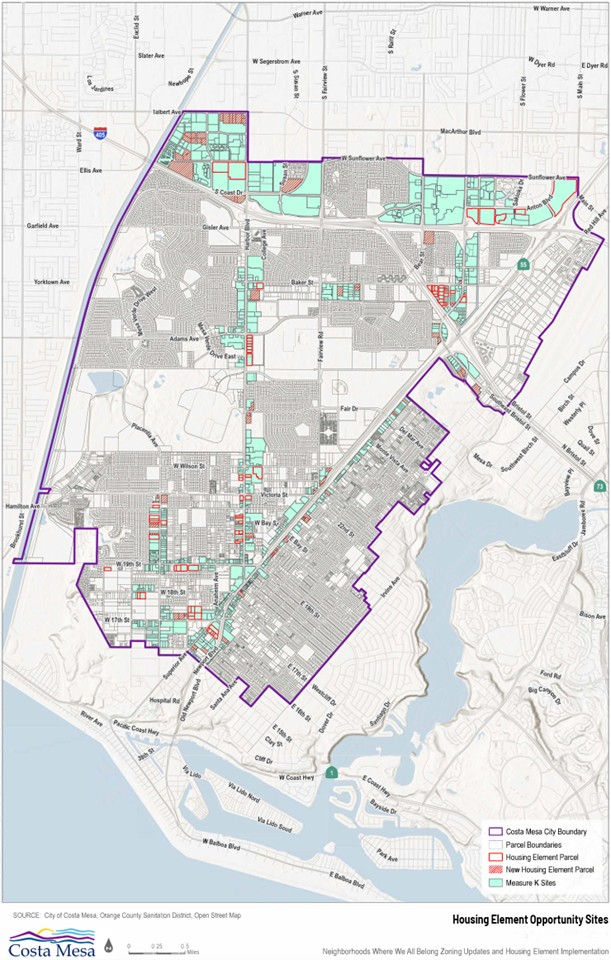
Zich questioned the relationship between SCAG's population forecasts and the City's planned housing capacity, as well as how RHNA affordable housing allocations are determined. Staff explained that RHNA allocations are based on a regional methodology developed by SCAG and are not directly tied to existing income distributions or population projections.
A significant portion of the discussion focused on open space. Staff confirmed that the Housing Element references a 40% open space standard that existed when it was drafted, but upcoming Measure K implementation zoning changes would allow balconies to count toward required open space citywide. Staff said the change is intended to reduce barriers to housing development while maintaining resident amenities. Zich also requested a clearer site inventory map, a legible copy of the inventory table, and redacted copies of property-owner notification letters.
Martinez focused on site selection criteria, property owner outreach, the status of the draft document, and RHNA compliance. Staff said developer interest, such as a signed letter of intent, pre-application, or active entitlement process, could support inclusion of a Measure K site in the Housing Element inventory. Staff also confirmed that all affected property owners received multiple notifications before sites were added.
Martinez sought assurance that the Commission was reviewing a substantially final document, with only minor revisions expected before City Council consideration. He also identified several technical errors that Staff agreed to correct. Regarding RHNA compliance, staff explained that very-low-income and low-income housing capacity is often tracked together as "lower-income" capacity and that affordability requirements are ultimately determined at the project level.
Andrade focused on the Fairview Developmental Center Specific Plan (FDCSP), educational properties, open space preservation, and concerns about concentrating housing along major corridors. Staff explained that while the Commission previously directed them to study up to 4,000 units at FDCSP, the Housing Element continues to assume 2,300 units because additional capacity would primarily produce above-moderate-income housing and would not help satisfy lower-income RHNA obligations.
Andrade also asked about housing opportunities on college-owned properties and whether developers could contribute to preserving open space. Staff noted that state law creates separate housing opportunities for schools, colleges, universities, and faith-based organizations, and that recent code changes provide more flexibility in how open space requirements can be met.
Regarding concerns about corridor-focused growth, Staff explained that Measure K largely determines which properties may be considered for rezoning and emphasized that Housing Element sites are distributed throughout the city to satisfy Affirmatively Furthering Fair Housing (AFFH) requirements. Staff also noted that only Measure K-designated sites can be rezoned through this process without additional voter approval.
Dickson focused on transparency and the methodology used to calculate housing capacity. He expressed frustration that the Agenda Report lacked simple summary tables showing sites, parcels, and associated unit capacities, making the proposal difficult for commissioners and the public to follow without having to navigate hundreds of pages of supporting documents. AMEN!
Dickson also questioned how capacity estimates were calculated, particularly the required 20% reduction factor used to account for realistic development outcomes. Staff explained that the Housing Element is intended to demonstrate zoning capacity, not predict exactly what will be built. The reduction factor is applied to avoid overstating likely housing production and is supplemented by local knowledge regarding redevelopment potential and developer interest.
Harlan asked which portions of the Housing Element actually guide City actions. Staff responded that Chapter 4 is the operative section because it contains the City's housing programs, RHNA compliance strategy, and implementation commitments. The remaining chapters primarily provide background information, data, and supporting analysis. In practice, Staff explained, Chapter 4 functions as the Housing Element's action plan, while zoning regulations and implementing ordinances govern actual development approvals.
Public Comment: Four speakers provided comments reflecting a range of views on housing development, redevelopment opportunities, and the broader direction of Costa Mesa's planning efforts.
Casey Griffin, representing the Costa Mesa Toyota car dealership, expressed support for housing development and requested a higher residential density designation for a 3.3-acre site near Harbor Boulevard and Adams Avenue. He argued that the current allowance of 30 dwelling units per acre (du/ac) is too low to make affordable housing projects financially viable and noted that nearby developments have been built at higher densities. He emphasized the property owner's desire to participate in the City's housing efforts and willingness to work with Staff on a feasible project.
Jay Humphrey asked whether the recently vacated Nissan dealership property and an adjacent vacant gym site were being considered as Housing Element opportunity sites. He sought to clarify misconceptions about how Measure Y interacts with state housing mandates and affordable housing requirements, particularly regarding when voter approval is required for redevelopment projects. He noted that affordable housing projects are exempt from Measure Y voting requirements.
Cynthia McDonald criticized the evolution of the Housing Element and Measure K process, arguing that it has moved away from the vision originally presented to voters. I stated that key planning work, including infrastructure, fiscal, and environmental analysis, remains incomplete and expressed concern that planning decisions are increasingly driven by project-specific rezonings rather than a comprehensive community vision. Citing the Environmental Impact Report (EIR) prepared for the Housing Element and Measure K rezoning, she urged the Commission to support the environmentally superior Alternative B (Housing Element Only) approach rather than the broader rezoning framework associated with Measure K.
Anna Mendoza, speaking on behalf of PLC Communities, formally requested that 2148 Newport Boulevard be added to the Housing Element site inventory. She stated that the site is surrounded by existing and proposed housing developments, making it an appropriate and logical location for future residential development.
Further Commissioner Questions and Comments. Andrade asked about public comments requesting higher housing densities on some Harbor Boulevard properties, particularly sites currently designated at 30 dwelling units per acre, with owners arguing that densities closer to 90 units per acre are needed to make affordable housing projects financially feasible.
Staff explained that the specific property at 2850 Harbor Boulevard is a Measure K site but not a Housing Element site, and the Environmental Impact Report studied it at 30 units per acre. Staff noted that increasing the density at this stage could require additional environmental review, but alternative pathways may be available. These include utilizing the State Density Bonus Law and other state housing programs that can allow greater density in exchange for affordability commitments. Staff indicated a willingness to continue working with the property owner to identify a feasible housing project.
Andrade also asked about a request from McCray Properties to add a parcel to the Housing Element inventory. Staff responded that some of the requested parcels are not Measure K sites, putting them in the same situation as other property owners seeking inclusion outside the Measure K framework. Staff noted that they have previously communicated with the property owner regarding sites already included in the Housing Element.
Motion. Andrade moved to approve the item, with Martinez seconding. Andrade said she appreciated Staff’s efforts. Martinez requested two amendments to the motion: that Staff is directed to incorporate minor revisions in response to the comments by HCD and the public, and to request that Staff meet with Mr. Griffin about the property on Harbor Boulevard.
After the meeting, Development Services Director Carrie Tai came down from the dais and approached Mr. Griffin. I knew that the designation of 30 du/ac was going to be a problem with developers because there are no elevators manufactured for three-story buildings. However, if the City Council decides to increase the density to 40 du/ac, a new EIR will need to be prepared to report on the new or increased impacts and any mitigation required.
Martinez went on to thank Staff and then espouse his hope and belief that this will be the magic wand that solves all the City’s problems and gets us a compliant Housing Element.
Zich spoke about why he would not be supporting the motion. He argued that the City has spent years responding to changing state requirements, comparing the process to Groundhog Day. He expressed concerns about RHNA allocations, shifting state mandates, and the continuing changes to the Housing Element inventory. He also questioned whether the Commission was being asked to act on a document that remained in flux and renewed his criticism that Measure K's promises regarding neighborhood protection, affordability, environmental stewardship, local control, and economic revitalization have not been fulfilled.
Dickson stated that he supports achieving a certified Housing Element but opposed forwarding a document that remained subject to revision and unresolved questions. He suggested a brief continuance could have addressed remaining concerns and warned that the City's pursuit of housing goals should not come at the expense of community character, open space, small businesses, and overall quality of life.
Harlan acknowledged those concerns but concluded that the document was sufficiently complete to move forward. Noting the unusual complexity of the Housing Element process, he cautioned against allowing "the perfect to be the enemy of the good" and emphasized that the City Council would ultimately make the final policy decisions.
Vote. The motion carried 5-2 with Vice-Chair Zich and Commissioner Dickson voting “No.”
OLD BUSINESS: None.
NEW BUSINESS: One Item: Study Session to Introduce (1) Proposed Measure K Zoning Code Amendments, Citywide Multi-Family Residential and Mixed-Use Objective Design Standards, (2) Proposed Repeal of Urban Plans, (3) Amendments to Circulation, Community Design, Land Use, Noise, and Open Space and Recreation Elements of General Plan, and (4) Amendments to Newport Boulevard Specific Plan, North Costa Mesa Specific Plan, and One Metro West Specific Plan. The Planning Commission held a study session on a comprehensive package of zoning, General Plan, and specific plan amendments intended to implement the City's Housing Element and Measure K through the "Neighborhoods Where We All Belong" initiative.
Background. Following adoption of the Housing Element and voter approval of Measure K in 2022, the City began a two-phase rezoning effort:
Path 1 (completed in 2025): Rezoned Housing Element sites through the Mixed-Use Overlay District (MUOD).
Path 2 (current phase): Addresses remaining Measure K sites, updates development standards, adopts objective design standards, and amends the General Plan and several specific plans.
Key Components:
Mixed-Use Overlay District (MUOD). Staff proposed a complete restructuring of the MUOD to:
Eliminate the existing Urban Plans and incorporate their regulations directly into the Zoning Code.
Simplify and modernize development standards.
Encourage mixed-use neighborhoods that combine housing, employment, shopping, services, and open space.
Development Standards. The proposed MUOD includes:
Residential densities ranging from approximately 20 to 90 dwelling units per acre, depending on location.
Building heights generally up to 60 feet, with additional height allowances in certain higher-density areas.
Revised setback standards designed to create more pedestrian-oriented streets.
New open-space requirements incorporating private, shared, and publicly accessible open space.

Parking and Infrastructure. A significant proposal is the elimination of minimum parking requirements within the MUOD. Developers could determine parking supply based on project needs and market demand. Projects would still be subject to traffic, noise, environmental, and infrastructure impact reviews.
General Plan and Specific Plan Amendments. Staff proposed amendments to the:
Land Use
Circulation
Community Design
Noise
Open Space & Recreation
along with elements of the General Plan, as well as the:
Newport Boulevard Specific Plan
North Costa Mesa Specific Plan
One Metro West Specific Plan
The goal is to align these documents with the updated MUOD while preserving existing development rights.
Zoning Code Updates. The proposal includes amendments to 19 sections of the Zoning Code, including:
Removal of outdated Urban Plan references
Updated definitions and development procedures
Revisions to ADU and Density Bonus regulations
New condominium conversion standards
Reorganized land-use tables
Adoption of citywide objective design standards
Objective Design Standards. New citywide standards for multifamily and mixed-use projects are intended to comply with state housing laws while providing more predictable project review. Proposed standards address:
Building massing and façade design.
Upper-story setbacks near residential neighborhoods.
Ground-floor design features such as porches and stoops.
Internal streets, pedestrian connections, parking placement, and open-space design.
Environmental Review. Staff also summarized the draft Program Environmental Impact Report (PEIR), which evaluates the long-term impacts of the proposed land-use changes through 2056. While Housing Element projects remain largely exempt from CEQA under state law, the PEIR evaluates broader citywide impacts of the initiative. A final PEIR has now been released.
Next Steps:
September: City Council consideration of the Airport Land Use Commission override and Planning Commission review of revisions.
October: City Council consideration of the full "Neighborhoods Where We All Belong" implementation package.
Commissioner Questions. Commissioners focused on several recurring themes, including environmental impacts, parking policy, open space, public outreach, property owner rights, and the practical implementation of the proposed Mixed-Use Overlay District (MUOD).
Zich focused on environmental review, parking, urban design standards, and the project timeline. He questioned whether significant impacts identified in the Program EIR could meaningfully affect future decisions or would simply be acknowledged and accepted. Staff explained that the Program EIR evaluates impacts at a citywide planning level, while project-specific traffic, noise, environmental, and site assessments will occur when individual development proposals are submitted.
He also expressed concern about eliminating residential parking minimums and the potential for spillover parking. Staff responded that the change applies only to residential uses within mixed-use projects and that parking issues would continue to be addressed on a case-by-case basis. He further questioned the rationale for proposed standards such as the 20-foot maximum setback requirement. Staff said the standard reflects both modern planning practices that promote walkable environments and feedback received through the Neighborhoods Where We All Belong outreach process.
Finally, Zich questioned whether the aggressive schedule leading to City Council consideration in October allowed sufficient time for additional public review and discussion. Staff said they hoped to stay on schedule but did not identify a hard deadline.
Dickson focused on public outreach, publicly accessible open space, and the relationship between the MUOD and existing specific plans. He sought greater transparency regarding public comments received during the outreach process and asked how privately owned but publicly accessible open spaces would function in practice, including questions about maintenance, liability, security, and permitted activities.
Staff explained that detailed outreach records are available in project appendices and that publicly accessible open spaces would remain privately owned and managed while being required to remain open to the public. Staff also emphasized that participation in the MUOD would generally be voluntary for property owners within existing specific plan areas and that property owners could choose whether the overlay's provisions were beneficial to their properties.
Martinez focused on technical implementation issues, including MUOD applicability, townhome design standards, off-site improvement requirements, land-use regulations, and setback requirements. He questioned language suggesting the overlay supersedes underlying zoning, noting that many property owners would have the option to elect whether to use the MUOD. Staff agreed that the language could be clarified.
Martinez also questioned several proposed development standards, including the requirement to break attached townhomes after six units, mandatory off-site improvements, theater-use regulations, and upper-story setback requirements near residential neighborhoods. Staff explained that many of these standards were carried forward from existing regulations, City Council direction, or long-standing design guidelines, while acknowledging that some provisions remain under review and may be refined before adoption.
Overall, commissioners generally sought reassurance that the proposed regulations would maintain neighborhood quality, remain understandable and transparent, and provide adequate flexibility to accommodate future development while implementing the City's Housing Element and Measure K goals.
Public Comment: Casey Griffin (South Coast Toyota) clarified that South Coast Toyota will remain at its current location and undergo a remodel to comply with Toyota's Image 2 standards. He noted that the former adjacent Nissan dealership has relocated nearby on Baker Street, creating an opportunity to redevelop the 2850 Harbor Boulevard property under Measure K. Griffin expressed concern that proposed design requirements, including setbacks and other site standards, could reduce achievable housing density below the planned 30 units per acre. He encouraged the City to evaluate the cumulative effect of the standards on development potential and cited a yield study showing significant housing capacity on the site.
George Sakioka (Sakioka Company) expressed optimism about Costa Mesa's future and highlighted his family's long-standing commitment to the city. He said the Sakioka Company is actively planning for residential development in North Costa Mesa and has partnered with developer Wilson Meany and design firm Hart Howerton. Sakioka voiced strong support for the proposed code revisions, describing them as thoughtful, housing-focused, and design-oriented. While he identified several concerns with specific provisions of the Mixed-Use Overlay District and objective design standards, he noted that discussions with Staff have been productive and constructive.
Chris Meaney (Wilson Meany) described the firm's goals for the Sakioka property as creating a high-quality residential neighborhood, helping meet state housing requirements, and establishing a lasting legacy for the Sakioka family. He requested additional flexibility in the proposed standards, particularly regarding open space requirements and street design standards, including the proposed 60-foot street width. Meaney argued that greater flexibility would better support walkable, pedestrian-oriented neighborhoods and help large projects achieve the housing production levels envisioned by the City and State. He thanked Staff for their collaboration and said that detailed project plans will be presented in the future.
Commissioner Comments. The Commissioners generally supported the proposed amendments but recommended a number of refinements to improve flexibility, clarity, and neighborhood compatibility.
Martinez focused on implementation details within the MUOD and objective design standards. He supported clarifying overlay zoning language, reconsidering the six-unit limit for attached townhomes, and increasing densities in certain non-Housing Element areas, particularly along Harbor Boulevard. Martinez also questioned whether some commercial uses should require conditional use permits, suggested aligning traffic study requirements with existing City thresholds, and expressed concern that overly prescriptive design standards could increase costs and limit design flexibility. He supported greater flexibility for private streets, circulation standards, and commercial operating hours, while recommending reliance on existing state bicycle parking requirements.
Dickson emphasized the importance of preserving flexibility for large, well-designed projects that may not fit conventional zoning standards. He urged Staff to keep traffic and parking concerns at the forefront of the regulations, noting that parking remains one of the most frequent quality-of-life complaints raised by residents. Dickson supported maintaining meaningful open space, setbacks, and neighborhood buffers, and cautioned against standards that could diminish residential livability or reduce usable open space. He stressed that future development should balance housing production with quality-of-life considerations, including privacy, light, air, parking convenience, and neighborhood character.
Harlan agreed that densities on some non-Housing Element sites should be revisited to better align with adjacent Housing Element properties and create more consistent development patterns. He also encouraged Staff to reevaluate the Newport Boulevard Specific Plan, questioning whether some of its policies and implementation measures remain relevant today. Harlan noted the area's shift toward more pedestrian-oriented, neighborhood-focused development and suggested removing outdated provisions that no longer serve a meaningful planning purpose.
Overall Themes. Several common themes emerged from the Commission's discussion:
Strong support for the City's housing and mixed-use planning efforts.
Interest in providing greater flexibility for larger projects while maintaining high-quality design standards.
A desire to balance housing production with neighborhood compatibility and livability.
Continued concerns regarding parking, traffic, open space, setbacks, and implementation of development standards.
Support for modernizing outdated planning documents and regulations to better reflect current development goals and community needs.
Motion and Vote. Martinez moved to receive and file the item, which was seconded by Dickson. The motion passed unanimously, 7-0.
This item returned to the Planning Commission on September 14. You can read our special report about that meeting (and its surprise ending) by going here.


Comments