COSTA MESA CITY HALL UPDATE FOR SEPTEMBER 2026: THOUSANDS OF FUTURE HOUSING UNITS MOVE FORWARD AS RESIDENTS RAISE CONCERNS
Growth, Surveillance, and Local Control: The Issues Shaping Costa Mesa's Future
We attended a bunch of meetings in September, some with surprises!
We have already written about the September 14 Planning Commission meeting and the September 15 City Council meeting. Our special report can be found here.
Here is a summary of the activity at City Hall in September:
Council, Commission and Committee Meetings:
City Council: Two additional meetings were held, including a Study Session
Planning Commission: One more meeting was held
Pension and Finance Committee: One meeting was held, but we were unable to attend
Here’s our report:
SEPTEMBER 1 CITY COUNCIL MEETING. At this meeting, five items were acted on:
Continuation Request—Appeal Of Planning Commission Decision to Uphold Denial of Reasonable Accommodation Request for Sober Living Home Operated by The Ohio House
General Plan Amendment: Housing Element Changes, Including Addition of Environmental Justice Policies
Resolution of Intent to Overrule Airport Land Use Commission’s Inconsistency Determination for the Measure K Zoning Updates and Housing Element Implementation
Second Reading of Ordinance Updating Non-Residential Land Use Classifications and Development Standards
Successor Labor Agreements and Compensation Updates for City Labor Groups
All Councilmembers were present.
City Attorney Closed Session Report. Kimberly Hall Barlow reported that there was direction given and no reportable action taken either. She reminded the Councilmembers to make disclosure when the last item on the Agenda was heard.
Presentations: The City Council recognized the Newport-Mesa Girls Softball 12U Silver All-Star Team for an outstanding season and postseason. A proclamation recognizing Hunger Action Month 2026 was read.
Public Comment. Seven members of the public addressed the Costa Mesa City Council on a range of issues, with the dominant theme being opposition to Flock surveillance technology, with speakers emphasizing privacy, transparency, civil liberties, government accountability, and public participation. Other comments focused on environmental concerns at Fairview Park, support for arts funding and culture, and a local business dispute involving waste collection services.
Opposition to Flock Surveillance Cameras. Multiple speakers urged the City Council to terminate the Flock contract, citing concerns about privacy, transparency, and government surveillance. Key concerns included:
Growing bipartisan opposition to Flock and AI-powered surveillance systems.
References to state and federal officials who have restricted, criticized, or investigated ALPR technology.
Lack of transparency, including the City's refusal to release Flock audit logs and related public records.
Claims that only a small percentage of vehicle scans are linked to criminal investigations, while data on law-abiding residents is retained and searchable.
Concerns regarding the accuracy and reliability of vehicle identification results.
Allegations that the City did not provide adequate opportunities for public input before implementing the program.
Concerns about misuse of data by law enforcement or outside agencies.
Claims that cybersecurity vulnerabilities could expose police vehicle locations and officer activity.
Concerns that expanded surveillance infrastructure could be used to support broader government monitoring programs.
General request: Speakers asked the City Council to end the City's contract with Flock.
Fairview Park Fly Field. A resident urged the City Council to relocate or suspend operations at the Fairview Park fly field, citing ongoing environmental impacts and the lack of action despite prior direction and recommendations. Key concerns included:
Multiple agencies and stakeholders have previously recommended relocating the fly field.
The draft Fairview Park Master Plan identifies relocation as appropriate, yet operations continue at the current location despite concerns about environmental damage.
Questions about why the City continues to permit use of the site after the agreement with Harbor Soaring Society expired.
A request for immediate action to cease use of the current location before adoption of the Fairview Park Master Plan Update.
Support for Arts and Cultural Investment. A local business owner and founder of the Songs in the Canyon music festival spoke in support of increased investment in arts and culture. Key points included:
Appreciation for the City's support of community arts events.
Support for increased funding for arts programs and artist grants.
The view that arts investment can strengthen community identity and boost economic activity.
Interest in participating in future arts planning efforts, particularly on the Westside.
Ware Disposal Service Complaint. A local business owner requested assistance and raised concerns about ongoing disputes with Ware Disposal. Key issues included:
Difficulty obtaining responses from the company despite repeated emails and phone calls.
Continued billing after service had allegedly been canceled, uncashed payments, and unresolved account issues.
Public Participation Concerns. One speaker criticized how a previous Council meeting was conducted, particularly regarding public testimony on Flock cameras. Concerns included:
Reduction of speaking times late in the meeting after residents had waited several hours.
A perception that City Councilmembers had already made up their minds before hearing public comments.
Frustration that public opposition appeared to have little influence on the Council's decision-making process.
Councilmember Comments. Jeff Pettis (District 6) reflected on the approaching 25th anniversary of the September 11 attacks, expressing concern that the significance of that day could fade over time. He also reminded the public about an upcoming community meeting at the Norma Herzog Community Center, where Mayor Stephens would discuss issues related to the Fairview Developmental Center property. Pettis encouraged residents to attend, ask questions, and share their perspectives, noting that he would be there as well.
Mike Buley (District 1) highlighted several community events and initiatives he attended over the weekend. He praised the Family Forward gala, recognizing the organization's work assisting families facing housing instability and other crises.
Buley commended the Costa Mesa Historical Society for its efforts to preserve and promote the city's history. He attended multiple Historical Society events, including a community gathering at the Diego Sepúlveda Adobe and the organization's gala, and noted that their programs consistently provide valuable educational opportunities and deepen appreciation for Costa Mesa's development and heritage.
In addition, Buley encouraged the City to explore using artificial intelligence to improve government efficiency. He referenced a pilot program in Laguna Beach that uses AI-assisted software in planning and permitting reviews, reportedly reducing review times and speeding permit processing. He suggested Staff investigate the program, evaluate its results, and consider whether similar technology could help Costa Mesa streamline permitting, support business activity, and improve city operations.
He concluded by asking Staff to monitor developments in AI-driven permitting technologies and explore potential opportunities for Costa Mesa to benefit from related pilot programs or best practices.
No. Thank. You. I do not want my personal information given to a bot that, because our IT Staff may not be monitoring it closely, distributes it everywhere on the web, including the darkest of places on the web. No. Thank. You.
Loren Gameros (District 2) reminded residents about available cooling centers during the recent heat wave and encouraged anyone experiencing heat-related illness to seek assistance.
He highlighted upcoming improvements at Ketchum-Libolt Park, including a new playground, public art and poetry installations, and an upcoming grand opening. He noted the park's significance as a memorial to police officers who lost their lives in service.
Gameros also reflected on her personal experience during the September 11 attacks, urging residents to remember the lives lost and the lasting impact of 9/11 on the nation.
Andrea Marr (District 3) highlighted the positive impact of Love Costa Mesa and its partnerships with local churches and the City. She described a recent meeting with a delegation from Australia that came to learn about the organization's community-service model, noting that Costa Mesa's collaborative approach is gaining international attention and may help inspire a future global conference of similar nonprofits.
Marr also shared updates from a recent tour of the City's homeless shelter, praising the facility's condition, new programming, and the efforts of its new operator. She noted that it was encouraging to see improvements at the shelter and recognized volunteers who support its work.
She congratulated the Costa Mesa Historical Society on its successful 60th anniversary celebration and community contributions.
Marr requested an update on negotiations regarding amendments to the Flock contract, stating that she would like the matter brought back to the council soon and that the public deserves an update on the status of discussions.
She also expressed interest in revisiting the City's ethics policy before the current Council's term ends. In particular, she emphasized the need for greater transparency regarding conflicts of interest and campaign contribution rules under state law. Marr suggested creating a public tracking system to identify when elected officials may be required to recuse themselves due to campaign donations or other financial interests, arguing that residents should have clearer visibility into how financial relationships may affect council votes.
She concluded by offering to follow up with a resident who had raised concerns regarding Ware Disposal.
Arlis Reynolds (District 5) supported bringing back an updated Flock agreement and requested updates on audit log public records requests and other transparency-related matters.
She recognized Hunger Action Month, thanked Second Harvest Food Bank for its work in Costa Mesa, and encouraged the city to share information about food assistance and volunteer opportunities. She also urged greater public outreach about cooling centers and other resources during periods of extreme heat.
Reynolds congratulated the Costa Mesa Historical Society on its 60th anniversary celebration, highlighting diversity as one of Costa Mesa's greatest strengths and expressing support for reviving the historic Fish Fry Parade.
She requested an update on the Safe Routes to School project, citing community interest in traffic-calming measures and school safety. She asked that the council and public receive a progress report, potentially in October, on efforts to improve walking, biking, and driving safety around schools.
She promoted upcoming community events, including the Historical Society's bicycle tour and Costa Mesa Night with the Orange County Soccer Club, which will benefit local youth sports programs.
Manuel Chavez (District 4) welcomed local high school students attending the meeting as part of a class assignment and congratulated Costa Mesa High School on its recent football victory over Bellflower High School. He encouraged residents to attend the final community outreach meeting for Shalimar Park scheduled for the following evening to learn about the project and share their vision for the park's future.
John Stephens (Mayor) expressed support for exploring the use of artificial intelligence in City operations, noting that many cities are already testing AI tools and that Costa Mesa can learn from their experiences before implementation.
He promoted upcoming community events, including a fundraiser for Bracken's Kitchen, praised the Costa Mesa Historical Society for its successful 60th anniversary celebrations, and encouraged residents to attend local 9/11 remembrance ceremonies at Costa Mesa fire stations.
He concluded by adjourning the meeting in memory of Beth Refrakes, a longtime Costa Mesa resident, community advocate, Historical Society volunteer, and supporter of veterans and military families. He honored her many contributions to the city and offered condolences to her family and friends. He also recognized Dolly Parton's recent passing, noting the significance of her mural in Costa Mesa and her support for the LGBTQ+ community, and included her in the meeting's adjournment.
City Manager Comments. Cecilia Gallardo-Daly provided updates on Measure C, directed residents to the city's website for information, including a fact sheet and FAQs about the ballot measure.
She also recognized National Preparedness Month, encouraging residents to review the city's updated Emergency Preparedness Guide, available in English and Spanish, and to sign up for AlertOC, the county's emergency notification system. She highlighted the upcoming countywide AlertOC test on September 16.
Finally, she announced that Hoon Jo, a Programmer Analyst in the IT Department, was selected as the city's August Employee Leadership Award recipient. Gallardo-Daly praised his GIS expertise, mapping skills, and contributions to city departments since joining Costa Mesa in 2020, and congratulated him on the recognition.
City Attorney Comments. City Attorney Kimberly Hall Barlow had no report.
Before continuing to the Consent Calendar, the Mayor requested that Old Business Item 1, Second Reading of Ordinance Updating Non-Residential Land Use Classifications and Development Standards, be heard before the Public Hearings. None of the other Councilmembers objected.
CONSENT CALENDAR. Item 6, the CalTrans Sustainable Transportation Planning Grant, was pulled by Reynolds. The remaining items were moved for approval by Chavez, which was seconded by Marr. That motion passed unanimously, 7–0.
Reynolds praised the city's progress since adopting its Active Transportation Plan in 2018 and welcomed the Caltrans grant that will fund an update to the plan. She highlighted the need to address emerging transportation trends, including increased e-bike use, community programs like bike buses, and improvements to public transit infrastructure.
Reynolds also thanked Caltrans for its nearly $300,000 grant award and acknowledged the agency's growing partnership with Costa Mesa on safe streets and complete streets initiatives. She said the update presents an important opportunity to build on past successes and continue improving transportation safety and mobility throughout the city.
Public Comment. None.
Motion and Vote. Reynolds moved to approve the item, and it was seconded by Stephens. The motion passed unanimously, 7–0.
OLD BUSINESS: There was only one item:
1. Second Reading of Ordinance Updating Non-Residential Land Use Classifications and Development Standards. Martina Caron, Planning Manager, presented the item. She said that the ordinance updates and clarifies Costa Mesa's municipal code for various commercial and non-residential land uses, including personal services, artisan studios, entertainment venues, event centers, and fitness uses. The ordinance was unanimously introduced by the City Council on August 4 and received unanimous approval recommendations from the Planning Commission.
There were no questions from the Councilmembers and no comments from the public. A motion to approve the item was made by Chavez and seconded by Reynolds. The motion passed unanimously, 7–0.
PUBLIC HEARINGS: There were three public hearings:
1. Continuation Request—Appeal Of Planning Commission Decision to Uphold Denial of Reasonable Accommodation Request for Sober Living Home Operated by The Ohio House. The public hearing was opened, but no one from the public wished to comment. A motion was made by Marr to continue the item until October 20, which was seconded by Chavez. The motion passed unanimously, 7–0.
2. General Plan Amendment: Housing Element Changes, Including Addition of Environmental Justice Policies. Anna McGill, Advanced Planning Manager, and Michelle Halligan, Senior Planner, presented a proposed Housing Element amendment to maintain Costa Mesa’s required RHNA housing capacity after property owners requested the removal of 28 housing sites and the addition of 14 new sites, partly due to a court ruling that changed requirements for mixed-use overlay districts.
The Mixed-Use Overlay District raises an important question about how Measure K will be implemented. By granting broad development entitlements now, many future projects may proceed with less project-specific public review than residents might expect. If community involvement was a central promise of Measure K, residents should carefully examine whether these overlays preserve meaningful opportunities for future input.
The amendment identifies 95 new housing opportunity sites with capacity for 6,996 units, updates Housing Element policies and environmental justice provisions, and maintains sufficient housing capacity across income categories while supporting state certification requirements.
Following public outreach and revisions based on California Department of Housing and Community Development (HCD) feedback, the HCD preliminarily determined the Housing Element meets state requirements, and Staff recommended City Council approval so the City can pursue certification and remain compliant with state housing law.
Councilmember Questions. Councilmembers spent nearly an hour asking questions of Staff about the Housing Element changes.
Pettis focused on the RHNA buffer and Environmental Justice (EJ) policies. Staff said the recommended 10-20% buffer is not required by state law but is strongly encouraged by HCD and helps the City remain compliant when projects are built differently than anticipated. Pettis also asked about EJ policies; Staff said 15 are existing policies and one new policy was added to strengthen outreach in EJ communities. Staff advised that separating the EJ policies from the Housing Element amendment could delay certification and require additional General Plan amendments.
Buley asked how the buffer works in practice, the impact of the court ruling that led property owners to withdraw Housing Element sites, and whether Staff evaluated the economic feasibility of replacement sites. Staff explained that the City uses an 80% realistic-capacity assumption based on historical development trends and that the buffer prevents frequent Housing Element amendments. Buley also questioned the link between the Housing Element and the Fairview Developmental Center (FDC) project. Staff stated that the Housing Element assumes 2,300 units at FDC, including 920 affordable units, and that a lower-density FDC plan would likely require another Housing Element amendment. He also discussed housing-related litigation and the risks of noncompliance, citing Huntington Beach's experience.
Marr focused on affordable housing production. She questioned how the City could realistically meet its RHNA requirement for roughly 5,000 low- and very low-income units and expressed concern that developers can obtain density bonuses while producing relatively few affordable units. Staff acknowledged that matching RHNA affordability assumptions with actual development is challenging statewide. Marr also raised concerns about the City's inclusionary housing ordinance, and Staff said a comprehensive review is planned for 2027.
Reynolds asked about ADU production, Housing Element sites, and affordable housing incentives. Staff reported that the City is ahead of projections on ADU permits, allowing higher ADU assumptions for the remainder of the planning period. Staff also confirmed that most sites removed from the Housing Element remain eligible for development under Measure K and the Neighborhoods Where We All Belong (NWWAB) framework. Reynolds also asked about incentives such as reduced fees and streamlined approvals, which Staff said are being developed through the NWWAB process and a state REAP grant.
Stephens asked broader questions about California's housing system, including whether RHNA-style housing planning is unique to California. Staff said other states have increasingly adopted similar housing-planning tools, though generally less aggressively. Staff acknowledged that California has historically not produced enough housing, which is one reason the current RHNA cycle is much larger than previous cycles.
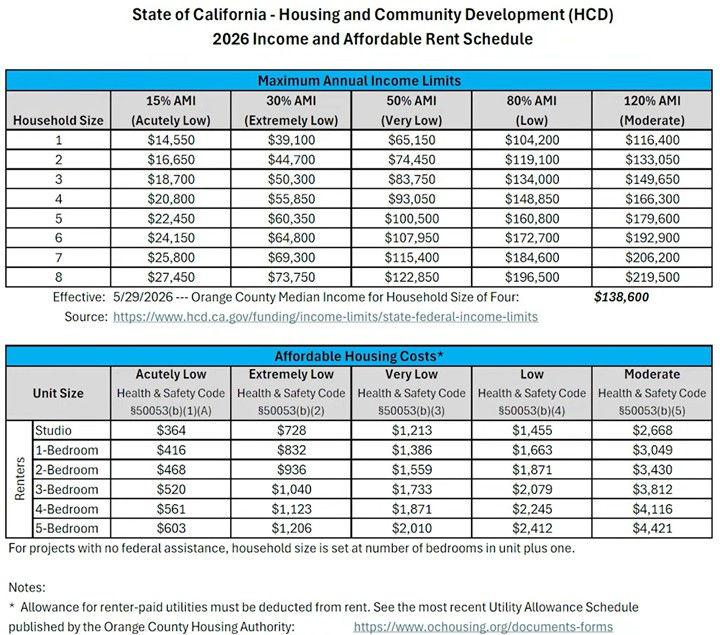
Chavez sought clarification on what terms like "affordable," "low income," and "moderate income" mean in practice. Staff explained that affordability categories are based on Area Median Income (AMI) thresholds established by the state. Chavez also asked who qualifies for affordable housing and whether the City has data connecting local household incomes to RHNA categories. Staff pointed to Housing Element demographic and fair-housing analyses that show income distributions across Costa Mesa and help guide housing planning.
This was not displayed at the meeting, but here is a chart showing how the State of California determines affordability in Orange County:
Public Comment. Public comment reflected a divide between residents who supported the Housing Element amendment as a necessary step toward addressing housing affordability and maintaining state compliance, and those who raised concerns about density, building heights, infrastructure, environmental impacts, parking, open space, and the long-term effects of growth on Costa Mesa's character.
Supporters, including Aaron Clem, Kathy Esfahani, Diane Russell, Steve and Maria Dezita, and Christine Nolf, urged the Council to approve the amendment. They argued that additional housing is needed for teachers, nurses, service workers, seniors, young adults, artists, and others who are increasingly priced out of Costa Mesa. Several speakers also supported a more walkable, transit-oriented, mixed-income future for the city.
Some supporters also called for stronger affordable housing requirements, arguing that the City's inclusionary housing ordinance is too weak, noting that projects under 50 units are exempt and affordable housing requirements remain modest compared to other Orange County cities.
Opponents and skeptics focused less on housing production itself and more on how growth is being managed. Jay Humphrey questioned increased densities, building heights, and the loss of open space. Rick Huffman argued that public outreach and long-term planning have been inadequate, while I raised concerns about cumulative environmental impacts, infrastructure demands, parking, traffic, and public services.
Annie McRae, representing a longtime Costa Mesa property-owning family, thanked Staff for their work but expressed concern that one of her family's properties was excluded from Measure K planning despite surrounding properties being included. She requested additional opportunities to participate in future housing and mixed-use development efforts.
Attorney Ugochi Anaebere Nicholson, speaking on behalf of disability-rights and public-interest organizations, opposed adoption of the Housing Element in its current form. She argued that several housing programs affecting people with disabilities remain legally deficient and urged the Council to revise those provisions before approval.
Motion, Comments and Vote. Marr moved to approve the Planning Commission recommendation; that motion was seconded by Stephens.
Before the vote, Councilmembers largely praised staff for navigating a lengthy and complex process shaped by state mandates, litigation, the Fairview Developmental Center, Measures Y and K, and changes in housing law.
Marr thanked Staff and affordable housing advocates for their years of work, noting that while the process has been difficult and imperfect, the City needs to move forward. She suggested future councils may revisit issues such as Measure K boundaries and the inclusionary housing ordinance.
Stephens praised Staff and acknowledged that, while he has reservations about the state's housing framework, approving the amendment is the best path available. He reflected on how housing affordability challenges have changed public attitudes toward housing growth in Costa Mesa.
Buley criticized California's housing mandate system as overly complicated and burdensome on local governments. While expressing concerns about impacts on neighborhood character, open space, and local control, he said the City is effectively required to comply and would support the item.
Chavez took a pragmatic view, arguing that regardless of opinions about state housing policy, Costa Mesa must work within the system it has been given. He emphasized the need to create housing opportunities for younger residents and future generations who are increasingly priced out of the city.
Reynolds highlighted the diverse perspectives expressed throughout the process and said Costa Mesa's housing affordability challenges are real. She expressed optimism that expanding housing choices, while continuing to plan for transportation, open space, and community amenities, will help maintain Costa Mesa as an inclusive and desirable place to live.
Gameros said that while the plan may not be perfect, inaction is not an option. He emphasized that the amendment creates opportunities for working families and future generations.
The motion passed unanimously, 7-0.

3. Resolution of Intent to Overrule Airport Land Use Commission’s Inconsistency Determination for the Measure K Zoning Updates and Housing Element Implementation. Senior Planner Michelle Halligan presented a resolution initiating the process to overrule the Orange County Airport Land Use Commission (ALUC) determination that portions of the City's Measure K/Neighborhoods Where We All Belong (NWWAB) zoning updates and Housing Element implementation are inconsistent with the Airport Land Use Plan.
Staff explained that NWWAB implements more than 20 Housing Element programs, including applying a revised Mixed-Use Overlay District (MUOD) to Measure K sites. In July 2026, ALUC found parts of the proposal inconsistent with airport land-use policies related to noise and safety zones.
In response, the City modified the proposal by removing MUOD applicability from certain Measure K properties located within more restrictive airport safety and noise zones. However, Staff did not recommend changes in areas where state airport planning guidance allows residential development or where height concerns involve existing zoning provisions rather than the proposed overlay.
Staff emphasized that ALUC is an advisory body and that state law allows the City Council to overrule an inconsistency determination through a formal process requiring a two-thirds vote, followed by a 45-day waiting period before a final overrule hearing.
Staff recommended that the Council adopt a resolution declaring its intent to overrule ALUC's determination, direct Staff to notify ALUC, and schedule a public hearing at least 45 days later to consider the final overrule.
Councilmember Questions. None.
Public Comment. None.
Motion and Vote. Chavez moved to approve Staff’s recommendation, seconded by Marr. The motion passed unanimously, 7-0.
NEW BUSINESS: There was one item:
1. Successor Labor Agreements and Compensation Updates for City Labor Groups. Before the hearing to consider approval of successor Memoranda of Understanding (MOUs) between the City of Costa Mesa and four employee bargaining groups: the Costa Mesa Police Association, Police Management Association, City Employees Association (CMCEA), and the Confidential Unit, along with related salary resolutions and annual compensation updates, Stephens asked councilmembers to disclose any communications they had with bargaining-unit representatives during negotiations. Most Councilmembers reported no communications. Reynolds disclosed an inadvertent but lengthy conversation with the head of the City Employees Association that did not involve contract discussions. Chavez and Buley reported meeting with representatives of the City Employees Association, including a breakfast meeting.
Following the disclosures, Human Resources Manager Kasama Lee presented new two-year labor agreements (July 1, 2026 through June 30, 2028) for the City's four bargaining units: the Costa Mesa Police Association (CMPA), Police Management Association (CMPMA), City Employees Association (CMCEA), and the Confidential Unit.
The agreements were reached following negotiations and ratified by all employee groups. Key provisions include:
Salary increases ranging from 2% for police bargaining units to 3% for City Employees Association members, phased in over the two-year term.
Higher health insurance contributions from the City, reflecting rising healthcare costs and helping employees cover family medical plans.
Police compensation adjustments, including restructuring the police sergeant and lieutenant salary ranges, updating bilingual pay to percentage-based compensation, increasing certain shift and plainclothes assignment pay, and improving overtime and court standby compensation.
City employee benefit enhancements, including increased sick leave accruals, larger compensatory time limits, holiday-pay rollover provisions, and new planning and permitting classifications approved in the budget.
Market-based salary adjustments for several CMCEA classifications, including accounting, engineering, permitting, and purchasing positions, to improve competitiveness and address compensation disparities.
Additional compensation adjustments were also proposed for the Deputy Police Chief, Police Recruit, and Reserve Public Safety Dispatcher classifications.
Staff reported that the estimated fiscal impact is approximately $2.8 million in FY 2026-27 and $3.7 million in FY 2027-28, with additional costs associated with market-based compensation adjustments.
Staff recommended approval of all MOUs, salary resolutions, and compensation updates, stating that the agreements support the City's goals of attracting and retaining qualified employees, strengthening public safety services, and maintaining a high level of service to the community.
Councilmember Questions. None.
Public Comment. None.
Motion and Vote. Gameros moved to approve Staff’s recommendation, seconded by Stephens. The motion passed unanimously, 7-0.
SEPTEMBER 8 CITY COUNCIL STUDY SESSION. All Councilmembers were present, except for Manuel Chavez (District 4). The session focused on the discussion about the future use of Measure Q cannabis tax revenues, including the previously proposed First-Time Homebuyer Program (FTHP) and the City's Housing Trust Fund.
Overview. Anna McGill, Advanced Planning Manager, with assistance from Nancy Suh, Grants Administrator, presented options for the future use of Measure Q revenues allocated to a first-time homebuyer program (FTHP). Staff noted that voters approved Measure Q in 2020, and in 2021 the City Council dedicated 0.5% of Measure Q revenues to the FTHP. Since implementation of the tax, approximately $616,000 has been accumulated, with an additional $242,000 projected this fiscal year. Staff explained that previous analysis found the funding level insufficient to fully implement the proposed program.

The presentation also reviewed the pilot FTHP introduced in June, including eligibility criteria, grant amounts, housing types, residency requirements, and application procedures. Staff noted that additional policy direction would be needed if the Council wished to move forward with the program.
Staff then outlined three options for the Measure Q funds: (1) continue the current set-aside and pursue a first-time homebuyer program; (2) redirect the funds to other housing-related purposes, such as rental assistance, alternative homeownership programs, affordable housing development, or the Housing Trust Fund; or (3) return the funds to the General Fund.
Finance Staff also reviewed the Housing Trust Fund, established in 2024 with $2.5 million in ARPA funding, which has supported tenant relocation assistance, housing rehabilitation projects, and the Jamboree senior affordable housing development.
Staff did not recommend a preferred option and instead requested Council direction on whether the funds should remain dedicated to a first-time homebuyer program, be redirected to other housing initiatives, deposited into the Housing Trust Fund, or returned to the General Fund.
Councilmember Questions: Arlis Reynolds (District 5) asked whether the Measure Q housing set-aside is expected to generate about $230,000 annually going forward. Staff said this is the current estimate, noting that cannabis tax revenues have largely stabilized and future growth is expected to come primarily from existing business renewals rather than new operators.
She also asked whether federal HOME and CDBG funds could support homeownership programs. Staff explained that HOME funds may be used for that purpose, but strict income, property value, and administrative requirements make such programs more difficult to administer.
Reynolds observed that the options presented were not necessarily mutually exclusive and asked whether revenues placed in the Housing Trust Fund could later be used for many of the same purposes listed under the alternative housing options. Staff confirmed that the City retains broad discretion over Housing Trust Fund expenditures and could use those funds for affordable housing development, homeownership programs, rental assistance, and other housing-related purposes.
Mike Buley (District 1) clarified that the discussion concerned only the 0.5% cannabis tax set-aside for the FTHP, not the separate arts allocation. Staff confirmed that only the housing-related set-aside was under consideration.
Buley asked how the remaining cannabis tax revenues are used. Staff explained that the other 6% of the City's 7% cannabis retail tax is deposited into the General Fund. He also asked whether the Council could dedicate the housing allocation to other purposes, such as parks or capital projects. Staff responded that doing so would require amending the Measure Q ordinance.
Buley expressed skepticism about the proposed FTHP, arguing that its limited funding would assist relatively few households and that the funds might provide a greater public benefit if directed toward parks, infrastructure, or other community improvements.
Jeff Pettis (District 6) noted that the approximately $842,000 available for the FTHP would benefit only a limited number of households and asked about administrative costs. Staff said most startup work could be handled by City staff, though eligibility verification may require consultant support. Administrative costs would vary by program design, with loan programs requiring ongoing servicing and compliance, while grant programs would be less costly to administer.
Pettis also asked whether redirecting the FTHP's 0.5% Measure Q allocation to another purpose, such as arts funding, would require an ordinance amendment. Staff confirmed that it would. Because Measure Q specifically allocates portions of cannabis tax revenues to both arts funding and the FTHP, any reallocation would require a supermajority vote of the City Council to amend the ordinance.
In a follow-up discussion, Reynolds revisited her earlier suggestion that the City explore partnerships with organizations such as Habitat for Humanity rather than creating a City-run homebuyer assistance program. Staff said the City has previously partnered with Habitat on deed-restricted affordable housing and noted that such partnerships could help create income-restricted homeownership opportunities.
Reynolds recalled prior discussions indicating that an affordable ownership unit might cost roughly $382,000 to build but could be affordable to qualifying households at only about $200,000, leaving a subsidy gap of approximately $200,000 per unit. She suggested that Measure Q revenues could help bridge these gaps and support permanently affordable homeownership opportunities. Staff agreed that funding gaps are a common challenge in affordable housing development and often require multiple funding sources.
She also asked about Habitat for Humanity's affordability model. Staff noted that while homeowners build equity and pay an affordable share of their income, rising costs such as HOA fees, utilities, insurance, and maintenance can affect long-term affordability.
Reynolds suggested that using Measure Q funds to help close financing gaps in permanently affordable homeownership projects could be an effective strategy for expanding housing opportunities in Costa Mesa. Staff agreed that the concept has merit and aligns with challenges identified by affordable housing developers.
Loren Gameros (District 2) recalled a previous City homebuyer assistance program and asked Staff how it operated and whether a similar approach could be considered today. Staff said the City formerly administered a first-time homebuyer assistance program funded through redevelopment resources that provided deferred-payment loans to income-qualified buyers. Repayment was generally deferred until the home was sold or transferred, and approximately seven loans remain active.
Gameros said he remembered an earlier program that provided direct financial assistance rather than loans and asked Staff to research its structure, eligibility requirements, and outcomes. He said lessons from the City's past housing programs could help inform future decisions regarding Measure Q funds.
Public Comment. None.
Councilmember Further Questions and Comments. Reynolds asked whether the City could issue a Request for Proposals (RFP) for affordable homeownership projects using the approximately $800,000 currently available, along with future annual revenues of roughly $230,000, to encourage innovative approaches to affordable homeownership.
Staff responded that they would not discourage an RFP process, noting that open solicitations can generate creative proposals and may identify projects that require only modest funding to become viable. However, Staff cautioned that the available funding level may be too small to attract traditional affordable housing developments, which often require $1.5 million to $2 million or more in local contributions to leverage tax credits and other financing sources.
Staff noted that the Measure Q set-aside was originally intended to support a first-time homebuyer program, but suggested that alternative approaches, including partnerships with affordable housing developers or organizations such as Habitat for Humanity, could also be explored. Staff further explained that lessons from the City's prior homebuyer loan program informed the recommendation to pursue grants rather than loans because of the significant long-term administrative and compliance costs associated with loan servicing.
When asked about projects previously funded through competitive solicitations, Staff cited developments by Jamboree Housing, American Family Housing, the 1400 Bristol project, and several Homekey projects. Staff noted that these developments were substantially larger in scale and received significantly greater public subsidies than the funding currently available for homeownership assistance. Reynolds observed that all of the examples involved rental housing rather than homeownership opportunities.
Buley questioned whether a City-operated first-time homebuyer program would duplicate existing federal, state, and county assistance programs. Staff explained that many jurisdictions operate similar programs, often funded through HOME grants and other housing resources, though assistance amounts and program structures vary considerably. Examples cited included Long Beach, which offers grants of approximately $25,000, and Garden Grove, which provides substantially larger assistance packages.
Buley expressed a preference for grants over loans, citing the administrative burdens associated with long-term loan servicing. Staff agreed, noting that grant programs are generally simpler to administer while still requiring eligibility verification and program oversight.
Marr stated that she was not prepared to provide firm policy direction and believed additional analysis was needed before deciding how to use the funds. She expressed interest in learning more about the Habitat for Humanity model and understanding how affordable homeownership programs function in high-cost housing markets.
Marr noted that Costa Mesa's previous homebuyer assistance program relied on second-lien loans, which differed significantly from the grant-based model currently under consideration. While she recognized the importance of supporting homeownership, she also emphasized that roughly 60% of Costa Mesa residents are renters and questioned whether prioritizing homeownership assistance represented the best use of limited housing resources given broader affordability challenges.
She expressed interest in further exploring a range of options, including affordable homeownership programs, affordable housing development, rental assistance, and potential use of the Housing Trust Fund. Marr ultimately favored allowing the funds to continue accumulating while Staff conducts additional analysis and evaluates alternative housing strategies.
Stephens expressed strong support for preserving the Measure Q housing set-aside and moving forward with a first-time homebuyer assistance program. He agreed with Staff's recommendation to structure the program as grants rather than loans, citing lower administrative costs and greater efficiency.
Stephens estimated that the current fund balance could assist approximately 17 to 28 households initially, with annual revenues supporting an additional 5 to 8 households per year. Although he acknowledged the program would benefit a relatively small number of families, he argued that helping residents overcome barriers to homeownership can have a meaningful long-term impact.
He also supported incorporating affordability criteria to ensure assistance is directed to households with demonstrated need. While praising Habitat for Humanity's work, Stephens distinguished that model from the City's proposed program and reiterated his preference for a broader homebuyer assistance program designed to help more residents achieve homeownership.
Overall, Stephens favored maintaining the housing set-aside, establishing a grant-based first-time homebuyer program, applying affordability standards, and moving forward with implementation when feasible.
Reynolds reiterated that the City's housing objectives extend beyond homeownership and include supporting renters and addressing homelessness. She expressed concern about Staff capacity given existing housing-related initiatives and suggested that allowing the funds to continue accumulating could create opportunities for a more impactful program in the future.
While open to transferring the funds into the Housing Trust Fund if it provided greater flexibility, Reynolds emphasized that the money should remain dedicated to housing-related purposes. She indicated that additional research and evaluation of available housing models would be beneficial before making a final policy decision.
Pettis questioned whether the proposed grant amounts would meaningfully improve homeownership outcomes in Costa Mesa's housing market. While not opposed to the concept, he stated that he would need additional evidence demonstrating how grants of approximately $25,000 to $35,000 would help a typical Costa Mesa household qualify for and sustain homeownership.
Pettis requested a more detailed financial analysis showing representative home prices, buyer incomes, down payment assumptions, mortgage obligations, debt-to-income ratios, and the specific impact of the proposed assistance. He emphasized the importance of measurable outcomes and data-driven decision-making before committing funds to a homebuyer assistance program.
Although he remained open to further discussion, Pettis indicated that he was not yet convinced the proposed program would produce significant housing outcomes and suggested that additional information would be necessary before he could support moving forward.
Summary of Council Perspectives:
Stephens supported maintaining the set-aside and creating a grant-based first-time homebuyer program.
Reynolds favored preserving the funds, exploring alternative homeownership models, and allowing additional time for study.
Marr recommended further analysis before committing to a specific housing strategy and emphasized the needs of renters alongside prospective homeowners.
Pettis remained skeptical of the program's effectiveness and requested additional data demonstrating measurable housing outcomes.
Buley questioned whether a City program would duplicate existing assistance programs but supported grants over loans due to lower administrative costs.
Gameros did not express an opinion.
Fifty minutes had passed since the start of the meeting, and it was over.
SEPTEMBER 28 PLANNING COMMISSION MEETING: Only four Commissioners were present. The meeting had to be delayed because there was not a quorum until Angely Andrade (District 4) arrived at approximately 6:08 p.m. Johnny Rojas (District 2), Karen Klepack (District 1), and Jon Zich (District 1) were absent. Zich, who almost always attends, was ill, but Rojas never seems to be present for an important vote.
Aside from approval of the Minutes of the August 17 meeting, the Commission considered two action items:
Measure K Implementation Package: Zoning Code Amendments, Design Standards, Specific Plan Updates, General Plan Amendments, and CEQA Certification
Design Review, Tentative Tract Map, and Density Bonus for A 21-Unit Single-Family Residential Development at 396 East 21st Street
Public Comment. There was one public comment. I asked if the public hearing on the first item would be reopened. The Chair responded yes, so I delayed my comments until that item was heard.
Commissioner Comments. David Martinez (District 5) shared several upcoming community events, including the Costa Mesa Fire & Rescue team’s open house at Fire Station Number 4 on Saturday, October 10th. The other Commissioners had no comments.
CONSENT CALENDAR: The only item on the Consent Calendar was the approval of Minutes of the August 17 meeting. Martinez moved to approve the minutes, with Dickson seconding, and the motion carried unanimously 4-0, with Klepach, Rojas, and Zich absent.
PUBLIC HEARINGS: There were two public hearings:
1. Measure K Implementation Package: Zoning Code Amendments, Design Standards, Specific Plan Updates, General Plan Amendments, and CEQA Certification. This item was continued from the September 14 hearing to allow Staff and the Planning Commission to review a lengthy list of revisions proposed by Commissioner Martinez. We previously reported on that meeting, and you can read it here.
Senior Planner Michelle Halligan and Advanced Planning Manager Anna McGill, assisted by Cathy Tang Saez of Dudek, presented Staff's analysis of the proposed changes. The presentation was hampered by technical difficulties in the Chambers, requiring Staff to depart from its prepared format.
Staff generally supported limited, targeted revisions while preserving the overall framework of the City's "Neighborhoods Where We All Belong" housing implementation program. The item includes zoning code amendments, updates to specific plans and General Plan elements, adoption of citywide objective design standards for multifamily and mixed-use development, repeal of the 2006 Urban Plans, and certification of the Program Environmental Impact Report (PEIR).
The proposed amendments are intended to implement Housing Element programs, facilitate residential and mixed-use development on Measure K sites, preserve development capacity formerly provided under the Urban Plans, and ensure compliance with State housing laws, including the Housing Accountability Act.
Because the Commission had already received a detailed presentation on September 14, Staff focused primarily on responding to Commissioner Martinez's proposed revisions and provided a written analysis of each recommendation. That written analysis can be found here:
Staff-Supported Revisions: Staff recommended approval of several technical and clarifying amendments, including:
Replacing the term "row house" with "townhouse."
Updating density bonus provisions to reflect current State law.
Clarifying Mixed-Use Overlay District (MUOD) development standards.
Refining parking regulations.
Clarifying language allowing alternative standards through master plans and planned development zones.
Correcting typographical errors and adding cleanup language where appropriate.
Revisions Staff Did Not Support: Staff opposed a number of Martinez's proposed changes, citing concerns that they could weaken project objectives, reduce housing capacity, or create unintended consequences.
Mixed-Use Overlay District Flexibility: Staff opposed proposals that would automatically defer to less restrictive underlying zoning standards. Staff cited public concerns regarding compatibility between residential and commercial uses and favored a more cautious approach to mixed-use development.
Open Space Standards: Staff recommended retaining existing open-space calculations and opposed excluding private streets from large-site open-space requirements, arguing that doing so could incentivize additional private streets and reduce usable open space.
Multifamily Storage Requirements: Staff supported retaining the requirement for 200 cubic feet of storage in multifamily developments, noting that it serves larger households and provides space for items such as strollers and bicycles. Staff also noted the standard is consistent with neighboring jurisdictions.
Objective Design Standards vs. Zoning Code: Several commenters suggested that Objective Design Standards (ODS) should automatically supersede conflicting zoning provisions. Staff opposed this approach, emphasizing that ODS are intended to supplement, not replace, the zoning code. Any future conflicts could be resolved through code updates or administrative interpretations.
Noise and Specific Plan Amendments: Staff generally recommended retaining existing language that had already undergone review by the California Department of Housing and Community Development (HCD) or was derived from previously adopted planning documents.
Housing Element Site Capacity: Staff reiterated that sites included in the City's Housing Element inventory must retain a realistic path to achieving required densities and development capacity. However, Staff did not support expanding MUOD supersession provisions beyond sites designated for lower-income housing because site classifications may change in future Housing Element cycles.
Façade Design Standards - The Main Policy Debate: The most extensive discussion centered on proposed modifications to Objective Design Standard No. 2, which regulates multifamily building façades. This is Nos. 29 and 30 in Staff’s written analysis linked above.
The original standard includes three key components:
Façade Length Controls requiring breaks in long building elevations.
Façade Modulation requiring building walls to project and recess rather than remain flat.
Façade Hierarchy creating visual distinction between lower and upper floors.
According to Staff and Dudek, these standards help prevent large buildings from appearing monolithic, reduce perceived building mass, eliminate long blank walls, and improve the pedestrian experience without mandating a particular architectural style.
Dudek's Concerns: Saez argued that the proposed revisions would significantly weaken the original standard by replacing mandatory façade breaks and modulation requirements with a menu of optional architectural treatments.
Under the revised approach, developers could potentially satisfy the standards through cosmetic measures such as:
Color changes
Roofline variations
Decorative architectural features
Alternative window patterns
She argued that while these treatments may create visual variety, they do little to reduce a building's perceived mass or improve the pedestrian environment.
The 75-Foot vs. 150-Foot Façade Break Debate: A major point of discussion involved how frequently façade breaks should be required.
Martinez’s Proposed Revision:
Façade changes required every 75 feet.
Staff and Dudek Recommendation:
Maintain façade breaks every 150 feet.
Staff and Dudek argued that a 75-foot interval would be overly restrictive for multifamily projects, affecting only two or three apartment units at a time and potentially limiting design flexibility. For townhouse projects, it could require breaks every two to three units.
By contrast, Dudek maintained that a 150-foot standard:
Still prevents long uninterrupted wall expanses
Is roughly equivalent to half a city block
Reflects standards used in other jurisdictions
Balances architectural flexibility with quality urban design
Importance of Mandatory Façade Breaks: Dudek strongly recommended retaining mandatory façade breaks, stating that they provide:
Visual relief for pedestrians
Opportunities for entrances and gathering spaces
Reduced perception of building bulk and mass
Better interaction with the public realm
Without required breaks, Dudek cautioned that large, flat buildings could technically comply through decorative elements while undermining the design objectives of the ordinance.
Dudek's Recommendation:
Preferred Option: Retain the original standards requiring façade breaks, façade modulation, and façade hierarchy.
Alternative Option: Retain mandatory façade breaks.
Require either façade modulation or architectural articulation
Eliminate façade hierarchy requirements
Dudek concluded that the original standards would provide the strongest design outcomes and most effectively reduce perceived building mass.
Greenhouse Gas and EV Infrastructure Mitigation: The Commission also briefly discussed greenhouse gas mitigation measures related to electric vehicle infrastructure.
Staff explained that CEQA mitigation measures must provide benefits beyond existing regulatory requirements. Because current regulations already require certain EV-related improvements, those requirements cannot also be counted as mitigation. Staff warned that removing the measure could expose the Program EIR to legal challenge and noted that other City climate-action strategies continue to support greenhouse gas reduction goals.
Commissioner Questions. Martinez referenced the first façade-break example presented by Dudek and asked whether the building shown would comply with the proposed Objective Design Standards as currently drafted. After learning that it would not, he noted that the image appeared to depict an existing Costa Mesa building and questioned why a similar design, which had already been accepted locally, would no longer meet the City's standards. His concern was whether the proposed regulations might inadvertently prohibit architectural designs that already exist in Costa Mesa and are generally viewed as successful.

Dudek's representative Saez explained that the image was intended only to illustrate the concept of a façade break and was not intended to represent a fully compliant design under the proposed standards. Staff clarified that a similar building could still be approved, but the façade break would need to be slightly deeper or more pronounced to satisfy the required amount of façade modulation. In practical terms, the recessed or projected portion of the wall would need to extend roughly one additional foot beyond what was shown in the example. The standards are intended to ensure a meaningful change in the building wall plane through greater recesses or projections.
Key Takeaway: Staff agreed that the example generally reflected the type of design feature they are encouraging. However, under the proposed standards, the façade break would require additional depth to comply with the objective design requirements.
Dickson asked whether the Planning Commission was bound by Staff's recommended resolution or whether it could recommend an alternative approach. Referring to comments made at the previous hearing, he noted that some commissioners had discussed different environmental review alternatives and possible modifications to Staff's proposal, and he sought clarification regarding the Commission's discretion.
Staff confirmed that the Planning Commission is not limited to Staff's recommendation. While the draft resolution and accompanying presentation reflected Staff's preferred approach, commissioners remain free to make alternative motions, recommend different actions, or modify portions of the proposal. Staff emphasized that the recommendation slide was intended only as a summary of Staff's position and not as a constraint on the Commission's authority.
Key Takeaway: Staff confirmed that the Commission has full authority to recommend alternatives and is not required to adopt Staff's proposed resolution as presented.
Andrade and Chair Jeff Harlan (At-Large) had no questions.
Public Comment: Six speakers provided comments:
Cynthia McDonald argued that Measure K was originally presented as a community-driven planning effort intended to balance housing growth with preservation of neighborhood character, quality of life, and Costa Mesa's identity. I noted that community outreach consistently identified priorities such as diverse housing options, walkable neighborhoods, open space, thoughtful urban design, and protection of existing neighborhoods, while also raising concerns about traffic, parking, infrastructure, and affordability.
While acknowledging the City's obligation to comply with State housing laws and Regional Housing Needs Allocation (RHNA) requirements, McDonald contended that the proposed amendments place too much emphasis on maximizing development capacity. I expressed concern that the plan could accommodate more than 51,000 additional residents without sufficient analysis of traffic, parks, infrastructure, and fiscal impacts.
I urged the Commission to recommend Alternative B from the PEIR, which the City had identified as the environmentally superior alternative. I argued that limiting the MUOD to Housing Element sites would still allow the City to meet its housing obligations while reducing potential impacts and preserving future public review of additional rezonings.
Jay Humphrey expressed concern about the scale of growth that could occur under the proposed framework, estimating that it could accommodate approximately 40,000 additional residents, representing a significant increase in Costa Mesa's population.
His comments focused on:
The City's existing shortage of parks and open space;.
The lack of a clear strategy for acquiring additional public open space.
The potential for larger and more intensive residential development.
The need to balance State housing mandates with community priorities.
Humphrey also noted that several architectural examples presented by Staff appeared to depict buildings taller than four stories, raising questions about consistency with community expectations and General Plan policies. He encouraged the Commission to ensure that local priorities remain central to the planning process while complying with State housing requirements.
Elizabeth Hansburg, representing People for Housing Orange County, spoke in support of Staff's recommendation and opposed Alternative B. She argued that:
High land costs make many lower-density projects financially infeasible.
Four-story residential buildings often do not pencil out economically.
Greater development flexibility is necessary to facilitate both market-rate and affordable housing production.
Housing opportunities should not be limited solely to Housing Element sites.
Hansburg stated that broader zoning flexibility allows property owners to pursue housing projects without repeated site-specific legislative actions and public hearings. She encouraged the Commission to advance Staff's recommendations.
Before the meeting, Hansburg and the next speaker were chatting in the aisle of the Chamber. Hansburg is a former Fullerton Planning Commissioner and land use consultant. Her organization, People for Housing Orange County, does not seem to be incorporated as a nonprofit in California, but seems to be operating as part of another organization, “OneOC,” that may be funding it. She routinely shows up at city council and planning commission meetings throughout the County to advocate for housing—not just affordable housing—but all housing. On the Board of Directors of People for Housing Orange County are Ryan Aeh, Senior Vice President of City Ventures, LLC, a large infill developer and builder located in Irvine, and David C. Smith, a lawyer who formerly practiced at Manatt, Phelps & Phillips, LLP, who counsels land developers (now at his own firm) and is a Planning Commissioner in Placentia.
George Sakioka, representing the Sakioka Company, expressed strong support for the proposal and thanked Staff, the Planning Commission, City leadership, and community members for their efforts throughout the process. He highlighted:
The extensive public outreach and review conducted over several years;
Staff's willingness to consider public input and refine the proposal; and
The significant effort invested in developing the NWWAB framework.
Sakioka encouraged the Commission to forward the proposal to the City Council and praised the collaborative nature of the planning process.
The Sakioka Company is in the early days of developing Sakioka 2, its last remaining undeveloped parcel in Costa Mesa.
Priscilla (via Zoom) strongly criticized the Neighborhoods Where We All Belong initiative, contending that it had evolved from a community planning effort into a process that primarily benefits developers. She argued that:
Measure K was being substantially altered from what voters originally approved;
Recent policy changes increase development entitlements and land values;
Affordable housing, homeownership opportunities, parks, and open space have not received sufficient attention; and
The process appears to favor development interests over community priorities.
She urged decision-makers to refocus their efforts on affordable housing, homeownership opportunities, and additional neighborhood-serving parks and open spaces.
Betsy Densmore spoke in support of the proposed planning framework and argued that the need for additional housing reflects local priorities as well as State policy. She emphasized that:
Costa Mesa generally recognizes the need for additional housing.
Most future housing development would occur along commercial corridors and targeted opportunity sites rather than within established single-family neighborhoods.
Theoretical buildout projections do not mean all permitted housing capacity will actually be developed.
The proposed amendments primarily create housing opportunities and a more predictable entitlement process.
Densmore expressed confidence in Staff and the overall planning process and encouraged the Commission to support the proposal.
Motions. Dickson moved that the Planning Commission recommend the City Council:
Certify the Final PEIR and designate Alternative B as the preferred alternative.
Adopt General Plan amendments to the land use, circulation, community design, noise, open space, and recreation elements, only as they apply to Housing Element sites.
Adopt zoning code amendments applicable to Housing Element sites, including objective design standards limited to those Housing Element sites.
Amend related specific plans, including:
Newport Boulevard Specific Plan
North Costa Mesa Specific Plan
One Metro West Specific Plan
These amendments would also be limited to changes needed for the Housing Element sites.
Dickson emphasized that the motion was intentionally focused on implementing the Housing Element and did not include his broader concerns about objective design standards outside those sites.
Outcome: The motion failed because it did not receive a second from another Commissioner.
Without a second, the item could not be discussed, and the Commissioners were not required to explain their lack of support for the PEIR's preferred alternative.
Martinez made a second motion that the Commission adopt:
Amendments 1 through 5 (all supported by Staff). These amendments pertained to the Zoning Code, most of them concerning density bonuses under State Denisty Bonus law.
Amendment 6 (not supported by Staff). This concerns permitted uses subject to Conditional Use Permits, Minor Conditional Use Permits, or Special Use Permits in the MUOD.
Amendments 8, 9, 10, and 11. Martinez’s amendments concerned development standards that Staff had drafted. Staff made modifications to 8, 9, and 10, but had a long explanation for not recommending 11. Amendment 11 concerned excluding streets and rights-of-way from open space standards for lots over four acres.
Amendment 15 (Staff concurred – this was requested by Sakioka Company).
Amendments 20 and 21. (Staff concurred – change to 21 was a typo. These are changes to the Land Use Element of the General Plan (the typo was mistaking Sakioka Lot 1 (already developed) for Sakioka Lot 2 (currently the subject of plans under review by the City).
Amendment 28 (Staff proposed different language).
Staff-developed alternatives for Items 29 and 30 regarding façade standards.
Amendment 31. Staff did not support the language, but proposed alternative language.
A direction for staff to correct grammar, spelling, numbering, and other technical errors before forwarding the package to the City Council.
He explicitly excluded amendments:
Amendment 7 (Staff did not support).
Amendments 12, 13, 14 (Staff did not support. Note that No. 14 was an amendment requested by Sakioka Company).
Amendment 16 (Staff did not support).
Amendments 17, 18, and 19 (Staff did not support).
Amendments 22 through 27 (Staff did not support) (Amendment 27 was proposed by Sakioka Company).
Amendment 32 (Staff did not support. This change to the PEIR was proposed by Sakioka Company to eliminate the greenhouse gas mitigation. Staff felt this would open the City to litigation).

Key Non-Staff-Supported Amendments: Commissioner Martinez highlighted two provisions where his motion differed from Staff recommendations:
Amendment 6: Permit Requirements in the MUOD: Martinez argued that some uses in MUOD projects were being subjected to more restrictive permit requirements than the underlying zoning already required.
His amendment would:
Allow uses such as active entertainment to follow the permit requirements already established in the base zoning district.
Eliminate unnecessary higher-level permit requirements where the underlying zoning already allows the use.
Retain stricter permit requirements where those are already required in industrial or otherwise restricted zones.
He described this as a consistency fix between the MUOD regulations and the City's existing land use matrix.
Amendment 11: Lot/Open Space Definition: Martinez proposed modifying how certain lot areas are treated for open-space calculations. His rationale was that:
The objective design standards already require circulation breaks, rights-of-way, or similar features for large sites (over four acres).
If those features are required, they should not necessarily have to count toward open-space requirements as well.
He acknowledged that existing paseo requirements may already address some of this concern and indicated he was open to discussion on the issue.
Motion Outcome. The motion was seconded by Andrade, allowing it to move forward for discussion and consideration by the Planning Commission.
Harlan first clarified that the motion had been amended, with the consent of both the maker and seconder, to remove Amendment No. 11.
He expressed support for the motion and reflected on the broader Housing Element implementation and rezoning effort, describing it as a lengthy and thorough process involving extensive public input, staff analysis, and Commission deliberation over multiple meetings. He noted the complexity of the issues and stated that the proposed changes sought to balance flexibility for applicants with greater certainty and predictability in the development review process.
While supporting the rezoning effort as a necessary step to facilitate housing development, Harlan cautioned against expecting immediate or dramatic results. He observed that the State has adopted housing-related legislation for many years without automatically producing substantial increases in housing production.
Harlan emphasized that successful implementation of the Housing Element would require continued effort by Staff, policymakers, and the development community, and that meaningful outcomes would take time to achieve. Nevertheless, he stated that he was pleased with the Commission's work, comfortable forwarding the recommendation to the City Council, and prepared to support the motion.
Note that Harlan did not include the citizens of Costa Mesa in the implementation. Harlan has always resented the residents passing Measure Y because he feels the residents cannot be trusted to make decisions about large development projects that impact our lives.
Dickson stated that, although he appreciated the substantial work completed by staff and recognized that the motion was likely to pass, he could not support it.
Dickson explained that his concerns centered on the process rather than the need to implement the Housing Element. He argued that several significant policy changes and substantive amendments were being introduced and refined during the motion-making process instead of through separate study sessions and broader public review. In his view, major zoning and design policy changes should receive additional discussion and vetting with stakeholders, including the development community.
He reiterated his support for advancing changes necessary to implement the Housing Element sites and noted that he had previously made a motion to that effect. However, he opposed extending objective design standards and zoning changes more broadly to other Measure K sites and citywide properties.
Dickson specifically argued that certain objective design standards reduced, rather than increased, design flexibility; reflected a particular planning philosophy regarding parking placement and site design; and could increase project complexity while reducing development efficiency. He also expressed concern that ground-floor residential requirements related to transparency and frontage could negatively affect privacy and marketability. More broadly, he stated that the standards prescribed too many design details, including window placement, transparency, and building orientation, before those concepts had received sufficient public review.
Characterizing the citywide objective design standards as not yet fully developed, Dickson remarked that "the cake is not baked" and maintained that additional study and discussion were warranted before adopting broader zoning and design changes beyond those necessary for Housing Element compliance.
Although he acknowledged the need to move forward with Housing Element implementation and recognized that the proposal contained positive elements, his opposition was based on the scope and timing of the proposed citywide zoning and objective design standards changes rather than any objection to Housing Element implementation itself.
Vote. Following discussion, the Planning Commission voted on Commissioner Martinez's motion. The motion passed on a 3-1 vote, with Commissioner Dickson voting “No.” The recommendation was therefore approved and forwarded to the City Council for consideration.
2. Design Review, Tentative Tract Map, and Density Bonus for A 21-Unit Single-Family Residential Development
at 396 East 21st Street. Senior Planner Victor Mendez presented a proposal to redevelop the 1.49-acre former mobile home park site with 21 detached single-family homes. The project includes Design Review, a Tentative Tract Map to create individual lots, and a Density Bonus application.
The proposed development would consist of 21 two-story homes, including one very low-income affordable unit and 20 market-rate units. The affordable unit qualifies the project for a state density bonus and associated waivers from certain development standards. The applicant requested 10 waivers related to lot standards, building height, setbacks, open space, parking, and sidewalk placement.
The project would be accessed from both Tustin Avenue and East 21st Street and would provide 60 parking spaces, exceeding the 40 spaces required under state density bonus law. A traffic study concluded the project would generate fewer daily vehicle trips than the former 28-unit mobile home park. Density would be 14.1 dwelling units per acre.
Staff reported that the project qualifies for a CEQA Class 32 Infill Development Exemption and that technical studies found no significant impacts related to traffic, noise, air quality, or water quality. Public comments focused primarily on traffic, parking, pedestrian safety, and project density. Staff concluded the proposal is consistent with applicable regulations, qualifies for the requested density bonus provisions, and should be approved.
Requested Waivers: The applicant is requesting 10 waivers, including standards related to:
Lot cap
Building height
Front, rear, and side setbacks
Distance between buildings
Open space requirements
Parking location
Sidewalk location within the public right-of-way
Under California density bonus law, these waivers generally must be granted unless specific findings related to health, safety, environmental impacts, historic resources, or legal conflicts can be made.
Site Design and Access:
Parking and Traffic: State density bonus standards would require only 40 parking spaces. The applicant proposes 60 spaces:
42 garage spaces
18 surface spaces
One bicycle rack is also required.
Traffic analysis concluded the project would generate fewer daily vehicle trips than the former mobile home park.
Commissioner Questions. Martinez sought clarification regarding the application of California's Density Bonus Law to the project's requested waivers. He noted that the applicant was requesting waivers rather than concessions and asked whether the denial findings cited in the staff report applied to both types of requests.
Staff explained that the findings referenced in the staff report apply only to concessions, not waivers. Martinez then asked whether any of the requested waivers could be denied, citing the proposed parking configuration as an example, and questioned whether waiver requests could be evaluated using the same rationale applied to concessions.
Staff responded that waivers and concessions are subject to different legal standards. Waivers are evaluated based on whether a development standard would physically preclude the project from achieving its entitled density, whereas concessions require the applicant to demonstrate a relationship to affordability or project economics.
Harlan asked for clarification regarding the legal basis for denying a waiver, noting that the denial findings for concessions do not apply to waivers. He asked whether waivers could only be denied if they would create a specific public health or safety impact, adversely affect historic resources, or conflict with state or federal law. The City Attorney confirmed that understanding.
Martinez subsequently asked whether any of the denial findings listed in the staff report could be used to reject a waiver request. Staff reiterated that the findings discussed in the report apply exclusively to concessions and were included for informational purposes, even though no concessions were requested as part of the project.
Staff concluded that, under the Density Bonus Law framework applicable to this project, the requested waivers must be granted and are not subject to the concession denial findings outlined in the staff report.
Here is how you can distinguish between Concessions (also called incentives) and Waivers:
Incentive/Concession | Waiver |
Addresses economic feasibility | Addresses physical feasibility |
Must show a reduction in project costs | Must show the standard would physically preclude the project |
Usually involves a specific regulatory concession | Can apply to any development standard that blocks the entitled density |
Subject to specific findings for denial | Generally must be granted if the standard physically prevents the project from being built |
How This Applied to the 21st Street Project: In the discussion before the Planning Commission, Staff explained that the applicant was requesting waivers only, not concessions. Therefore, the Commission was not evaluating whether the requests produced a cost reduction for affordable housing. Instead, the waivers were being considered under the density bonus provisions that require approval when the development standards would physically preclude construction of the project at its entitled density. This is why Staff repeatedly noted that the denial findings listed for concessions did not apply to the project's waiver requests.
Applicant’s Presentation. Applicant and property owner Peter Zehnder presented the project, emphasizing his team's experience developing residential communities in Costa Mesa and their goal of creating a neighborhood-oriented development rather than a traditional multifamily project. He stated that the proposed Nordic farmhouse-style homes were designed to complement surrounding residential development in Eastside Costa Mesa and Newport Beach.
Zehnder explained that the project team intentionally removed the site's existing perimeter wall and oriented several homes toward East 21st Street to better engage the public realm and integrate with the neighborhood. He also highlighted features such as three- and four-bedroom floor plans, private open-space areas, and a central pedestrian “paseo” intended to encourage interaction among residents and foster a sense of community.
That “paseo” is just a long concrete sidewalk between two rows of houses.

The project will be marketed as "Eira," which Zehnder described as a thoughtfully designed infill neighborhood that would provide new housing while complementing the character of the surrounding area.
Questions to Applicant by Commissioners. Dickson complimented the project's architectural design and asked how the applicant would ensure that future material substitutions would not diminish the Nordic farmhouse character shown in the renderings.
Zehnder responded that while specific materials may evolve, the overall design intent would remain unchanged. He noted that the team is exploring durable composite products that replicate the appearance of natural wood and stated that the project's architectural quality would be maintained through construction.
I hope that “wood-like material” doesn’t turn into aluminum siding.

Martinez asked about an earlier redevelopment concept for the site. Zehnder explained that the team had initially explored redeveloping the property as a manufactured housing community but abandoned that approach due to challenges involving manufacturing, permitting, and project delivery, ultimately pursuing the current residential proposal instead.
Martinez also asked about the placement of the project's very low-income unit and its proximity to an adjacent market-rate home. Zehnder stated that the affordable unit's location was based on site design and floor plan considerations rather than its affordability designation.
Regarding the narrow separation (six inches!) between the two homes, he explained that the final configuration could be refined during engineering and building-plan review. Staff added that the homes could potentially be attached, provided all applicable building and fire code requirements are met.
Andrade asked whether the project could provide more than the single required affordable unit. Zehnder responded that the project complies with state density bonus requirements and noted that an earlier proposal had included two affordable ADUs, which staff determined would not satisfy the affordability requirement. Andrade encouraged the applicant to consider additional affordable homeownership opportunities, while Zehnder acknowledged the importance of affordability and expressed a willingness to explore such opportunities in future projects.
Public Comment. Public testimony reflected a mix of support and opposition, with most concerns focused on density, parking, traffic, pedestrian safety, neighborhood compatibility, and affordable housing.
Heather Kupferman, a nearby homeowner on East 21st Street, expressed concerns that the project's parking supply would be insufficient because many residents use garages for storage rather than parking vehicles. She argued that overflow parking would spill onto surrounding streets, which already experience significant congestion. She also raised concerns about school-related traffic around Kaiser and Woodland Elementary Schools, pedestrian safety, crosswalk needs, sidewalk conditions, code enforcement issues, and the impact of construction activity. She urged the City to address existing neighborhood traffic and parking problems before adding new residents.
Christy Gritzmacher, who lives across from the site, supported redevelopment of the long-vacant property but questioned the project's density and potential traffic impacts. She noted that the former mobile home park generated fewer vehicle trips than the proposed homes would and compared the project unfavorably to another nearby development with fewer homes on a similarly sized site. She emphasized the heavy year-round use of nearby schools, athletic fields, and the Boys & Girls Club and warned that additional residents could worsen child pedestrian safety issues at the already busy intersection of 21st Street and Tustin Avenue.
Jamie, a resident near one of the project entrances, echoed concerns that the issue was not whether housing is needed but whether this site is being developed too densely. She stated that parking is already extremely limited and that traffic associated with schools, the Boys & Girls Club, apartments, and existing residents creates hazardous conditions. She questioned whether traffic studies accurately reflected peak conditions and argued that the proposed density was too high for the location.
Another speaker similarly argued that the project was overcrowded for the size of the property and predicted significant parking shortages because residents would not consistently use garages for vehicle storage. He also raised concerns about speeding traffic on 21st Street and potential conflicts between vehicles entering and exiting the project and fast-moving traffic along the corridor.
Several speakers argued that the project contains too many units for the site and would alter the character of the surrounding neighborhood.
One speaker, who identified himself as a commercial real estate professional familiar with development projects, described the proposal as an overly dense attempt to maximize financial returns. While he praised the project's architectural appearance, he argued that the amount of open space was inadequate and that the central paseo would not function as represented. He urged the Commission to reduce the density.
Cynthia McDonald questioned whether the project's Nordic farmhouse architecture was compatible with the surrounding neighborhood, which consists largely of ranch-style homes and one very large and beautiful Craftsman-style home next door. I criticized the amount of hardscape, limited private open space, and the perceived lack of landscaping. I also suggested that the affordable unit was the least desirable unit in the project because it was placed in a corner location and questioned why a market-rate unit was not designated as the affordable unit instead.
Maureen Dolan-Galavis, a tenant in the apartment complex adjacent to the site, focused on the project's impacts on nearby renters. She expressed concerns about construction duration, noise, environmental impacts, and quality-of-life effects for neighboring residents who would not be able to afford homes in the development. She also requested information regarding expected home prices and affordability.
Several speakers noted that the former mobile home park provided relatively affordable housing and questioned whether replacing it with primarily market-rate homes, including only one affordable unit, adequately addressed local housing needs.
Two speakers voiced support for the proposal:
Erin Gonzalez, an Eastside Costa Mesa resident and a broker with The California Land Company, supported redevelopment of what she described as an underutilized property. She argued that the project would add thoughtfully designed housing to an aging neighborhood, provide homes close to schools and amenities, and bring investment into the community. She also highlighted the reputation of the local development team and encouraged approval.
Elizabeth Hansburg strongly supported the project, describing it as an appropriate "missing middle" housing type that bridges the gap between apartments and traditional single-family homes. She disputed concerns about parking demand, arguing that residents of townhome-style developments typically use their garages differently than owners of larger single-family homes. Hansberg also emphasized the broader need for housing in Costa Mesa, contending that new housing is necessary to retain families, support schools, and address regional housing shortages. She urged the Commission to approve the project and comply with applicable state housing laws.
Overall Themes: The dominant concerns raised by opponents were:
Excessive density for the site.
Parking shortages and overflow parking.
Traffic congestion and pedestrian safety near schools and recreational facilities.
Limited open space.
Loss of affordable housing relative to the former mobile home park.
Construction impacts and neighborhood compatibility.
Supporters emphasized:
The need for additional housing.
Redevelopment of a long-vacant and underutilized property.
The project's architectural quality.
Its contribution to the city's housing supply and neighborhood vitality.
Commissioners' Further Questions and Comments. Martinez sought clarification regarding parking requirements, landscaping, and construction impacts. Staff explained that the project's CC&Rs would require garages to be used for vehicle parking, with enforcement handled by the homeowners association. While State Density Bonus Law requires only 40 parking spaces, the project proposes 60. Staff also noted that a detailed landscaping plan will be submitted during final review and that construction is expected to last approximately 18 to 24 months, subject to a construction management plan addressing truck routes and worker parking.
Martinez acknowledged public concerns regarding speeding near the site and suggested highlighting the City's ongoing Safe Routes to School Action Plan during a future departmental report.
Dickson asked about the City's authority to regulate the project under State Density Bonus Law. Staff explained that state law limits the City's ability to deny requested waivers or modifications unless they would create public health or safety issues, significant environmental impacts, harm historic resources, or conflict with other laws.
Andrade raised concerns about pedestrian safety and asked whether traffic-calming improvements could be considered. Staff responded that the Safe Routes to School Action Plan includes recommendations for pedestrian and bicycle improvements in the vicinity of the project.
Andrade also asked whether the site could accommodate 22 homes instead of the proposed 21. Staff explained that the project's base density allows 18 units, and the inclusion of one very low-income unit qualifies it for a four-unit density bonus, permitting up to 22 units. However, the applicant elected to propose 21 units. Staff further noted that even at the maximum 22 units, State Density Bonus Law would still require only one very low-income affordable unit.
Response by Applicant. Zehnder stated that the site is currently a vacant 28-space mobile home park and argued that the proposed 21-home development would better serve families while remaining comparable in overall density. He noted that the project's location would allow residents to walk to nearby destinations, including Kaiser Elementary School, local parks, and the Boys & Girls Club.
Zehnder also observed that the property could have been redeveloped as another mobile home park under state law, whereas the proposed project is subject to local planning, design, and building standards. He emphasized that the site's base zoning permits 18 units and that the proposed 21-unit project, including one very low-income affordable unit, is enabled through State Density Bonus Law.
In closing, Zehnder argued that the project represents a modest increase in density over the site's prior use while providing an affordable housing component and a higher-quality residential environment.
Motion and Vote. Martinez moved to approve all major project entitlements, including the CEQA exemption, design review, tract map, and density bonus provisions allowing the 21-unit residential development to proceed with a maximum building height of two stories (31 feet, 5 inches), with one very low-income affordable housing unit, three density bonus units, and associated waivers necessary to facilitate the development. The motion was seconded by Harlan. The motion passed unanimously 4-0, with Klepach, Rojas, and Zich absent.
They didn't have a choice. If they voted "No," that would have brought another lawsuit against the City.
OLD BUSINESS: None.
NEW BUSINESS: None.
COMMUNITY DEVELOPMENT DEPARTMENT REPORT: Manager Carrie Tai provided several updates on upcoming City projects and hearings:
The City Council adopted the Fairview Developmental Center (FDC) Specific Plan on September 16, with several modifications to the Planning Commission's recommendation. The Council:
Decreased the maximum residential capacity to 2,300 units.
Required a minimum of 25 acres of open space.
Increased the minimum nonresidential development requirement to 15,000 square feet.
Removed the proposed secondary access road from the plan, while allowing a future request to add it if conditions warrant.
The FDC Specific Plan will return to the City Council for second reading on October 6.
Also on October 6, the City Council will hold a hearing on the Ohio House Reasonable Accommodation item that was previously considered by the Planning Commission.
Staff anticipated that the October 12 Planning Commission meeting would likely include one or two agenda items, pending confirmation.
On October 20, the City Council will consider the Planning Commission's recommendation regarding the Measure K rezoning item discussed earlier that evening.
CITY ATTORNEY REPORT: The City Attorney reported on recent amendments to SB 707, which had taken effect earlier in the year and was subsequently modified by SB 1187. He explained that the amendments are limited in scope and primarily concern translation requirements for public meetings. Under the amendments:
Public agencies are no longer required to assist members of the public who wish to provide their own meeting translations.
Agencies are not required to provide additional space for interpreters at meeting locations.
Agencies are not required to allow members of the public to use personal translation equipment.
Certain translation-related website and agenda requirements were reduced.
Cities and other public bodies are not required to translate meeting agendas into specific languages, provide website translation links, or provide physical space for posting translated agendas.
The City Attorney emphasized that public agencies may still choose to provide these services, but the amendments clarify that these services are no longer mandatory under State law.


Comments