CITY HALL UPDATE FOR DECEMBER 2025 – MORE ON THE 🐝FAIRVIEW PARK MASTER PLAN UPDATE🐝, THE NEW ZONING 🏢“MIXED USE OVERLAY DISTRICT”🏢 (ARE YOU IN THE “MUOD”?)
Besides the early December meeting of the City Council, things were somewhat calm at City Hall. Here’s an update:
Council and Committee Meetings:
City Council held only one meeting on December 2, and we already covered it in a special update since it concerned the Draft Fairview Park Master Plan Update. Please read that dispatch here: https://www.costamesa1st.com/post/city-update-for-november-2025-and-the-december-2-2025-city-council-meeting-fairview-park-master
Planning Commission met once
Fairview Park Steering Committee also held a meeting
DECEMBER 8 PLANNING COMMISSION MEETING. This was one of the most important meetings of the year, and only a few took notice. All Commissioners were present. Five items required action:
Continuance of Review of a Minor Conditional Use Permit for a New Wireless Communication Facility at 2065 Placentia Avenue
Design Review and Tentative Parcel Map for a Small Lot Subdivision to Create Two Parcels, Each With a new Two-Story Residence at 2396 Orange Avenue
Ordinance to Amend Municipal Code to Allow for Ministerial Approval of Two-Unit Small Lot Ordinance (SLO) Projects
Study Session to Introduce Approach to Housing Element and Measure K Rezoning (this was the meat and potatoes of the meeting)
Review and Approve the 2026 Planning Commission Meeting Calendar
Public Comment. Jay Humphrey thanked Staff for their efforts on the Fairview Park Master Plan Update that is proceeding on to environmental analysis.
Commissioner Comments. David Martinez (District 5) reminded Staff that the Planning Commission “bylaws” need updating, noting several limitations on project review. He said the Planning Commission is responsible for reviewing the Fairview Park Master Plan. The “bylaws” are actually part of an ordinance defining the review authority of the City Council, Zoning Administrator, Planning Department, and Planning Commission. However, City Council Policy 500-11 specifies that changes to the Fairview Park Master Plan shall be reviewed by the Parks and Community Services Commission, which then directs Staff to forward the plan to the Planning Commission for review. The Planning Commission would then make recommendations to the City Council. I’m not certain why the Planning Commission was bypassed, but it may have an opportunity to review the Fairview Park Master Plan Update once it reaches its final stages.
Rob Dickson (District 5) encouraged the public to watch City Council and Planning Commission meetings to better understand how the City operates. And about how your tax dollars are being spent! He admitted that Tuesday night City Council meetings aren’t exactly entertaining. Well, that is where Costa Mesa First comes in! You can read all about it here without the pain of actually watching.
Angely Andrade (District 4) wished everyone Happy Holidays.
CONSENT CALENDAR: The sole item on the Consent Calendar was approval of the minutes from the November 10, 2025 meeting. Jon Zich (District 1) commended staff for preparing thorough and accurate minutes, but noted that he had not yet received the information he requested at that meeting. He then moved to approve the minutes, and Rob Dickson seconded the motion. The motion carried unanimously
PUBLIC HEARINGS: There were three public hearings, but the first, a Continuance of Review of a Minor Conditional Use Permit for a New Wireless Communication Facility at 2065 Placentia Avenue, was short as the continuance was unanimously approved to March 23, 2026 to address outstanding comments and finalize the necessary materials for review. The remaining public hearings were:
2. Design Review and Tentative Parcel Map for a Small Lot Subdivision to Create Two Parcels, Each With a new Two-Story Residence at 2396 Orange Avenue. The applicant wanted approval for a small lot subdivision to create two parcels. Each parcel will contain a new two-story, detached single-family residence with an attached two-car garage. Each unit will have three bedrooms, three full bathrooms, and one-half bathroom. The existing two-story single-family residence and garage on the property will be demolished
Jeffrey, Raimondo, Assistant Planner, presented the project details. The property is zoned R2-MD (Multiple-Family Residential, Medium Density) and has a gross lot size of 7,580 sq. ft., reduced to 6,952 sq. ft. net due to a five-foot sidewalk easement. The proposed subdivision will create two new lots measuring 3,752 sq. ft. and 3,200 sq. ft. net. Surrounding properties are residentially zoned (R2-MD and R1).
The project complies with all zoning and development standards, including density, setbacks, building height, open space, parking, and landscaping.

Commissioner Questions. Dickson asked about the fencing or wall materials required by the Municipal Code for both the exterior of the property and the interior boundary between the two parcels. Staff struggled to provide a clear answer, even after additional prompting from Chair Jeffrey Harlan (At Large), and requested more time to research the requirement.
Martinez inquired whether the project complies with the California Housing Crisis Act of 2019, specifically asking if the existing unit being replaced was considered affordable, which would trigger a requirement for affordable units. Both Staff and the City Attorney confirmed that the Act does not apply because the current single-family unit is not classified as affordable housing.
Applicant Presentation. None, but the Commissioners had questions for the Applicant.
Andrade asked whether union workers would be used on the project. The Applicant answered that he typically doesn’t engage with local contractors using union workers. She pushed further to determine whether the workers would get benefits. The Applicant answered that it isn’t typical on small projects like this.
She asked about whether the City could have incentivized affordable housing for the project. The Applicant responded that the only way to do that would be to build more, such as condos, or what he called “stack-a-shacks.” He said he is a resident, and he is building what is permitted and appropriate for the neighborhood. Andrade kept pushing him in an attempt to get him to say he could have put in four stacked units. The Applicant pointed out that parking would be a problem. Small developers with small projects don’t use union labor because they aren’t going to take the time to engage in collective bargaining over wages and benefits. In addition, small projects like these usually don’t contain affordable units unless they are an ADU or JADU.
Public Comment. None.
Commissioner’s Further Questions for Staff. Dickson revisited the fencing question, but Staff still did not have a complete answer. Zich asked whether the Conditions of Approval should be updated to allow vinyl fencing. He also raised concerns about potential overcrowding, questioning whether the City has measures to prevent more occupants than intended from moving into the units. Staff responded that enforcement would rely on building code requirements, which are the only mechanisms available to address overcrowding.
Staff then returned to the fencing issue and clarified the range of permitted materials for both exterior and interior walls and fences.
Motion and Vote. Harlan requested a motion on the item. There was a long pause, then Zich moved to approve the item, adding changes that were requested to Condition of Approval No. 4 and clarifying that Staff should specify the fence material. That motion was seconded by Dickson, noting that it is rare for a project to come before the Commission with zero deviations
Martinez complained that he didn’t think Staff or the City Attorney was correct in their interpretation of the Housing Crisis Act. Martinez doesn’t have a degree in urban planning or law, and to my knowledge, hasn’t worked in either field (he may work for a lobbyist), so his soapbox antics have to be taken with a grain of salt. He used his interpretation of the law to mean that the unit is a protected unit. I read the Housing Crisis Act, and while I’m not a lawyer, it does NOT appear that the unit, in its current state, is a “protected” unit as defined by that Act, so I have to agree with Staff and the City Attorney. Andrade said the project would work towards balancing the homeownership to rental housing in the City, but that it doesn’t make homeownership more affordable.
Harlan said the size of the project fits in well with the neighborhood.
The motion was approved by a vote of 6-1, with Martinez voting “No.”
3. Ordinance to Amend Municipal Code to Allow for Ministerial Approval of Two-Unit Small Lot Ordinance (SLO) Projects. Senior Planner Christopher Yeager presented the proposed ordinance amendment. The Small Lot Ordinance (SLO), originally adopted in 2014 to facilitate lot redevelopment—primarily on the Eastside—has been amended three times (2015, 2018, and 2021) to update setbacks, parking requirements, open space, and design standards.
Senate Bill 9 (SB 9), effective January 1, 2022, allows ministerial review for two-unit developments and urban lot splits in single-family residential (R1) zones. The law limits local discretionary review and caps the number of units per lot to a practical maximum of four when combined with Accessory Dwelling Units and/or Junior Accessory Dwelling Units. Under SB 9, both one- and two-story structures are permitted by right.
The proposed amendment would extend ministerial processing to two-unit SLO subdivisions in multi-family zones, eliminating the need for a Planning Commission hearing and design review. Compliance would be verified through a Two-Unit SLO Checklist based on objective standards. Additional changes include:
Clarifying development standards
Reducing driveway width for flag lots
Clarifying setback requirements
Fiscal Impact: Transitioning to ministerial review is expected to reduce processing time and costs. Current SLO application fees may be reevaluated to align with the streamlined process.
Commissioner Questions. Martinez asked if any existing properties with three or more units would be eligible under this ordinance. Yeager responded that they would not, as reducing the number of units to two is not permitted. Martinez also requested minor language cleanup in the ordinance.
Zich sought clarification on how processing would work without Planning Commission review and asked if Staff would prepare a report. Yeager confirmed that no report would be prepared. Zich then inquired about the appeal process. Yeager initially stated that all Staff decisions are generally appealable but deferred to the City Attorney for confirmation. Tarquin Preziosi, the City Attorney, wasn’t paying attention and had to have the question repeated. He said that ministerial approvals are NOT appealable.
Andrade asked why a property owner can’t develop attic space the way they want, specifically why there are restrictions on electricity and double-sided walls. Yeager, gun-shy from the results of his last answer, said he would have to research why. It’s because you can’t use an attic as living space unless it goes through plan check and code compliance review. Some rooms, such as bedrooms, must have two exits (a door and a window) for fire protection. Many attic spaces do not have a window, and therefore, aren’t safe to be used as bedrooms or living spaces. She also asked why more than two stories would be allowed in the Westside Overlay and not across the rest of the city, and could the SLO be amended to allow taller structures? Yeager said it is because that is how the Westside Overlay was designed, and three stories were already seen on the Westside when the overlay was adopted. Yeager said changing the height limitation would require amending a different ordinance.
Andrade then asked if developers might be discouraged from including more than three bedrooms since the project would not qualify for ministerial review. Yeager clarified that the determining factor is not the number of bedrooms, but whether the lot is split into two units, which allows for ministerial review. He added that approximately 60% of SLO projects involve two units due to existing lot sizes. If a developer believes the market can support three units, that project would need to proceed through the standard development process.
Harlan asked if the developer fees would be reduced if a project only requires ministerial approval. Yeager said that would be a separate item decided by the City Council.
Dickson asked about compliance with the Subdivision Map Act (SMA), which is an older law that requires public noticing, particularly to adjacent property owners, and the possible conflict of the SMA with the newer housing laws that require expediting and ministerial approval of housing projects. Dickson said that “when something happens at the property next door and people are surprised, it is generally a negative experience.” He wants the posting of notices on property and other noticing to continue. Yeager said that will not be the case, as SB 9 removed that requirement, and these are “by right” approvals. Yeager then corrected his statement earlier and said that “appeals could not be requested on this process.”
Public Comment. None.
Commissioner’s Further Questions for Staff. Zich asked if the Planning Commission did not approve this item or decided to take no action, would Staff then bring it to the City Council, or would it simply go back to the Planning Department? Carrie Tai, Economic and Development Services Manager, responded that because the City Council has requested this item, it would be taken to the City Council, with the Planning Commission’s disapproval or no action noted. Harlan noted that the Planning Commission is an advisory body and that the City Council is the only one that can formally amend ordinances. Zich asked if the City Council had taken formal action to request that the Planning Commission review this item. The answer was that it did not.
Motion and Vote. Martinez moved to approve the item with the correction previously noted, and Harlan seconded the motion. Both Martinez and Harlan emphasized the need for additional housing and expressed support for streamlining the approval process for these types of projects.
Zich explained his reasons for opposing the motion, stating that the City is aligning its ordinance with SB 9—a housing law that many residents dislike. He noted that most R1 property owners are unaware that SB 9 allows neighbors to subdivide a lot into two parcels. Zich objected to the lack of public notice, hearings, and appeal rights for such projects, arguing that eliminating these steps only saves applicants about 10 days. He stressed the importance of maintaining transparency under the current SLO requirements, stating, →“This is the wrong direction. You’re cutting out the public. You cut them out with Measure K, you cut them out with ADUs, yet you pretend you are here to serve.”←
Dickson also opposed the motion, citing the removal of notice and appeal processes. He underscored the importance of preserving transparency in local government and urged the City Council to recognize that need. Dickson added that SB 9 is, in his view, “a complete abomination and upside down when it comes to California legislative history,” but beyond that, any measure that eliminates a property owner’s right to know what is happening next door is unacceptable. He concluded by saying that the City exists to serve the people of Costa Mesa, and cutting them out of the process does not serve their interests.
None of the other Commissioners had anything to say about their votes.
The motion was approved by a vote of 5-2, with Zich and Dickson voting “No.”
OLD BUSINESS: None.
NEW BUSINESS: There were two New Business items, the first one being the main course of the evening:
1. Study Session to Introduce Approach to Housing Element and Measure K Rezoning. Michelle Halligan, Senior Planner, Anna McGill, Planning and Sustainable Development Manager, and the consultants from Dudek gave the presentation.
The purpose of the study session was to introduce strategies for rezoning over 1,000 Measure K sites to meet the City’s RHNA allocation of 11,760 housing units (17,042 units with buffer). Rezoning is required for Housing Element certification by the California Department of Housing and Community Development (HCD). The City must have a fully certified Housing Element in order to receive funding and not be subject to penalties and other enforcement by the State. We know that the City LOST funding for the homeless shelter. We don’t know what other funding it lost. The Housing Element remains uncertified because the City must complete rezoning of the Housing Element sites, along with many other programs.
The City is referring to this rezoning effort as “Neighborhoods Where We All Belong,” or “NWWAB.” According to the Notice of Preparation for the Environmental Impact Report (EIR) for this project, the City anticipates the capacity for an additional 21,522 dwelling units and approximately 17,306,003 sq. ft. of commercial uses at buildout in 2056. The Notice of Preparation and Initial Study, worth the time to read, can be found here: https://www.costamesaca.gov/home/showpublisheddocument/61658/638989864729700000
Background: Voters narrowly approved Measure K in November 2022, allowing rezoning of commercial and industrial sites for housing without a citywide vote. All of the Housing Element Sites, except for Fairview Developmental Center, are within the Measure K boundary.
Senate Bill 131: Effective July 1, 2025, SB 131 introduces CEQA exemptions for certain housing projects, which could accelerate rezoning and Housing Element certification. The City is currently working with HCD to determine how this applies locally. However, because HCD has not yet issued guidance, the City must continue preparing an Environmental Impact Report (EIR). Important Note: a CEQA exemption means residents will lose many of the protections and public noticing requirements that CEQA currently provides regarding project impacts.
Redondo Beach Court Decision: A recent court ruling requires Housing Element sites to include at least 50% residential development and a minimum density of 20 du/ac to satisfy RHNA requirements. The City is adjusting its strategy to comply with this decision. The Redondo case is being appealed, and other cities are joining the appeal to challenge the ruling.
Key Deliverables:
Rezone Housing Element sites and non-Housing Element Measure K sites (a total of 1,079 sites citywide)
Conduct community outreach, economic feasibility analyses, and environmental impact studies
Draft Zoning Code amendments, objective design standards, and updates to the Housing Element and General Plan
Submit revised Housing Element to HCD for certification
This slide from the presentation is a flow chart of how planning is structured in Costa Mesa:

You will note that there are overlays and specific plans that have been tailored to the unique parts of Costa Mesa to recognize the distinctive characteristics of those areas. The overlays were complicated for Planning Staff to deal with, so the focus of the rezoning effort was on them.
Rezoning Approach:
Simplify and consolidate existing land use regulations by amending the Mixed-Use Overlay District (MUOD (pronounced “mood” by Staff))
Get rid of outdated urban plans and incorporate relevant guidelines into citywide design standards (Note that some of these were created through a citizens’ advisory committee)
Strategically amend the North Costa Mesa Specific Plan to permit residential development at a density of up to 90 du/ac
Extend the MUOD to non-Housing Element Measure K sites to provide additional housing opportunities
Specific provisions will be applied to Housing Element sites
Further changes to the Land Use Element of the General Plan will be needed
The Mesa West Residential Ownership Urban Plan will be terminated due to its lack of mixed-use entitlement; all its sites will be brought in under the new MUOD. The Specific Plans will receive a comprehensive amendment at a later date. In other words, the City isn’t done making zoning changes.
Before we get too far, let me remind you what an “overlay” is: “A zoning district that applies another set of zoning provisions to a specified area within an existing zoning district. The overlay zone supersedes the zoning regulations of the base zoning district, unless otherwise indicated.” [CMMC Section 13-83.51, see https://ecode360.com/42616379]
This is a map of the parcels that will be rezoned:
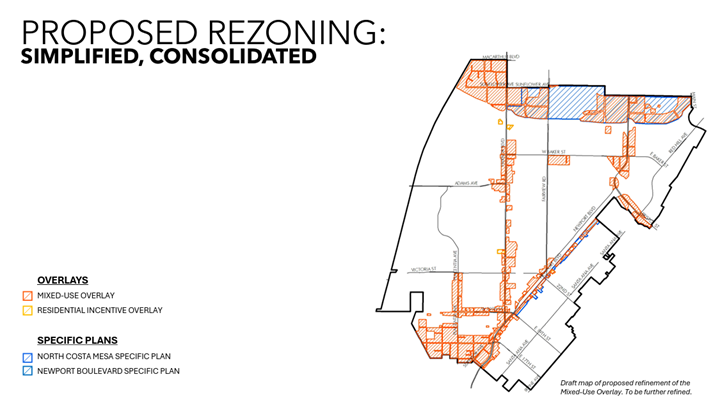
Do you live near any of the parcels? When you drive to work or shopping, do you pass by any of these parcels? The upzoning of these parcels will add at least 40,000 more residents to the City and more workers as well. Our lives are about to change.
Next Steps: Of course, the City is behind schedule, so it wants to speed things up:
A scoping meeting was held on December 10 at 5:30 p.m. As noted below, we only attended part of this meeting as it was scheduled at the same time as another important City meeting
Continue public outreach and engagement, with Round 2 starting in February 2026
Coordinate with HCD on SB 131 and the Redondo Beach case implications
Present draft amendments to the Zoning Code, General Plan, and other regulatory documents at the February 9, 2026, Planning Commission meeting
Commissioner Questions. Harlan, acknowledging the complexity of the project, asked what direction or feedback Staff was seeking from the Commissioners. McGill responded that the purpose of the hearing was primarily to ensure transparency. If that was true, why not publicize it more and hold it on a night that isn’t near the holidays? McGill added that any feedback would be welcome; however, she noted that the draft MUOD is already being used for the environmental study, which has commenced. In other words, this was a check-the-box theatrical event more than anything else.
Zich asked what happens if a property owner whose property is part of this plan decides it doesn’t want to develop housing. McGill said if the property is a Housing Element site, then the property owner has no choice. Take note, property owners. You are losing your choice of what happens to your property. This has the stench of eminent domain.
Dickson observed that only five people were present in the audience, and five were watching online. He asked what public notice had been provided for the meeting. Halligan responded that an ad was placed in the Daily Pilot, and notifications were posted on the City’s webpages along with the usual email alerts. The Daily Pilot, which consists of six pages on Sunday, no longer publishes daily, so it really should change its name. Its circulation has dropped so much that it is no longer publishing fictitious business name statements. Dickson expressed concern that the notice did not convey the significance of the meeting, noting that this involves a major overhaul of the City’s zoning. He reminded Staff of the extensive public engagement that accompanied the development of the urban plans, which included citizen committees and significant outreach efforts. Dickson emphasized that the NWWAB represents far more than rezoning under Measure K and called for a much more robust public outreach process.
He’s absolutely right about the lack of public outreach. The City—under the direction of the City Council—has failed residents and business owners by keeping this rezoning effort largely out of public view. Other cities, like Irvine and Laguna Beach, demonstrate how effective outreach can be, as shown by the higher attendance at their meetings. Staff should have done far more to educate the public—and frankly, even some Commissioners—about the complexity of this project and the significant impact it will have on our daily lives.
Dickson then asked the RHNA buffer, which he calculated at 31%, but Halligan said it was higher. He said that other cities’ Housing Element buffers are 10-15%.
Martinez asked about the draft MOUD provisions provided Staff, noting that they currently apply only to the current Housing Element cycle and not to future cycles. Staff responded that it would consider removing the reference to the current Housing Element so the provisions would apply to all future cycles.
Martinez then addressed the definition of “Use by Right,” which requires that at least 20% of units be affordable for lower-income households. He asked whether the 20% requirement applies to the entire Housing Element site inventory or just to an individual project site. Of course, it is only for the project’s site, because one project cannot provide all the low-income units required by RHNA.
“By-right housing” means a housing project that strictly complies with existing local zoning, building codes, and land-use laws, allowing it to be approved automatically without discretionary review, meaning it has no permits or variances, and public hearings are not required. It's a rule-based, administrative process that streamlines development, making it faster and cheaper for developers because it removes the uncertainty of the review process.
Martinez asked about maximum density but appeared to confuse the number of units with unit density, assuming the Housing Element set a cap on the total number of units. The consultant clarified that there is no requirement to build at the maximum density; zoning regulations simply establish allowable maximums, and in some cases, minimum density requirements apply.
McGill added that developers can exceed maximum density by using the State Density Bonus Law, which permits higher density for projects that include at least 20% affordable housing. Martinez then inquired about how the MUOD changes affect existing overlays. Staff provided a vague response and did not directly address the issue.
Harlan jumped in and asked why some of the overlay sites were not included in the new MOUD. The consultant spilled the beans and said that there are sites that weren’t included in Measure K, so changes to the zoning of those sites may require a vote under Measure Y. Harlan said, “Measure Y has a significant limitation on what can be rezoned citywide.” He’s correct. The people wanted a say in major, large-scale changes like this.
Martinez, still appearing confused, asked why the City isn’t simply eliminating the urban plans altogether. The consultant explained that the urban plans are being integrated into the zoning code and will no longer exist as separate documents.
Martinez then asked about the North Costa Mesa Specific Plan, questioning whether rezoning it would result in the loss of development rights. He specifically wanted to know what property owners would lose under the changes. Halligan did not provide a detailed list but noted the complexity of the Specific Plan. The Sakioka Company has a development agreement with the City that has rights that the City cannot remove, because doing so would violate the law.
Harlan asked whether any analysis had been conducted on the effectiveness of the urban plans. The consultant explained that they had reviewed the plans, examined projects developed under them, and spoken with property owners. They concluded that the plans are overly complex and need to be simplified.
Harlan then questioned the rationale for folding these regulations into the MUOD when they are already so complicated. The consultant responded that modifications will be made to streamline and simplify the development process, but not to the extent that it would trigger a “significant change” under Measure Y.
Halligan added that the final structure has not yet been determined. However, to comply with the Housing Element, the MUOD will need a substructure to incorporate certain elements from the existing urban plans. She further explained that the State has reviewed how urban plan projects are processed and considers the initial City Council screening requirement an impediment to housing production.
Harlan concluded by expressing frustration with Specific Plans—particularly the Newport Boulevard Specific Plan—because no projects have come forward under those plans. There have been projects under the North Costa Mesa Specific Plan, but he insists on ignoring those. Harlan then expressed frustration with Measure Y, calling it a roadblock to updating the Specific Plans, and let out a big sigh. The consultant noted that amending Specific Plans would not achieve the primary goal of completing Housing Element rezoning in a timely manner. Harlan is hellbent on getting rid of the citizens' right to vote on projects that will have a significant impact on their lives. Don’t forget that in 2026.
He also asked whether the General Plan would be amended to remove density requirements. The consultant did not confirm this, but since it was previously stated that the Land Use Element will be amended, density changes would likely be part of those amendments.
Andrade asked whether the definitions of low-income households could be adjusted to include a cost-of-living adjustment (COLA). The consultant explained that low-income households are defined by the State. Andrade pressed further, asking if the City could add its own COLA. Tai clarified that the State already incorporates COLA into its definitions and provides each county with tailored income limits.
Andrade argued that the State’s definition is unrealistic because it assumes housing costs equal 30% of household income. This led to an extended discussion between Tai and Andrade about affordable housing, but no changes were made to the issue before the Commission that evening.
There was also a lengthy discussion about the difference between Housing Element opportunity sites and Measure K sites—two categories that are not always the same. Despite repeated explanations, this remains a concept that many Commissioners continue to struggle with. The bottom line is there is much more work to be done on zoning code and General Plan updates, and Staff will need to bring all of that to the Planning Commission and City Council before we can see the impacts of those changes.
Harlan asked what would happen if the Court ruled that the City cannot use the MUOD—because it is an overlay—to accomplish rezoning under the Housing Element and Measure K. The consultant explained that the language in the MUOD would serve as the superseding development standards, including the requirements of 50% of the FAR being housing, maintaining a minimum density of 20 du/ac, and complying with all other Use by Right provisions.
Staff noted that they are still awaiting guidance from HCD but are proceeding under the assumption that the MUOD can be used..
Public Comment. Jay Humphrey noted that the Notice of Preparation for the EIR lists parcels by Assessor’s Parcel Number rather than street address, making it difficult for the general public to identify which properties will be rezoned for high-density housing.
He also argued that Measure Y has not been the impediment some claim, pointing out that housing has continued to be built since its passage. Finally, Humphrey reminded the Commissioners that, due to the in-lieu fee option under the Inclusionary Housing Ordinance, the result will likely be exclusively market-rate housing.
Rick Huffman acknowledged that while the MUOD approach is complex, it achieves the goal of modernizing outdated zoning. However, he criticized the Agenda Report for failing to disclose that rezoning some parcels will still require voter approval under Measure Y. He noted that this is not necessarily a negative, as it ensures the City must inform voters about the impacts of rezoning.
Huffman also questioned the lack of planning for traffic, pointing out that there has been no mention of amending the Circulation Element of the General Plan. He emphasized that changes can be made, but they require strong public outreach and voter approval, asking: “What’s wrong with that?”
I expressed concern that the scoping meeting for the EIR was held just one week before the deadline for comments. Much of the information presented tonight was new and not included in either the Notice of Preparation or Initial Study, yet the public was expected to provide informed comments.
I emphasized that residents are largely unaware that the City plans to add 21,522 dwelling units and approximately 17,306,003 square feet of commercial space. Both the Notice of Preparation and the Initial Study acknowledge significant impacts on air quality, biological resources, cultural resources, transportation, utilities, and public services, yet the City has stated it will not address transportation issues.
I noted that the City’s outreach has been opaque, leaving residents uninformed about these sweeping changes. This process has undermined transparency and prioritized development over community interests.
I concluded by requesting that the presentation from tonight’s meeting be uploaded to the City’s website—just as presentations are for City Council meetings—something the City has not been doing. As I stated, I remain concerned that the City routinely violates the Brown Act, and this lack of accessible information is one example of how that occurs.
I am worried that it will take a built project for residents to realize what is coming to Costa Mesa. But by then, it will be too late.
Commissioner Comments. Dickson clarified that he views the MUOD as an effective approach for consolidating and simplifying the existing overlays. He asked whether maps would be provided to illustrate how the MUOD will regulate development across different areas of the City. The consultant confirmed that this is the intent.
Dickson then suggested that the City prioritize removing Measure K sites if they are delaying Housing Element rezoning and holding up State certification. He noted that updating Specific Plans will take longer because those areas typically generate strong public engagement.
Martinez stated that the City should prioritize Housing Element programs, particularly those that promote affordable housing. He then began scrutinizing specific programs, which the State requires to be completed before granting full certification of the Housing Element.
Martinez appeared to believe he could modify these programs, suggesting incentives for developments that reduce automobile use. He also criticized the need for parking standards, implying that the City might not be able to complete that program. Martinez continued proposing additional changes, but Staff did not respond.
Motion and Vote. Martinez moved to receive and file, which was seconded by Andrade. The motion passed by a vote of 6-1, with Zich voting “No.”
2. Review and Approve the 2026 Planning Commission Meeting Calendar. The Planning Commission meets on the second and fourth Mondays of each month. It plans to skip the following meetings in 2026: January 12, May 25, August 24, November 23, and December 28.
Motion and Vote. Martinez moved to approve, which was seconded by Harlan. The motion passed unanimously.
DEVELOPMENT SERVICES REPORT: Tai told the Commissioners to look for the NWWAB and Fairview Developmental Center Specific Plan to come to the Commission in early 2026.
DECEMBER 10 FAIRVIEW PARK STEERING COMMITTEE MEETING. All Committee members were present, except Daniel Baume, Bo Glover, and Jose Toscano. Toscano has now missed as many meetings as he has attended. Also in attendance were Kelly Dalton (Fairview Park Administrator), Brian Gruener (Parks and Community Services Director), and Seung Yang (City Engineer). Council Liaison Arlis Reynolds and Orange County Model Engineers Liaison Hank Castignetti were present, while Parks and Community Services Commission Liaison Jason Komala was absent.
PUBLIC COMMENT. This meeting was held at the same time as the Scoping Meeting for the Environmental Impact Report on the Housing Element and Measure K rezoning. We attended the first 25 minutes of that meeting before coming here, so we missed the public comments.
COMMITTEE MEMBER AND LIAISON COMMENTS.
Jay Humphrey emphasized that the Committee’s role is to advise the City Council. He expressed concern that activities are happening at the park without the City Council being informed and stressed the need for the Committee to voice recommendations at its level. He also noted that trail designs should encourage proper behavior.
Kohl Crecelious stated that the November 18 City Council packet was a “gross misrepresentation,” pointing out that the Committee did not agree to the recommendations included in that packet.
Hank Castignetti said he was pleasantly surprised that Councilmember Mike Buley believes the Committee can bring issues to the City Council. He suggested that in 2026, the Committee should focus on the Capital Improvement Program (CIP) and make recommendations for park improvements. Castignetti highlighted significant expenditures:
$50,000–$200,000 in fees and staff time working with HSS
$500,000 spent by former Fairview Park Administrator, Cynthia D’Agosta, working on HSS issues
$300,000–$400,000 paid to consultant MIG
He noted that millions have been spent on the fly field for just five residents.
Arlis Reynolds acknowledged that the Committee’s feedback is valid and said she would have approached things differently if possible. She accepted responsibility for the Committee’s recommendations not being communicated to the City Council. Reynolds emphasized that this is an opportunity for education and engagement, describing the current plan as a balance between restoration and recreation, natural and cultural resources, and community needs. She praised the Cultural Resources appendix for its moving explanation of Fairview Park’s significance to the tribal community and expressed surprise that the motion on tribal relations passed. Reynolds encouraged the Committee to focus on a broader range of topics in the future.
APPROVAL OF MINUTES. A motion to approve the Minutes from the October 15 meeting was made by Humphrey and seconded by Terri Fuqua, and was approved by the Committee.
NEW BUSINESS: There were two items. The first was a request to donate a bench. Discussion was had about the location, the design of the bench, how the plaque is affixed, distance from the restoration project, how many requests are received each year, and future limitations on memorial benches and memorial trees. The item will now go to the Parks and Community Services Commission for review and approval.
The second item was the annual report to the City Council. Humphrey reiterated that the role of the Committee is to advise the City Council; there needs to be more direct communication with the community. Jennifer Thomas suggested that the committee elevate what it has done. Castignetti suggested a docent program; the constituents need to advocate for the park.
Reynolds said the City Council has been talking about the role of the Committees; she doesn’t want to see a “book report” of what happened in the past, but did suggest having a list of accomplishments, to advocate for upcoming CIP projects, and to make budget requests.
Public Comment: I suggested forming an ad hoc committee for the presentation so that several Committee members could meet and work outside of the formal Committee meeting. The Committee needs to ask for what it wants, but it should also consider the CIP. The presentation should be the Committee’s, not Staff’s.
A woman who previously spoke at a City Council meeting continued her commentary about being surprised by the restoration project that recently commenced in the park (a long-planned project that the City Council had approved).
Kim Hendricks advocated for a reserve watch similar to the Bolsa Chica Reserve Watch docent program that the Bolsa Chica Land Trust has. Those docents wear vests and educate the community about the marsh; it helps get citizens involved and lets them know where activities are appropriate.
ADMINISTRATOR’S UPDATE: Dalton spoke about the City Council’s direction to move forward with the Master Plan Update, to make the bicycle trails align with the Active Transportation Plan, and to continue coordination with the tribal advisory group, including using tribal languages in interpretive elements. The next steps will be:
Finalize the draft according to City Council direction
Prepare the CEQA documentation: a programmatic Initial Study/Mitigated Negative Declaration (IS/MND) with a 30-day comment period
Return to City Council for adoption of MPU in 2026
Note that an IS/MND has less opportunity for public input than a full-blown environmental impact report.
Alterations will be made to the trail plan to make it realistic and achievable. Stairs will be added at the south end of the park to access Talbert Park (not a switchback as that would cause too much disturbance of Fairview Park). See revised Trails Plan below.

He gave an overview of current and upcoming capital projects, such as:
Restoration of the mesa native vegetation and cultural resources preservation (still awaiting final permit from CDFW for nonnative vegetation removal); it will take 7 to 8 years to meet the success criteria for this project
West bluff stabilization project addresses erosion, restoration of coastal scrub habitat, and preservation of biological and cultural resources (RFP is complete, tentative contract in 2026)
Wetland circulation project will improve water recirculation, water quality, and water flow control mechanisms (this is in design phase)
Vernal Pools 5, 6, and 7 (ongoing restoration)
Trail and boardwalk repair projects
Educational hubs and signage
There was also a report about Staff’s attendance at the California Invasive Plant Symposium:
Importance of early intervention and response to save time and money
Use of a strategic approach to manage the life cycle of nonnative plants
Next steps: begin an approach to attempt to eradicate plants, including adding volunteers to work on projects
Dalton thinks that relocation of the BMX bumps might be appropriate to Eastside because it is in the Master Plan.
Comments from Committee Members: Thomas said bikes on the muddy trails after the rains are ruining them. Humphrey stated that trails need enforcement and education.
Public Comment: Two members of the public commented about wanting to have more trails for bikes in the park, others spoke about restricting trails and eliminating the canyon trail that created on illegal fill. Rick Huffman pointed out that restoration work on the Eastside of the park needs to be considered. Relocating the fly field to the Eastside may create more impacts by the flyers creating more user defined trails there.
Since it was 8:00 p.m., the meeting adjourned without further comment.
WE WISH YOU A HAPPY, HEALTHY, AND PROSPEROUS NEW YEAR! IF YOU APPRECIATE THE INFORMATION WE PROVIDE, PLEASE DONATE TO OUR EFFORTS AT https://www.costamesa1st.com/donate

Comments