CITY UPDATE FOR NOVEMBER 2025 – AND THE DECEMBER 2, 2025 CITY COUNCIL MEETING🌻FAIRVIEW PARK MASTER PLAN UPDATE 🌻 LAND USE ELEMENT AMENDMENT AND A 💣BOMBSHELL 💣ABOUT THE HOMELESS SHELTER
Updated: Dec 11, 2025
November was a dynamic month for governance in Costa Mesa. Here’s an update:
Council and Committee Meetings
City Council held two meetings in November—we already covered the November 18 meeting in a special update about the Draft Fairview Park Master Plan Update, but it met again on December 2, with that same subject on the Agenda;
Planning Commission met once;
Active Transportation Committee met; and
Finance and Pension Advisory Committee (FiPAC) also held a meeting.
NOVEMBER 4 CITY COUNCIL MEETING. At this meeting, the items acted on were:
Ordinance Amending Title 5: Buildings & Structures and Title 7: Fire Protection and Prevention of Municipal Code and Adoption by Reference 2025 California Building Standards Code, and Adoption of Orange County Grading & Excavation Code and Associated Supplements
Amendment to Land Use Element of General Plan to Provide Consistency with Sixth Cycle (2021-2029) Housing Element
Amendment No. 7 to Agreement Between Orange County Transportation Authority and City for I-405 Improvements Project
Consideration of Ordinance to Require Staffing at Self-Service Checkout Stations
Housing Element Rezoning (Neighborhoods Where We All Belong) Public Engagement Update
All City Councilmembers were present.
City Attorney Closed Session Report. Kimberly Hall Barlow reported that there was no reportable action taken, but there was one item for which the Councilmembers would need to return to Closed Session after the Regular Session concluded.
Public Comment. There were four public comments, which included:
Upcoming street improvement and safety workshops, a grant received by police department to improve safety, and the need to stop crashes between cars and pedestrians and cyclists.
Redevelopment of Fairview Developmental Center and the need to do a land swap to preserve the playability of the City golf course.
Change name of Fairview Park to Fairview Nature Park; remove fly field from park.
Issue with Costa Mesa Police Department and alleged violation of civil rights.
Issues with City’s contract with Costa Mesa Tennis Center and Staff’s treatment of the management team;
Councilmember Comments.
Arlis Reynolds (District 5) addressed concerns about deported veterans and the discontinuation of benefits for those needing food and financial assistance. Highlighted how the City is providing support, upcoming safety events, and efforts to build a partnership with AAA for these events. Also noted the upcoming World Day of Remembrance for Road Traffic Victims.
Jeff Pettis (District 6) shared experiences working at the VA hospital and expressed appreciation for veterans.
Mike Buley (District 1) announced plans to meet with the City Manager regarding tennis center issues. Discussed potential community engagement activities for the 250th anniversary of the Declaration of Independence, the City’s financial status, possible loss of climate action plan funding, and his interest in revisiting the plan
Loren Gameros (District 2) reported on Staff efforts to resolve parking issues in the Manistee Drive neighborhood and emphasized the need to support Someone Cares Soup Kitchen
Andrea Marr (District 3) recognized the 50th anniversary of women attending the Naval Service Academy, mentioned the College Park bike bus, and requested adjournment in honor of a Costa Mesa resident who died in ICE custody before family could reach him.
Manuel Chavez (District 4) spoke to high school students about the importance of voting, requested adjournment in honor of a City staff member who passed away, and stressed public involvement in the Fairview Park Master Plan Update.
John Stephens (Mayor) announced the upcoming Mayors’ Happy Hour with the Mayor of Newport Beach, shared insights on the area’s military history, and honored the career of the City staff member who will be remembered at the meeting’s close
Interim City Manager Comments. Cecilia Gallardo-Daly spoke about Veterans’ Day, upcoming outreach, and safety events,
City Attorney Comments. Kimberly Hall Barlow thanked the City for its support during her partner’s medical issues.
CONSENT CALENDAR. No items were pulled. A motion to approve the items was made by Chavez, seconded by Marr. The approval was unanimous.
PUBLIC HEARINGS:
1. Ordinance Amending Title 5: Buildings & Structures and Title 7: Fire Protection and Prevention of Municipal Code and Adoption by Reference 2025 California Building Standards Code, and Adoption of Orange County Grading & Excavation Code and Associated Supplements. Ziad Doudar, Building Official, and Ryan Bohr, Fire Marshall, gave the presentation.
Councilmember Questions and Comments. Reynolds asked about the impact of the fire maps adopted earlier in the year. Staff clarified that there are no new requirements beyond those already in the State Building Code.
Gameros inquired about the timeline for revising the national fire code, which serves as the basis for California’s code. Staff explained that the national code is updated every three years, and the City typically adopts it about two years after its release.
Marr asked about new rules for electrical disconnects for lead-acid and nickel-cadmium battery systems. Staff noted that the updated code requires the disconnect to be within 36 inches of the main panel. This change replaces the previous “line of sight” requirement, which was considered less safe, and aligns with the commercial fire code. Given that the location of electrical panels varies from residence to residence, having to place the disconnect within 36 inches of the main panel can be problematic, say, if there is a window or door currently in that location.
Public Comments. None.
Motion and Vote. Marr moved to approve the item, with an amendment that the disconnect would have to be placed within six feet of the main panel; that was seconded by Reynolds. The motion passed unanimously.
2. Amendment to Land Use Element of General Plan to Provide Consistency with Sixth Cycle (2021-2029) Housing Element. It was announced that a presentation was given by Melinda Dacey, Principal Planner, and Anna McGill, Planning and Sustainability Manager. That didn’t happen right away because they were not in the City Council Chamber. The Councilmembers took a break, after which the meeting resumed. The proposed changes are:
Land Use Designation Changes: Updates to allow high-density residential development as outlined in the Housing Element.
South of the 405 Freeway: Sites may exceed four stories in height.
North Costa Mesa Specific Plan Area: Removal of trip generation caps; height and density will follow Housing Element standards.
Westside Overlays & Urban Plans (e.g., SoBECA): Removal of height and density limits, allow up to 50+ dwelling units per acre (du/ac); increased floor area ratios.
Fairview Developmental Center: Minimum density of 60 du/ac (10 du/ac is roughly equivalent to one story).
Remove Conflicting Regulations: Eliminate site-specific restrictions that prohibit residential uses (e.g., Segerstrom Home Ranch).
The implications of the changes are increased building heights and density; removal of traffic trip regulations; potential Measure Y vote for certain parcels; and significant neighborhood impacts. The City’s justification for making these changes is to ensure internal consistency between Land Use and Housing Elements, enable residential development on Housing Element sites, comply with state housing laws, and meet the RHNA target of 11,760 dwelling units.
Councilmember Questions and Comments. Pettis asked whether, when the zoning code and specific plan amendments come before the Council, Staff would provide a map showing parcels that would gain or lose capacity. Note: there will never be a loss, because that would be a “take,” which is against California law. McGill noted that objective standards will be presented to the Council at that future date. These amendments to the Land Use Element are intended to align zoning with the Housing Element. Pettis also questioned the use of the term modification versus reduction or increase. Dacey explained that development standards in the Land Use Element limit site capacity, and modifications occur when a site seeks a new entitlement. McGill added that modification means realizing the capacity outlined in the Housing Element. Clarification of development standards will come with future rezoning efforts under the “Neighborhoods Where We All Belong” initiative.
Public Comments. I expressed concern about the lack of notice to property owners regarding nearby parcels being upzoned. This failure to follow the City’s own Municipal Code procedures undermines public trust. Residents should be informed of potential impacts, such as parcels near their homes being rezoned for tall developments.
Motion and Vote. Chavez moved to approve Staff’s recommendation, seconded by Stephens. Chavez emphasized the need to comply with State housing allocation requirements.
Reynolds asked Carrie Tai, Director of Economic and Development Services, to respond to my comment. Tai explained that the action taken that evening should have accompanied the Housing Element adoption in 2022–2023, but staff recently discovered it had not been completed. She stated the City followed State notification laws.
When asked about property owner notifications during the Housing Element approval, Tai and her staff had no personal knowledge, as they were not employed by the City at that time. Tai believes property owners whose parcels were identified for rezoning were notified. Which tells me that the neighbors of those properties likely were NOT notified. Hence, my comment about the City’s failure to follow its ordinance. I’d like to know if a parcel near my house was up for being rezoned for seven stories.
The motion passed 6–1, with Pettis voting “No.”
OLD BUSINESS: There was one old business item:
1. Amendment No. 7 to Agreement Between Orange County Transportation Authority and City for I-405 Improvements Project. Presentation was given by Raja Sethuramen, Public Works Director. This Amendment authorizes an additional compensation to the City by OCTA of $1,989,000 for post-construction pavement mitigation of various I-405 Project-related detours on Harbor Boulevard, Fairview Road, and South Coast Drive that are outside the I-405 Project limits.
Councilmember Questions and Comments. None.
Public Comment. One comment about significant dips on Harbor Boulevard under the 405 Freeway. The commenter was informed that the dips had been fixed.
Motion. Stephens moved to approve the item, which was seconded by Reynolds. The motion passed unanimously.
NEW BUSINESS: There were two new business items:
1. Consideration of Ordinance to Require Staffing at Self-Service Checkout Stations. Jay Barkman, Government Affairs Manager, gave the presentation. During the March 2025 City Council meeting, concerns were raised about theft and inadequate staffing at self-checkout stations in grocery and drug stores. In response, Stephens and Chavez requested research on potential staffing and operational standards, citing a similar ordinance adopted by Long Beach in August. That ordinance requires staffing at self-service checkout stations in grocery and retail stores and aims to reduce theft and protect employees. Enforcement would be by employees or customers through a civil court action.

Councilmember Questions and Comments. None.
Public Comment. There were nine comments, seven in favor and two against (one noting Trader Joe’s successful business model of no self-service checkouts).
Motion and Vote. Chavez moved to direct Staff to bring back an ordinance mirroring Long Beach’s ordinance, which was seconded by Gameros.
Chavez emphasized the importance of protecting workers. Gameros criticized stores for prioritizing profits over employee well-being, calling it a “horse and buggy” mentality. He argued that keeping cash registers open preserves jobs, similar to how putting cars on the road created employment. Pettis noted that free-market capitalism is based on competition and pricing, suggesting that consumers choose self-checkout for lower prices. Has anyone experienced that? I haven’t. Pettis argued the ordinance would mandate jobs that don’t currently exist. Stores in Long Beach closed self-checkout registers in response to its new ordinance. Buley stated that the ordinance goes too far and should be left to negotiations between stores and unions. Reynolds pointed out that cannabis businesses in Costa Mesa are required to maintain certain staffing levels and cited other regulations that govern business operations. She stressed the need for staff to engage the business community more effectively on the proposed ordinance. Stephens observed that the cost of goods sold, not labor, is the largest expense for retailers.
The motion passed 5-2, with Pettis and Buley and voting “No.”
2. Housing Element Rezoning (Neighborhoods Where We All Belong)—Public Engagement Update. Presentation was given by Michelle Halligan, Senior Planner, and Anna McGill, Planning and Sustainability Manager, with consultants from Dudek and from Kearns and West in attendance. I attended all but one meeting. Based on my observations, and if you have been following my comments, you know that I think the public engagement on the rezoning has been superficial and largely a failure. Several meetings had participation by City Council members and Planning Commissioners, which skewed the survey results, as they will get a vote at a later date.
Councilmember Questions and Comments. Pettis asked about holding a town hall. Taylor Funderburk (Kearns & West) said they were not directed to organize one, citing resident discomfort with microphones. Historically, Costa Mesa residents have been vocal at town halls. Cathy Tang Saez (Dudek) stated that town halls are not productive for the City. Engagement should center on the community, not convenience for Staff. Ultimately, the City Council did not direct staff or consultants to hold a town hall, so none were scheduled.
Reynolds expressed her thought that town halls are about sharing information rather than gathering public input. She emphasized the need for visuals showing what is planned for streets like Placentia and other corridors in the city. She thinks that these will come from the community. If you want to see what is coming, go to Anaheim and look at State College Boulevard. Go to Irvine and look at Jamboree Road. Developers recycle plans from every city where they build. There will be no innovative ideas for Costa Mesa, unless the City tells developers they need to bring something new, something better, and something Costa Mesa, to the city.
Saez said consultants will present zoning code changes in a format “people can grasp,” likely focusing on site design, building design, and open space with some visual examples. She wants to keep the presentation “fun and light.” In other words, she’ll dumb it down and leave out details that might upset the public.
When Reynolds asked about renderings, Saez said diagrams—not full renderings—would be provided to illustrate how code text translates into physical form. Reynolds requested that diagrams be organized by corridor for clarity.
Reynolds also asked about mixed-use development. McGill confirmed housing and mixed-use will be addressed, with renderings showing massing, design standards, building form, and heights.
Stephens asked for data on public priorities and a tangible work product. He voiced support for a town hall, but also stressed urgency, citing pressure from HCD and his desire to complete the process by mid-March. Reynolds asked if the schedule had changed. Tai confirmed that the completion remains targeted for Fall 2026.
Public Comment. There were four comments.
Resident (sharing the same last name as one of the consultants) spoke in favor of the public outreach.
A question was raised about collaboration between Costa Mesa PD and Newport PD on gang intervention.
Commenter who criticized the process as rushed, disagreed with the RHNA allocation, and argued that outreach is structured to produce predetermined outcomes rather than reflect community input. He also cited the 3150 Bear Street project as an example of ignoring public concerns.
I spoke about the outreach being perfunctory and box checking, noting that several meetings failed to gather meaningful input. I reminded Stephens that he served as emcee of a Costa Mesans for Responsible Government town hall in 2014 on the General Plan update (which I helped organize). I also highlighted the City’s hostility towards its citizens when it comes to engagement on this topic. During my remarks, Gameros appeared disengaged, flipping through a printout instead of listening.
Motion and Vote. Marr moved to receive and file, which was seconded by Chavez. Marr spoke about how much she loved the outreach and about how people told her they liked the popups. Chavez thought the City got new perspectives, but then said the same people with the same opinions come to all these meetings. Stephens says he remembered the town hall in 2014 and being the emcee, but he didn’t remember what it was about. The motion passed unanimously.
NOVEMBER 3 ACTIVE TRANSPORTATION MEETING. All members were present except Trace Yulie and Farhad Khosravi. Both City Council Liaisons, Arlis Reynolds and Andrea Marr, were present.
Public Comment: Ralph Taboada highlighted discrepancies between the bike trail map in the Fairview Park Master Plan and the final Active Transportation Plan, urging the Committee to review the Master Plan.
Committee and Liaison Comments:
Members shared updates on assorted topics, including bike lane usage, collision data, bicycle safety, transportation survey by OCTA, and community events like the College Park Elementary School Bike Bus and Ciclovia events.
NMUSD Liaison Sarah Coley discussed efforts to improve bicycle safety and the Safe Routes to School (SRTS) Plan.
Reynolds announced a community bike ride on November 16 for the World Day of Remembrance and highlighted bicycle safety education initiatives.
Marr reminded everyone to attend the Safe Routes to School Action Plan and Fairview Road Improvement Project workshop the following evening.
Staff Comments: Updates were provided on:
Construction progress on Fairview Road improvements, expected to be completed by spring 2026.
Upcoming Safe Routes to Schools workshops, the last on January 15, 2026.
Completion of school walk audits and modal tallies.
Updates on the Adams Bicycle Facility Project and the expansion of the "Let’s Go Costa Mesa" service area.
Approval of Minutes: The September 3, 2025, meeting minutes were approved with minor edits.
Old Business: The Committee discussed and approved three updated goals and objectives:
Provide active transportation advocacy to agency stakeholders (Caltrans, OCTA, NMUSD, etc.). This will need identification of specific targets and a list or matrix of activities to be conducted.
Develop a process for updating the Active Transportation Plan within the Circulation Element. The outcome would be a list of activities, a list of deliverables (e.g., recommendations to City Council), and a complementary schedule.
Work with staff on periodic reporting of pedestrian and cyclist involved collisions (e.g., raw numbers) that will be included in the Annual Report to City Council. Suggestion: integrate with the rezoning update.
New Business: The Committee reviewed and approved nine objectives for the Active Transportation Plan:
1. Participate in Safe Routes to Schools (SRTS) planning and activities (school walk audits, etc.).
2. Participate in Walk and Bike to School Day events.
3. Provide input on City Capital Improvement Program design projects.
4. Recommend potential City/community educational focus areas.
5. Support development of social media posts and videos.
6. Support citywide encouragement efforts (open streets events, demonstration events, community festivals, etc.).
7. Represent the City at community events (Earth Day, Love Costa Mesa Day, etc.) and provide information on ongoing projects and initiatives.
8. Strengthen community support for existing and future active transport projects (for example on social media comment boards).
9. Review upcoming repaving schedule and give input on re-striping.
Note: We attended the meeting the following evening about the Safe Routes to School Action Plan and Fairview Road Improvement Project.
The Fairview Road project will:
Install Class IV Cycle Tracks on both sides of Fairview Road.
Improve connectivity and access to the Fair and local schools.
Improve safety for cyclists and pedestrians.
Keep the same number of motor vehicle travel lanes.
Bus stop improvements.
The Safe Routes to School Action Plan will recommend infrastructure improvements 23 Newport-Mesa Unified School District schools. You can help by taking a survey at https://costamesasrts.org/interactive-map-and-survey/.
NOVEMBER 10 PLANNING COMMISSION MEETING. All Commissioners were present. Two items required action:
Conditional Use Permit to Operate a Cat Lounge with 15 Adoptable Cats at 2981 Bristol Street, Suite B3 (the Camp)
Housing Element Housing Element Implementation (Neighborhoods Where We All Belong) Public Engagement Update
Public Comment. A resident complained about excessive noise coming from “The 12” gym at 140 East 17th Street. The resident has repeatedly complained about loud noise in the early morning hours when the gym opens the doors and plays amplified music and cheerleading sounds.
Commissioner Comments. David Martinez (District 5) announced several November events and the launch of the College Park bike bus. He inquired about the timeline for releasing pre-approved plans for ADUs and JADUs and asked about updating the Planning Commission Bylaws.
Rob Dickson (District 5) raised concerns about a constituent’s use of TESSA to search and find information. Carrie Tai, Director of Economic and Development Services, agreed to give him an update on the system at a future meeting or offline.
Jon Zich (District 1) echoed concerns about TESSA and suggested that the constituent, Jim Fitzpatrick, would benefit from a sit-down meeting with Staff. He expressed frustration with public comments that do not lead to action. Zich also addressed noise issues at The 12 gym, stating the City could be doing more. He requested earlier delivery of meeting packets, as was previously standard, and reiterated his request for a comprehensive list of all active planning applications.
Jeff Harlan (At-Large and Chair) also spoke about The 12 gym, noting he asked Staff to notify the complaining neighbor about a permitted special event. When asked if she received notice, she indicated “No,” prompting Harlan to say the issue needed correction. He suggested the neighbor bring the item to the City Council, which can review the gym’s CUP. Harlan concluded by announcing that the meeting would be adjourned in memory of Assistant Planner Christopher Aldana.
CONSENT CALENDAR: The only item was the minutes from the October 27, 2025 meeting. Zich moved to approve the minutes, which was seconded by Martinez. The motion passed unanimously.
PUBLIC HEARINGS: There was only one public hearing:
1. Conditional Use Permit to Operate a Cat Lounge with 15 Adoptable Cats at 2981 Bristol Street, Suite B3 (the Camp). The applicant is requesting a Conditional Use Permit to operate a cat lounge:
15 adoptable cats, retail space, a maximum of 12 guests at a time
Daily hours: 10:00 a.m. to 9:00 p.m.
Overnight care for the cats will be provided through a monitored security system, with no staff present overnight.
Project is exempt from minimum parking requirements under AB 2097.
Jeffrey, Raimondo, Assistant Planner, gave the presentation.
Commissioner Questions. Zich asked about the noticing process, expressing concern that the Daily Pilot readership has declined and suggesting that email notifications to City subscribers may reach more people. He also referenced public comments regarding the City’s difficulty in processing simple applications, noting that a four-month timeline seemed quick. Zich inquired about the meaning of “by right,” which staff explained refers to a use permitted within the zone. He further explored why a Conditional Use Permit (CUP) might or might not be required.
Martinez questioned whether conditions of approval allowed only prepackaged food or included drinks. Staff clarified that the application was limited to prepackaged food and explained the health department distinction for food prepared on or off-site. Martinez then asked whether food purchases would be mandatory and who determines the classification of food sales, as well as whether such decisions are appealable. Tai seemed to struggle with understanding why he was asking the question about the decision, but responded that these determinations are made by a staff review team and are generally not subject to appeal.
Karen Klepack (District 1) asked if there was a minimum age requirement for children. Staff confirmed this was not discussed with the applicant.
Dickson clarified that questions about use stemmed from discrepancies between the applicant’s letter and the Agenda report. Staff explained that, based on square footage, the cat lounge was the primary use, while retail was secondary.
Harlan summarized the discussion, noting that some uses require a CUP while others do not. In cases of uncertainty, the decision rests with the Director (Tai) and Staff.
Applicant Presentation. The applicant gave a presentation about its business and its rescue partner, Friends of Normie Rescue. They indicated consideration of an age limit of 5 years with parent supervision.
Klepack spoke about the need for an age limit and the fact that she wants the City to consider a TNR program. She must have missed the comments at the City Council about the TNR ordinance coming to the City Council.
Martinez asked about the intended hours of operation. The applicant wants flexibility, should the popularity of the business increase. Staff confirmed that to change the hours of operation later would require an amendment to the CUP.
Angely Andrade (District 4) asked about staffing and private events. The applicant didn’t provide the number of staff and said that they would like to do private events. The applicant will be speaking to our local shelter about helping with adoptions.
Public Comment. Chris Bennett, representative of property owner LAB Holding, spoke in support of the business. Shaheen Sadeghi, the owner of LAB Holding, spoke in favor of the business. He also requested that older codes be updated to make doing business easier and less costly.
Klepack asked if she could change the Conditions of Approval to provide a minimum age of six, and minors under the age of 12 must be unaccompanied by an adult. Tai responded that it would need to be tied to a finding, such as health, safety, and welfare.
Motion and Vote. Dickson moved to approve the project, which was seconded by Zich. Dickson added that the Conditions of Approval would be modified to reflect that store hours would be the earliest opening and latest closing of the LAB (he meant the Camp) and he would entertain the idea of an age limit. Harlan clarified that the opening time would be 9:00 a.m. and the closing time would be 10:00 p.m. After discussion with the applicant, it was decided to modify a condition of approval to include that any child under 12 would have to be accompanied by an adult. The second concurred. Several Commissioners spoke about their overwhelming joy that the business would be coming to the City.
Martinez went sideways and decided to attack the idea that the CUP process applied to the application. He made a substitute motion to overturn the Director’s decision and find that the use is a permitted one that doesn’t need a CUP. He wanted the CUP fee returned. The motion died for the lack of a second. Martinez went on to pontificate that he thinks we are going to see more businesses like this, and he doesn’t want to hamper them from opening in Costa Mesa. The City Attorney later spoke on Martinez's motion, saying it would have been illegal to take that action since it had not been requested by the applicant, and it had not been noticed to the public.
The original motion was unanimously approved.
OLD BUSINESS: None.
NEW BUSINESS: There was one new business item:
1. Housing Element Housing Element Implementation (Neighborhoods Where We All Belong) Public Engagement Update. This was essentially a rehash of the November 4, 2025 City Council presentation. Anna McGill, Planning and Sustainability Manager, led the presentation, Cathy Tang Saez of Dudek and a representative of Kearns and West. McGill noted that this presentation was longer because the City Council presentation had been shortened due to its placement as last on the Agenda.
Commissioner Questions. Martinez heard about an accelerated timeline at the City Council meeting. McGill corrected his statement and said the schedule remains unchanged and is not being expedited. Martinez reiterated his view that the housing crisis warrants faster action He asked whether rezoning or an overlay would apply to Housing Element sites. McGill said that Staff would be returning to the Commission on December 8 for a Study Session at which time it will unveil rezoning strategies. He cited “an appellant case in the South Bay” as a court decision prohibiting overlays from being used for housing elements. He cited a recent appellate case (New Commune DTLA LLC v. City of Redondo Beach) that prohibits overlays for housing elements. The order vacated a trial court decision and compelled Redondo Beach to revise its draft Housing Element. The opinion can be found here: https://law.justia.com/cases/california/court-of-appeal/2025/b336042.html but that case will soon be appealed to the Supreme Court of California, with several cities already stating they will join in as amici curiae.
Zich asked what happens if the City fails to meet its RHNA allocation (approximately 17,000 units, including buffer) by the next cycle. McGill explained that while penalties are unclear, the State would likely require the City to make development easier. Zich questioned how much “visioning” remains when so many requirements are state-mandated. Saez responded that the City still controls elements like setbacks, parking (to some extent), and open space, and noted community feedback emphasizing walkability and design quality.
He asked about parking standards and how the City can control those. It can only be done when a project isn’t on a major corridor with public transit. Zich challenged the claim that the City would prioritize housing near jobs, called the sites identified in the Housing Element and Measure K “shoehorned.” Saez said the sites are in predominantly commercial and industrial areas. Zich accepted that answer, but I will point out that the new housing will take away jobs, so will the new housing really serve the community, or will it be for the few who can afford to buy here?
Zich requested a clear definition of “affordable housing,” asking whether it refers to government-provided units or simply lower-cost housing. The consultant said it encompasses both, and Zich asked for a definition broken into two components. He referred to this slide:

Zich asked what “Foster hope for the future” means, the consultant said that they want the outreach to inspire hope in people because the Housing Element points out that affordability, overcrowding, and disrepair are all situations that need to be remedied.
READ THIS ↓. READ IT TWICE.
Dickson asked about the outreach in terms of social media, referring to the claim there were over 2,000 separate views of the project’s website, but there are only 545 participants in the outreach and 206 unique signups. He noted that the City was “superhuman” in its outreach for Measure K, but it can’t get a response to this project. The interest is even less than the Fairview Developmental Center Specific Plan, yet it affects far more people. I agree! This will impact EVERY resident in the City. Dickson said that the people of Costa Mesa have no idea what is going on, adding that Staff and the consultants shouldn’t be trotting the claim that “we are doing everything the City asked of us,” when that obviously isn’t working. He said he shares the Mayor’s concern about not having enough data. Dickson said the City isn’t doing enough to engage residents and it’s not him criticizing Staff, it’s in the numbers that were presented. He said that if he weren’t involved in land use, that he would probably throw away a postcard with “Neighborhoods Where We All Belong” on it. To accelerate the timeline would just be doubling down on an uninformed public.
I have wondered too why I don’t see more of the public showing up at these events. While I’ve complained about the infantilism of the information presented, I still would like to see YOU at these outreach events and hear YOUR voice! This is the single most important and impactful rezoning that Costa Mesa will undergo and IT WILL IMPACT YOU. Why isn’t the City reaching its residents? Something is WRONG!
Zich said he thinks the public doesn’t understand the impacts. He said that the City should sent out graphics of Harbor Boulevard and seven story towers all up and down the corridors, they’d get the idea of what is going on. Maybe something like this depiction of a five-story building at Newport and 19th?

Zich said the public is getting nuanced communication painting the City as doing great stuff. If we got 110,000 people to show up and said they were concerned about the height of buildings, would the City say, “th
anks for your opinion, but we can’t do anything about that”? Would the City say, “before you leave, will you pick a shade of beige you want the tall buildings painted?” Obviously, he was being sarcastic, but in every joke there is a little bit of the truth. Sometimes, a lot of the truth. He said that is why the City isn’t getting good input. The public doesn’t know what it can change materially. We do come to City meetings and talk about parking, and we talk about the need for more open space. But it feels like it falls on deaf ears. But we have to keep talking! If we don’t, then the City will think it is okay to completely ignore us.
Harlan asked about this slide:

Harlan asked how public feedback will be incorporated into design standards, zoning code amendments, the zoning map, and the final planning product? Saez said “Not everything we heard will be directly translated into the work that we are doing.” The transportation option is not going to be addressed. However, elements such as public spaces and open spaces within the new developments can be incorporated. She noted a desire for an eclectic character, which will be reflected in permitted uses and regulations for a variety of housing types. But then you have to make it clear to the developers to not expect variances, deviations, and administrative adjustments, which they always want.
Harlan observed that achieving more open space will require taller, denser projects and stressed that this reality needs to be communicated to residents. He didn’t ask why the City hasn’t told the residents that. Harlan added that the City needs to engage developers early on about design standards, warning that excluding their input could hinder the City’s ability to achieve its goals. In other words, he wants to let developers do the planning.
Andrade said that she felt the communication could be more direct. She suggested using something like “Harbor Boulevard is going to change, and we want your input.” She said that one resident, once they learned about the City outreach, thought that he should have a private event in his home to inform his neighbors. She suggested that the City look at the outreach done for the Bristol Related and the South Coast Plaza Village developments in Santa Ana.
Dickson returned with the observation that some of the input was unreasonable, particularly the input on a slide he felt showed that most people want single-family homes and mobility in the public sphere. This is not what this program is about and the public needs to know. You need to be telling the public: “There’s a lot more housing coming. It’s coming to Harbor. It’s coming to Newport. And it’s not going to be eclectic unless you guys raise your voices.” He looked at the visioning boards at the meetings and saw the standard modern housing that you see in Irvine and Santa Ana. That’s not Costa Mesa.
The consultant attempted a defense by saying that was the sticker exercise was an ice breaker about where people have lived, and it was something that the consultant needed to know, but that people saw other boards that showed other types of housing.
Public Comment. The sole comment was from a resident gave his stream of consciousness thoughts on public outreach, urban planning ideas, the high-speed rail projects, and a few other subjects. He said that he has more of a personal stake in what will be built versus someone two or three times his age. He said that people will probably have something to say once they see some of the projects. He said that he is speaking for all the people that he talks to.
Yes, people will speak up once they see the projects built. But by then, it will be too late.
Motion and Vote. Dickson moved to receive and file, which was seconded by Andrade. Dickson said he wished more of the public had spoken because the Commission doesn’t hear enough from the public. The motion passed unanimously.
PUBLIC WORKS REPORT: There are several upcoming bike safety events.
DEVELOPMENT SERVICES REPORT: Tai reported that the City Council approved several code updates. The Council got the smaller presentation on the last item heard this evening, and there will be a summary of the outreach coming soon. There are two upcoming EIR scoping meetings—one on Fairview Developmental Center Specific Plan and one on the Neighborhoods Where We All Belong effort.
OCTOBER 12 FiPAC MEETING. All Committee members were present, however, Quinn Callanan needed to leave early. Also in attendance were Finance Director Carol Molina and several other members of the City’s Finance Department. Council Liaison John Stephens was present, but Council Liaisons Manuel Chavez and Mike Buley were absent.
PUBLIC COMMENT. Two members of the public addressed the Committee regarding the Orange County Power Authority (OCPA) proposal—expressing support for the Committee’s choice not to recommend joining OCPA. Jim Fitzpatrick gave his usual story about the City being “broken.” He said the City balanced the budget, then blew it off. He’s right about that. He also said that the quarterly report from HDL isn’t being shared. I could not find the most recent report on the City’s website. He said he thinks there is a structural deficit, and there should be a budget cut. He wants more long-term financial planning. Then he left.
APPROVAL OF MINUTES. Minutes from the October 1 meeting were approved with a minor amendment.
OLD BUSINESS. An ad hoc committee report was given by Ralph Taboada and Daniel Morgan about the proposal to put two measures on the 2026 ballot for (1) increasing the business license tax and (2) raising the City’s transient occupancy tax. They met with Molina and decided there are too many options to consider, such as additional revenue sources, to make a recommendation to the Committee. They need more information, which will require City Council approval for additional Staff time. The Committee was unanimous in its recommendation of Staff spending more than four hours on the project.
NEW BUSINESS: Steve Ely, Information Technology Director, gave a presentation about the five-year IT strategic plan. Much of the technology at City Hall is outdated, and some has reached the point where the software can no longer be updated. Funding for Phase I of the program was approved by the City Council in 2020. The IT department continues to work on many upgrades, but there are more items that will require budgeting, including increasing Staff to complete other phases of the plan. $9.226m was allocated, and $5.2 has been spent. Projects are coming in under or at budget.
There will be a City Council Study Session in April or May of 2026 on the upcoming budget.
There was another presentation about Budget Book: Long Term Financial Plan. The mid-year budget report has been delayed, but Molina still thinks income is up, due to better-than-expected sale tax collections.
Committee Member Questions and Comments. The source of IT funding was discussed. Some funds have been allocated to IT expenses, but some are still in the General Fund. Discussion about the Capital Asset Needs ordinance. The choice to not fully fund the CAN was for one year and the Mayor has expressed a desire to realign the ordinance.
Bottom Line: Molina thinks the budget will be balanced for the next five years. The positions that were frozen in the last budget will require City Council approval to reactivate. Staffing levels will stay the same. When asked about a structural deficit, Molina explained that a structural deficit would mean that the City can no longer fund ongoing expenses, and that is not the case for Costa Mesa.
NOVEMBER 18 CITY COUNCIL MEETING. I previously reported on this meeting because on the Agenda was the Fairview Park Master Plan Update. Please read that dispatch here: https://www.costamesa1st.com/post/special-update-november-18-city-council-meeting-fairview-park-master-plan-update
DECEMBER 2 CITY COUNCIL MEETING. At this meeting, the items acted on were:
Continuation of Appeal of Planning Commission’s Decision to Uphold the Decision to Deny a Reasonable Accommodation Request to Deviate from the Zoning Code to Operate a Sober Living Home at 115 East Wilson Street, Units A-E
Development Impact Fees Annual Report and Traffic Impact Fee Analysis
Draft Fairview Park Master Plan Update: Discussion and Approval of Recommendations
Bridge Shelter Beds Amendment
Exploration of Ballot Initiatives Pertaining to (a) Transient Occupancy Tax (TOT) and (b) Business License Tax
Employment Agreement for City Manager, Cecelia Gallardo-Daly
All members were physically present, except Councilmember Andrea Marr, who attended remotely.
City Attorney Closed Session Report. Kimberly Hall Barlow reported that the City Council took no action in the Closed Session, but gave direction to Staff. She added a comment about a social media post that alleged the City hadn’t taken any action on the immigration defense agreements. She said that isn’t correct. She has been in contact with Immigration Defenders and PLC (Public Law Center), the two groups that the City has contracted with to provide services to those residents needing legal help.
Public Comment. There were 14 public comments on topics which included:
Correction of article in the OC Register that incorrectly stated that more public comments were received against the Fairview Park Master Plan Update than were for it. The Mayor interrupted and said the resident was sliding in a comment about the Master Plan Update, and he had cut off the comments on that item, so the Mayor wasn’t allowing his comment.
Several comments requesting an update on the immigration defense fund and for help obtaining food from Someone Cares soup kitchen; the City’s website didn’t have much information, and one page had a broken link; how the family members of a deceased resident who died in ICE custody could use information on how to access the defense fund.
Student from ISSAC School extended an invitation to the Mayor and City Council to visit the school and speak about how local government works; the Principal of ISSAC School also spoke about the school.
Several comments about how difficult it is to use the City’s website to find information about immigration resources, the “Know Your Rights” program and other needed resources, and request to publicize information about these programs and resources.
The Fairview Park 2026 Calendar that can be obtained with a donation of $20; the calendar can be purchased here: https://www.fairviewparkalliance.org/product-page/2022-fairview-park-calendar ; and volunteer opportunities.
Literature that is available about immigration rights in several languages, including Vietnamese (40% of those being taken by ICE are Vietnamese).
Request that in the interest of fairness and transparency that the public comment for the Fairview Park Master Plan Update be reopened.
Announcement that Santa will be at the Fairview Park train station on December 20 and 21; there is a toy drive, so bring a gift.
Request for a second dog park in the city and repairs to the current one.
Comment on US immigration policies; concerns that new housing in Costa Mesa will only be high-density housing; concerns about congressional seat apportionment.
Councilmember Comments.
Mike Buley (District 1) reported his wife wants another dog park; acknowledged the efforts of Staff for the year he has been on the City Council; attended a fundraiser for a home-school Christian resource center, and the Segerstrom’s tree lighting event in the South Coast Plaza area.
Loren Gameros (District 2) thanked Staff for their work; inquired as to status of the soup kitchen funds and restrictions on their use.
Andrea Marr (District 3) attended the firefighters' promotion ceremony and how proud and grateful she is for those who serve and protect us.
Arlis Reynolds (District 5) spoke changes to U.S. laws that will open our coast up to more oil drilling; request for support for the Costa Mesa Historical Society and the events it sponsors; comments about the impacts that the immigrant community have faced this year; request to Staff to make information about resources more visible; encouragement to shop local because it supports the City and the efforts to help the citizens of Costa Mesa;
Jeff Pettis (District 6) thanked Staff and Public Works Director Raja Sethuramen for getting a plaque in Fairview Park replaced; attendance at the firefighter pinning ceremony.
Manuel Chavez (District 4) acknowledged the speakers from ISAAC School and said he wants to visit; requested that Staff fix the website; information about City programs can be found in the rear of the Chamber; he reminded everyone that Snoopy House will open soon and that the Estancia High School students helped make and repair some of the cutouts.
John Stephens (Mayor) spoke about the Basket Brigade effort to make Thanksgiving food baskets; birthday wishes for Shirley Foster, who turned 100 that day; acknowledged the firefighters who were promoted; spoke about Snoopy House opening on Friday, December 12; request that the public donate to the legal defense fund by going to https://www.costamesaca.gov/trending/costa-mesa-legal-defense-fund .
City Manager Comments. Cecilia Gallardo-Daly spoke about Snoopy House opening; said Staff would look at ways to make the community resource information more accessible; she acknowledged how important it is that information is available.
City Attorney Comments. Barlow said that the City has been following the direction of the City Council to enter into agreements with Immigration Defenders and PLC; the City has signed the agreement with PLC and it is accepting clients; the City is finalizing Immigration Defenders, but they have been accepting clients since the date of Council approval; the money goes to the firms to provide services, not individuals; contact information is on website; all client information is confidential.
CONSENT CALENDAR. A member of the public pulled Item No. 7 and the Mayor pulled Item No. 9. A motion to approve the remaining items was made by Reynolds, seconded by Chavez. The remaining items were unanimously approved.
7. Measure M2 Expenditure Report. This was pulled because the report shows $12,191.82 spent on a nonexistent traffic signal at Belfast and Fairview Road.
Public Comment. A resident questioned why the expenditure report lists $12,000 spent on a signal at Belfast and Fairview, even though no such signal exists. Traffic engineers have confirmed they would not approve a signal there because it falls within one block of existing signals to the north and south.
I explained that I’ve been tracking accident reports on Fairview Road for years. The data shows more crashes at McCormack (which has a signal), more at Paularino (which has a signal), and more at Dorset (which does not). Residents in the Killybrooke tract are asking for measures to reduce speeding on their streets—not for another traffic signal.
This issue is not about public safety. It’s about spending an excessive amount of money—approximately $650,000—so one City Council member can exit their tract a few seconds faster. These funds should have been allocated to a project that genuinely improves safety.
Motion and Vote. Stephens made a motion to approve, which was seconded by Chavez. Stephens spoke about the necessity to get this report correct. He never addressed the waste of public funds. Reynolds said that in 2026, the CIP projects will be tailored to collision data so the response (project) will match the data. The motion passed unanimously.
9. Adams Avenue Bicycle Facility Project (From Harbor Boulevard To Fairview Road). The Mayor pulled this because it costs $2.5 million with the contingency. Ramin Nikoui, Senior Engineer, gave a presentation. This is a federally funded project implemented in partnership with OCC to improve cyclist safety and accessibility and includes:
Narrowing center medians for enhanced bike facilities without reducing the number of vehicle lanes.
New cycle track bikeways from Harbor to Pinecreek Drive.
Eastbound cycle track and westbound buffered bike lane from Pinecreek to Fairview.
Traffic signal and bikeway modifications at Adams and Fairview.

Public Comment. None.
Motion and Vote. Stephens made a motion to approve, which was seconded by Chavez. The motion passed unanimously.
PUBLIC HEARINGS: There were two public hearings, but the first was short because it was the Continuation of Appeal of Planning Commission’s Decision to Uphold the Decision to Deny a Reasonable Accommodation Request to Deviate from the Zoning Code to Operate a Sober Living Home at 115 East Wilson Street, Units A-E. Applicant Ohio House requested that this item be pushed to February 3, 2026. The public hearing was opened, but not closed. Stephens made a motion to continue, seconded by Chavez. That motion passed unanimously.
2. Development Impact Fees Annual Report and Traffic Impact Fee Analysis.. A presentation was given by Carol Molina, Finance Director and Paul Martin, Transportation Services Manager. By law, this presentation must be given each year in December. The recommendation of the Traffic Impact Fee Ad Hoc Committee and Staff, includes:
Traffic impact fee of $231 per Average Daily Trip (ADT) based on the attached list of Capital Improvement Projects, and Active Transportation projects in the adopted Active Transportation Plan (ATP), This is an increase of $3 per ADT or 1%.
Allocation of up to ten percent (10%) of traffic impact fees towards traffic signal synchronization projects.
Five percent (5%) reduction in automobile trips as a result of ATP implementation and an additional five percent (5%) reduction in automobile trips for developments proposing to implement active transportation improvements beyond typical development requirements.
Councilmember Questions and Comments. Buley asked about a chart showing the use of park development fees for the past five years. The law requires a five-year review on the use of the impact fees. Buley asked about why the expenditures dropped; Staff responded that it is because the projects were completed. He asked about the reduction in revenue; that is because development decreased for the period of 2020-2025.
Stephens blamed Measure Y for the decrease in revenue. Measure K has been around for two full years now and we aren’t seeing any new large projects (except the Hive Live project that died), so that claim isn’t true. Any developer will tell you the biggest impediment is the cost of land.
Public Comments. Planning Commissioner David Martinez was the only person to comment. He informed the City Council about SB 358, legislation that will incentivize transit-oriented development by reducing vehicular traffic impact fees for housing near three or more amenities, such as public transit, supermarkets, parks, and community centers. This means the fees for high-density projects on our corridors will be reduced, therefore the City will have to look elsewhere when funding the upgrade of streets. Martinez thinks the City should change its traffic impact fees now in anticipation of the new law. Traffic impact fees typically aren’t considered an impediment to most developers when considering a project, so go ahead and raise them.
Motion and Vote. Reynolds moved to approve the Staff recommendation, which was seconded by Stephens. Reynolds asked Staff if the new fees complied with State law or if there had been an analysis. Sethuramen said it’s not a matter of lowering the fee, it’s the number of trips that will comply with the new State law, and the law will change the way the trips are calculated. When the vote was taken, Zoom went down. The motion passed 6-0, with Marr counted as absent. That was later corrected to Marr voting yes, and a vote of 7-0.
OLD BUSINESS: There was one old business item:
1. Draft Fairview Park Master Plan Update: Discussion and Approval of Recommendations. Stephens spoke about the November 18 meeting, where the hearing on this item was continued to this meeting so that the City Council could consider the information presented. He said that the City Council would be allowed to speak on the matter, but the public would not, as he had closed public comment. This is despite added information becoming known in the form of an email from the U.S. Fish & Wildlife Service, after the meeting. He said he wanted the Council members to get the full opportunity to express themselves, including “taking second bites of the apple.” Too bad he didn’t extend that consideration to the public.
Councilmember Questions and Comments. Reynolds began by confirming with staff that tonight’s hearing focused on approving a Draft Master Plan Update (MPU), which would then undergo a CEQA review before returning to the City Council for final approval. The CEQA process will identify necessary mitigation measures. Brian Gruner, Parks and Community Services Director, affirmed this and noted that the CEQA document will also receive feedback from wildlife agencies and tribal groups.
Reynolds expressed concern that any trail plans account for “sensitive” areas within the park. Kelly Dalton, Fairview Park Administrator, explained that both tribal groups and the archeologist consulted for the MPU consider the entire park “sensitive” for tribal cultural resources. Dalton clarified that the intent is not to eliminate all trails in these areas but to limit access where artifacts must be preserved and where trails are redundant. The trails plan is still under review, and input from the City Council will be valuable. The current draft trails plan is based on findings from the biological report.
Jenni Zell, a consultant from Moore, Iacofano and Goltsman (MIG), provided details on the tribal engagement process, including an on-site meeting with tribal representatives and the biologist. She shared recommendations from tribal groups, including:
Recognize and protect Fairview Park as a unified Tribal cultural landscape to address threats from actions that degrade natural communities and erode protective soil cover.
Prevent damage through site management and honor Tribal stewardship with respectful handling of cultural materials.
Reduce erosion and unauthorized trail impacts through targeted revegetation, no-till stabilization, signage, fencing, barriers, and raised walkways.
Protect archaeological sites from unauthorized collection or disturbance while maintaining appropriate public access.
Reynolds confirmed with Dalton that a detailed process exists for determining trail and bench locations to avoid disturbing sensitive cultural and biological resources.
Pettis said he wanted to get something off his chest. He emphasized the importance of public input and addressed concerns about the validity of emails received. He noted that some had dismissed these emails because they appeared to be copied from a single source. He pointed out that repetitive emails are not unusual, citing past examples such as messages claiming, “There is an ICE agent in every bush waiting to deport people, so we need to give them money now.”
He referenced the representative from the Waldorf School of Orange County who submitted 500 signatures in support of the plan. However, he stated that someone later told him they signed the petition under the impression that failure to approve the plan would result in condominiums, skate parks, and high-density housing being built—a claim he called a gross misrepresentation. He stressed that such misinformation undermines the process and reiterated his desire for the public to have a clear and strong voice. If someone was misinformed, they should identify themselves and speak up; otherwise, this is just hearsay. I will add that the grapevine is notoriously unreliable.
Pettis has never offered any comments or suggestions about the MPU itself.
Chavez offered that he missed the in-person atmosphere in the room at the previous hearing because he attended remotely. He stated that the bike trails, while the least controversial aspect to him, should be maximized wherever possible to improve public access to Fairview Park and nearby parks.
Regarding the fly field, Chavez said it should remain in Fairview Park but not in its current location. He indicated he would not support keeping it where it is and suggested that relocating it to the Eastside of the park could be a reasonable compromise. He also expressed support for expanding the types of planes allowed beyond the silent gliders currently permitted. Ultimately, he emphasized that the fly field should be moved to a location that minimizes risk and liability for the City.
Buley stated that the City Council is working to strike a balance among the differing viewpoints on this issue. He emphasized that Fairview Park is in an urban setting—not the remote woods of Utah—and the City must find a way for everyone to enjoy the park in their own way. Buley noted concerns about potential liability if certain uses trigger regulatory scrutiny, which means the City must proceed cautiously.
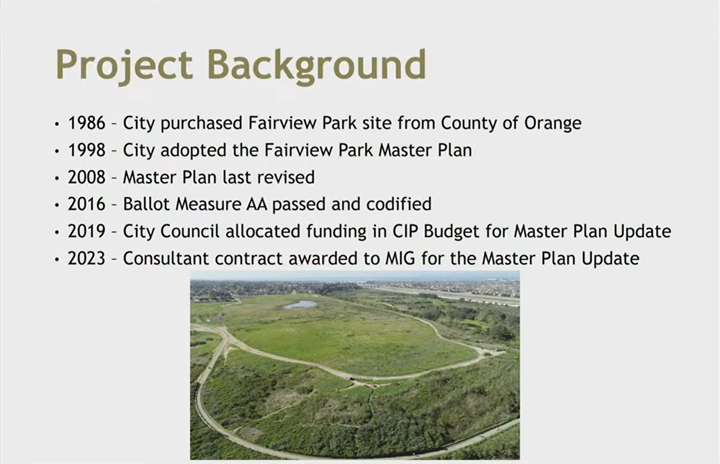
He expressed his preference to “receive and file” the report, which would keep the existing 2008 Fairview Park Master Plan rather than adopt an update. He pointed out that Measure AA affirmed the public’s desire for a preserve, and the creation of the Fairview Park Steering Committee in 2017 provided a mechanism to uphold both Measure AA and the 2008 plan. He believes the Steering Committee should determine which actionable items merit funding.
Buley reiterated his desire to preserve the 2008 Master Plan, arguing that the proposed update would violate the will of the people, subject all park activities to renewed review, and place the City under increased regulatory scrutiny.
At the City Council’s direction, the City contracted with MIG in December 2022 to update the 2008 Master Plan. This effort included commissioning new expert reports on biological conditions, cultural and archaeological resources, and geological and hydrological assessments. Buley’s proposal to retain the outdated 2008 plan would effectively discard all of this work and the significant investment the City has already made.
Gameros began by referencing the recommendations and noted that the trail system is not clearly defined. He called for a clear, concise map distinguishing walking trails from bike trails. He cited the Upper Newport Bay Preserve and its Muth Interpretive Center as an example of a well-marked and monitored trail system, praising its effectiveness. However, his comments overlooked Dalton’s earlier point that the trails plan is still under review and that the CEQA analysis will determine where trails can be located.
Gameros remarked that “perception and intention isn’t lining up,” though he did not elaborate. He asked about sustainability measures for protecting and preserving the vernal pools. On the fly field, he said relocation has “to be worth it,” emphasizing that it should offer more than basic amenities and become a destination people enjoy—similar to the model trains. He acknowledged Measure AA’s prohibition on grading but noted it does not address landscaping. He expressed support for several recommendations, again pointing to Upper Newport Bay Preserve as a model.
I take the phrase “to be worth it” to mean he wants to allow motorized aircraft to fly on the Eastside.
Returning to the model trains, Gameros voiced concern that one track crosses a vernal pool and worried the trains might be removed. He said he wants trains and planes to coexist on the Eastside. He criticized the concept of a “management plan” as too vague and questioned the effectiveness of community partnerships, seemingly unaware that nonprofit organizations currently conduct restoration and preservation work in the park—those partnerships referenced in the MPU, not the train and plane groups.

Gameros proposed dividing the park into two distinct areas with names reflecting their uses. He said the motion on the item should include “What does doing all this stuff do to trigger Measure AA, and what’s going to happen to the constituents when they realize, well, we are going to start disturbing this area that we didn’t want disturbed, but it's mostly for the purpose of putting in ‘landscaping.’” He thinks moving the fly field won’t trigger Measure AA because it is an existing use.
He urged that any motion include clarity on whether proposed actions would trigger Measure AA and warned of constituent backlash if areas intended to remain undisturbed are altered for landscaping. He argued that relocating the fly field would not trigger Measure AA because it is an existing use.
Finally, Gameros suggested that unless the City Council can unanimously approve the MPU, then it should amend Measure AA.
Marr asked for confirmation that a trails plan would be brought back and inquired about resolving the conflict between the Active Transportation Plan (ATP) map with the one in the MPU. Dalton explained that the MPU map will be updated to reflect the final ATP map, and that update will occur before the MPU is finalized. She also suggested separating the trail map as a distinct issue from the MPU. Marr observed that any specific projects in the park would require City Council approval. The City Attorney confirmed that observation.
Marr concluded that, based on the consultants’ and experts’ input and the City’s legal obligations, the decision seemed clear-cut.
Stephens expressed interest in holding a City Council meeting in Fairview Park and stated his agreement with Buley’s position to keep the 2008 Master Plan. He noted that the cut-and-paste emails had an impact on him because, in his view, someone still took the time to send them. He added that he did not consider them to be mere cut-and-paste messages (despite the wording being exactly the same in many of them).
He discussed the long history of efforts to revise the Fairview Park Master Plan, the illegal DG path, the creation of the Fairview Park Citizens Advisory Committee (the one that was stacked with many Mensheimer minions), and the passage of Measure AA, which he characterized as stripping power from the City Council.
He argued that the MPU would replace and amend the 2008 Fairview Park Master Plan, noting that the original plan explicitly referenced “glider flying” and permitted planes in the park. He asserted that Measure AA would not have passed if gliders and planes had been prohibited, then alluded to exaggerated fears surrounding the issue. He went on to describe the creation of the Fairview Park Steering Committee and the City Council’s later decision to only allow silent gliders for only a few hours each month.
Stephens expressed that glider flying opportunities are limited and voiced support for keeping the BMX dirt jumps (the ones that sit atop cultural artifacts). He became emotional when recounting a story about a child who enjoys flying planes. Stephens then stated his belief that there has been no “take” and that regulatory agencies are unlikely to act against the City. The decision on a take would be decided by those agencies and would require an application by the City to be submitted, which would cost the City $50,000 to $100,000 in application fees, plus monitoring that would cost $10,000 and upwards per year. He didn’t touch on who would pay for that.
He talked about enforcement issues, but didn’t talk about how enforcement would be done. He returned to his feeling that the 2008 Master Plan should be preserved because he thinks Measure AA didn’t contemplate that the Master Plan would change. But it does. In Measure AA, there is this definition: “Fairview Park Master Plan” means the document and its amendments approved by the City of Costa Mesa to guide the continuing and future alterations to Fairview Park that have been in effect since November 2008.” [Emphasis added to point out that Measure AA acknowledged that the Master Plan would be amended.]
Stephens then called for a motion. Note that no public comment was allowed.
Motion. Reynolds made a motion, but then revised it during the proceedings. I have redlined her motion so I don’t have to type it twice and you don’t have to read it and find the differences. She moved to:
Proceed with the draft plan;
Modify the draft plan by bringing trails map into consistency with ATP;
Add a speed limit of 10 mph for bicycles;
Fly field
in either existing location oron Eastside for purpose of getting CEQA analysis; andChanges to Tribal work: Interpretive programming, explicitly include collaboration and coordination with Tribes; signage – multilingual – incorporate tribal languages as supported by Tribes; page 65 – cultural and restoration – add recommendation to establish ongoing communication and collaboration with Tribes.
Seconded by Marr (second concurred with changes).
Reynolds later added a separate motion to separate the actions on tribal interaction to:
Direct Staff to continue engagement with the tribal advisory group and bring back a proposal for the City Council for ongoing relations with Tribal governments;
Engagement for interpretive signage and other park programming, site access and use; and
Any other recommendations prioritized by the Tribes.
Substitute Motion by Buley: Don’t amend and restate the plan; leave the 2008 Master Plan as is, but add Recommendations Nos. 8, 16, 18, 19, 24 and 25.
For your information, here is the text of those Recommendations (he didn’t read them):
#8: Provide for a potential native plant growing space on the east side of Fairview Park in a location that avoids impacts to native habitat. The growing space shall be planned and designed in consultation with a qualified restoration ecologist.
#16: Adopt the Maintenance, Operations, and Management Plan for Fairview Park, including the Invasive Species Management Plan for Fairview Park.
#18: Provide continuing opportunities for tribal coordination and participation in the implementation of the Updated Fairview Park Master Plan.
#19: Provide an ADA-accessible pathway from the main parking lot to the existing paved multipurpose path west of the main parking lot.
#24: Incorporate a native pollinator area to attract butterflies and other pollinators. The native pollinator area would replace the ornamental vegetation, including invasive species currently located in the planter area.
#25: Based on community input - consider renaming the site to reflect the site's natural and cultural resources.
Marr asked how the City Council reconciles the fact that it is just recognizing old data when it has new data? Buley spoke, but didn’t provide a what I perceive to be truthful answer to the question.
Stephens spoke about the failure of the City to do many of the projects in the 2008 Master Plan. He’s been on the City Council since 2016, so that’s on him.
Gameros stated that he thinks that HSS should be able to use electric motors and won’t be limited to gliders. He wanted to make another substitute motion, but that is not allowed when one substitute motion is already on the floor.
Vote on Substitute Motion. Buley’s motion failed 3-4, with Reynolds, Marr, Chavez and Gameros voting “No.”
Vote on Original Motion: Reynolds made the redlined changes above. That revised motion passed on a vote of 4-3, with Pettis, Stephens and Buley voting “No.” Members of the audience applauded. The few HSS members got up and left. The second motion passed 6-1, with Pettis voting “No.”
NEW BUSINESS: Three items here:
1. Bridge Shelter Beds Amendment. Nate Robbins, Neighborhood Improvement Manager, gave the presentation. Newport Beach indicated that next year it wishes to alter the agreement with Costa Mesa to reduce its allocation from 25 beds to 20, with flexibility for 5 extra if available, but at an increased cost per bed; in 2027 Newport would no longer have access to the shelter.
Annual cost drops from $1,359,225 to $1,189,880.
Net revenue loss for Costa Mesa: $169,345.
Councilmember Questions and Comments. Buley asked whether Newport’s reduction in beds would cause the shelter to operate at a loss. Robbins responded that the shelter already operates at a loss because the City receives no grant funding or other financial support to provide services for Costa Mesa’s unhoused population. Buley then asked Finance Director Carol Molina about charging Newport additional fees to offset costs. Molina explained that Newport is charged overhead and per-bed costs to cover administrative expenses, but with the loss of revenue from Newport, the City’s deficit will increase.
Reynolds inquired what would happen to Newport’s unhoused once the contract ends. Robbins expressed confidence that he or Newport could secure alternative housing for them.
Chavez asked if other cities were interested in partnering with Costa Mesa. The City Manager confirmed that another nearby city has approached the City, and a multi-year contract is being prepared for Council review. Chavez also asked why the City is no longer receiving State funds. Gallardo-Daly explained that the lack of a certified Housing Element has prevented the City from receiving funds for the past two years. WELL, THAT’S A BOMBSHELL!
Public Comments. None.
Motion and Vote. Chavez moved to approve the Staff recommendation. which was seconded by Stephens. The City Attorney requested that language be added to make Newport responsible for placing its own unhoused when the agreement terminates. The motion passed 6-0, with Marr absent as she had left the meeting.
2. Exploration of Ballot Initiatives Pertaining to (a) Transient Occupancy Tax (TOT) and (b) Business License Tax. Molina gave the presentation. This item has been before the Finance and Pension Advisory Committee (FiPAC) twice, with FiPAC formally requesting that the City Council authorize Staff, in coordination with FiPAC, to conduct a comprehensive review and analysis of both items as potential revenue sources for the City. The fiscal review shows:
The fiscal impact of placing an initiative on a previous November ballot was $25,000; the cost of citywide mailings was about $10,000.
City revenues could increase by $1 million for every additional 1% of TOT above the current 8%.
City’s revenues could increase in line with the percentage rise of any business license tax increases; however, the estimated absolute amount of the increase to City revenues would be contingent on the extent and structure of the increases from current levels within each revenue category.
Costa Mesa lags on the TOT compared with other cities. In addition, other cities generate more than Costa Mesa’s $700,000 to $900,000 in business license taxes:
Anaheim $7.5 million
Huntington $3 million
Beverly Hills $64 million
Newport Beach $4.9 million
Santa Ana $17.5 million
Staff recommends not increasing the fees for small businesses. FiPAC has requested City Council approve extra staff time for the Committee to work with the Finance Department on determining more information and a recommendation for the City Council.
Councilmember Questions and Comments. Buley asked if this was cost recovery, and Molina said yes, but the City cannot make a profit on these taxes. He asked if the research into these taxes would require more work. Molina said the business license structure could be looked at about 10 separate ways, so “Yes.”
Reynolds asked if it was correct that the Business License Tax hadn’t changed since 1985. The answer was “Yes.” She said that is frightening that it is as old as she is. She asked about a CPI increase and Molina said that would require investigation because it may or may not be allowed. She asked about the deadline and Molina said the last date could be in August.
Public Comments. David Martinez ask why these two items were being reviewed, but not sales tax? He said Irvine has a utility users tax. And other cities have other taxes that may be considered.
Motion. Stephens moved to approve the Staff recommendation to explore increasing these taxes for the 2026 ballot; that was seconded by Chavez. Chavez spoke on regressive taxes, such as sales taxes, that impact everyday expenditures and marginalized communities, and it isn’t likely to get past the voters because, frankly, we don’t like taxing ourselves. In terms of the business tax, he was born in 1995, which it is ten years after the last update. It’s a 40-year correction.
Buley made a substitute motion to limit the review to the TOT only; seconded by Pettis. He is concerned about driving away business by raising taxes, with the result being a reduction in the collection of sales taxes. Pettis said it is important that the perception is that we are doing well in business licensing.
Vote. The substitute motion failed 4-2, with Reynolds, Chavez, Stephens, and Gameros voting “No.” The original motion carried 4-2, with Pettis and Buley voting “No” and Marr absent.
3. Employment Agreement for City Manager, Cecelia Gallardo-Daly. Ms. Gallardo Daly said she was going to leave the dais for the discussion, but the City Attorney Barlow said she didn’t have to, so she stayed. Barlow gave the presentation. The proposed contract is for:
Salary of $320,000 annually, with the caveat that the base salary is at least 10% higher than the highest paid executive; on July 1, 2026, a 10% compaction issue with the Assistant City Manager classification is expected to raise the annual base salary to $328,296.
Deferred compensation of $50,000 annually, starting in January 2026, increasing by $5,000 every year thereafter, subject to the maximum contribution limits allowed by Federal Law to a 401(a) deferred benefit account.
Same benefits as provided to other City executives.
Use of City automobile.
Forty hours of executive leave per year; the Mayor and City Council may award Employee an additional sixty (60) hours of executive leave annually.
Term of three years, terminable at will, except within ninety (90) days after any municipal election for the selection or recall of one or more of the members of the City Council.
If termination is without cause, there would be a severance payment of one year’s base salary. Termination with cause would not require any severance payment.
The estimated annual fiscal impact for the City Manager’s services is $451,700: $320,000 in salary and $131,700 in benefits, not including the City-assigned vehicle.
Councilmember Questions and Comments. Reynolds asked about the development of performance goals and why those would be developed by an ad hoc committee for the first year. The City Attorney gave a nonanswer. Reynolds suggested that the City Council and the City Manger will develop performance goas.
Public Comments. None.
Motion. Gameros moved to approve Gallardos Daly as the City Manager; seconded by Stephens who had to remind Gameros to include Reynolds revision. I find that rich in light of Gameros and Stephens involvement in the removal of the prior City Manager and the ongoing lawsuit in that matter.
Vote. The motion carried 6-0 with Marr absent.
AND THAT IS IT FOR 2025. Don’t expect to see another missive from us until 2027! We wish you the best holidays, and health and happiness in the New Year.
ALSO, A BIG THANK YOU to those of you who have given monetary donations and words of support this year. They mean more to us than you can imagine. Our heartfelt thanks to you for supporting our mission to keep Costa Mesa residents informed and involved. Don’t forget to keep us in your holiday donations by giving to us at: https://www.costamesa1st.com/donate
Comments