CITY COUNCIL MEETS TUESDAY FOR A HEARING THAT COULD IMPACT EVERY NEIGHBORHOOD IN THE CITY
🚨Save the date: November 17, when the City Council is expected to review the Fairview Park Master Plan Update and the Flock ALPR contract.
🏛️ The Costa Mesa City Council meets next Tuesday, October 20, 2026, and the agenda is packed with significant items. Don't expect an early adjournment.
One of the final public hearings on the agenda could affect residents citywide by rezoning properties throughout Costa Mesa. Why does this matter? Scroll down to my commentary on Public Hearing No. 5 for a closer look at what is being proposed and why it could have long-term implications for the community.
📅 Date & Time: Tuesday, October 20, 2026, at 6:00 p.m.
🔒 Closed Session begins at 4:00 p.m.
📍 Location: City Council Chambers, 77 Fair Drive
📄 Agenda: Can be found here.
🔒 CLOSED SESSION: There are 10 closed-session items scheduled for discussion:
Three conferences with labor negotiators:
Costa Mesa Executive Employees,
Costa Mesa Costa Mesa Fire Association, and
Costa Mesa Costa Mesa Fire Management Association.
Existing litigation, five active lawsuits are on the Agenda:
Three involving The Ohio House, LLC, or its owners
One with the California Attorney General and the Housing and Community Development. ). The State recently extended the City's deadline to respond to the Petition for Writ of Mandate until October 23 because:
“The Parties have engaged in initial settlement discussions to determine if the dispute can be resolved and wish to continue further discussion.”
Will the City Attorney provide an update on those negotiations? Probably not. The City rarely comments publicly on active litigation.
One with Disability Rights California. On October 15, the City filed a response that largely avoids the merits of the organization's claims. Instead, the City is asking the court to fast-track only the Housing Element challenge while placing the remaining discrimination, zoning, and related claims on a slower litigation track. Why is this significant? The filing suggests that the City wants to avoid any delay in resolving questions surrounding Housing Element compliance while litigating the other issues separately.
Real property negotiations involving the property located at 3303 Hyland, which is where Ferguson Home is located. Again, The agenda states that the item is “Under Negotiation: Price and Terms of Payment,” but doesn’t say why the City is interested in the property.
Anticipated litigation, one case (meaning City officials believe a lawsuit may be filed against it soon). Who could that be? One possibility is former Finance Director Carol Molina, whose name appeared in claim documents included in the reading file for the City Council's previous meeting. However, there is currently no evidence connecting her to this agenda item.
🏛️ REGULAR SESSION
An interesting detail in this agenda is that the meeting is being conducted jointly by the:
Costa Mesa City Council,
Costa Mesa Housing Authority,
Costa Mesa Financing Authority, and
Costa Mesa Public Financing Authority.
While that may seem unusual, it appears necessary because Public Hearing No. 3 requires action by multiple governing bodies.
📜 PRESENTATIONS: A proclamation will be read for Breast Cancer Awareness Month.
🎤PUBLIC COMMENTS: This is the time for YOU to comment for THREE FREE minutes on ANYTHING that is not on the agenda.
📌 IMPORTANT! WRITTEN PUBLIC COMMENTS AND VISUAL PRESENTATIONS MUST BE SUBMITTED BY NOON TO BE SCREENED AND PUBLISHED ON THE CITY'S WEBSITE.
🗂️CONSENT CALENDAR: Most Consent Calendar items are routine, but Item 3, the Warrant Resolution, deserves a closer look.
Among the expenditures is a $60,547 payment to the City of Fullerton for Costa Mesa's membership in the Integrated Law and Justice Agency of Orange County (ILJAOC). Through a joint powers agreement involving approximately 23 Orange County public agencies, member jurisdictions share the costs of operating and maintaining the regional information system. ILJAOC provides technology and data-sharing services that support law enforcement agencies throughout Orange County.
Another noteworthy payment is $1,075,013.34 to Kalban, Inc. for alley improvement projects. While modernizing city infrastructure is never inexpensive, Costa Mesa appears to be nearing the end of its multi-year alley improvement program.
📑PUBLIC HEARINGS: There are five public hearing items on the agenda.
1. Continuation Request—Consolidated Master Fee Schedule. The Finance Department is requesting that the public hearing on the Consolidated Master Fee Schedule be continued to November 17, 2026.
This item has been delayed multiple times. It was originally scheduled for August 4, then moved to September 15, later postponed to October 20, and is now being pushed to a November meeting that is already shaping up to be one of the busiest of the year (more on that below).
The repeated delays raise the question of why the City has not yet brought the updated fee schedule forward for discussion. Regardless of the reason, residents interested in potential fee changes will now need to wait another month before the matter is considered.
2. Appeal Of Planning Commission Decision Regarding The Ohio House Sober Living Home. If you've been following Costa Mesa's long-running dispute with The Ohio House, here's the latest chapter.
At its October 6 meeting, the City Council voted unanimously to send this matter back to the Community Development Director for reconsideration. The remand was intended to allow staff to evaluate the request under anticipated changes to the City's reasonable accommodation procedures resulting from recent state law changes.
I prefer to get the bad news out of the way first, so here it is: Staff is recommending that the City Council approve a Conditional Use Permit (CUP) allowing The Ohio House to continue operating its sober living facility at 115 East Wilson Street.
The facility consists of five residential units housing up to 45 residents, along with live-in managers, and has operated at this location since 2012. If approved, the project would remain subject to an Operator's Permit, operational requirements, and ongoing City oversight. The CUP could also be modified or revoked if the operator fails to comply with permit conditions or creates a public nuisance.
What's the main issue?
The controversy centers on Costa Mesa's separation requirements for sober living homes.
City code generally requires similar facilities to be separated by at least 650 feet. The Ohio House is located approximately 550 feet from another City-approved sober living home at 165 East Wilson Street, creating a 100-foot separation shortfall.

However, the code allows exceptions when the reviewing authority determines that granting relief will not create an overconcentration of similar uses. Following the City Council's remand, the Community Development Director approved a reasonable accommodation on October 13, including relief from the separation requirement and approval of an Operator's Permit.
How did we get here?
The City's 2019 denials of reasonable accommodation and CUP requests led to years of litigation. Both the federal district court and the Ninth Circuit ultimately upheld the City's earlier decisions.
In 2025, The Ohio House submitted a new reasonable accommodation request, arguing that circumstances had changed and citing housing and fair-housing considerations. The request was again denied by Staff and the Planning Commission, leading to the appeal before the City Council.
After the Council's unanimous remand earlier this month, the Director approved the reasonable accommodation request, bringing the CUP back for reconsideration.
Why is Staff recommending approval?
According to Staff, the facility is compatible with the surrounding area because it is located in a multifamily neighborhood near Newport Boulevard and the 55 Freeway and has operated for more than a decade without materially changing the character of the area.
Staff also found that the project is consistent with General Plan policies supporting housing opportunities for individuals with specialized needs, including those protected under state and federal disability laws.
The facility would remain subject to operational rules, permit conditions, and enforcement mechanisms intended to address potential neighborhood impacts.
Issues residents may be concerned about:
While Staff recommends approval, several issues are likely to draw attention during the hearing:
Neighborhood impacts: The facility can house up to 45 residents across five units, making it one of the larger group living arrangements in the area.
Noise and nuisance concerns: Conditions require the operator to maintain a Good Neighbor Policy, provide contact information to nearby residents, and take reasonable steps to preserve neighbors' quiet enjoyment.
Parking: The property contains 20 parking spaces, and permit conditions require those spaces to remain available and accessible. Whether that supply is adequate for a facility of this size may be a topic of debate.
Public safety and code compliance: The facility must maintain an Operator's Permit, obtain fire clearance, comply with applicable laws, and may face additional review if it generates an excessive number of calls for City services.
Property maintenance: Conditions require ongoing landscaping, site maintenance, and proper trash handling.
Operational changes: Significant changes to house rules, resident intake criteria, or management practices would require City review and potentially additional approvals.
One issue raised by neighboring residents involved second-hand smoke. In response, The Ohio House indicated it will purchase smoke-filtration devices, reevaluate its designated smoking area, and ensure neighboring properties have current management contact information.
My takeaway: Barring an unexpected development, Staff is recommending approval of the CUP and has concluded that The Ohio House can continue operating at its current location despite not meeting the City's standard 650-foot separation requirement. The key question for the Council will be whether the existing operational conditions are sufficient to protect nearby residents while accommodating housing for individuals in recovery.
But let's ask the obvious questions. If this reasonable accommodation is approved, what prevents other operators from seeking the same relief? If enough exceptions are granted, does the City's 650-foot separation requirement become effectively meaningless? And if the City refuses to "repeal and replace" that ordinance as demanded by the State, will the Housing and Community Development withhold certification of the Housing Element?
The Agenda Report does not explore any of these possibilities. However, they are critical questions for residents because the answers could shape land-use policy, neighborhood character, and the future distribution of sober living homes across Costa Mesa for years to come.
Finally, the City spent a lot of money on lawyers to fight The Ohio House for years. I have to wonder what kind of advice the City was getting.
3. 2026 Lease Revenue Bonds For Fire Station No. 2 Reconstruction Project. The City Council and the Costa Mesa Financing Authority are being asked to approve a financing plan that would authorize the issuance of up to $16 million in Lease Revenue Bonds to fund the reconstruction of Fire Station No. 2 at 800 Baker Street. Note that this is related to New Business Item 1 below.
In simple terms, the City plans to borrow approximately $14 million through bonds, with the remaining project costs covered from City reserves. The bonds would have a 20-year term, although they could be prepaid without penalty after 10 years. Annual debt-service payments would come from the General Fund and would reduce the amount otherwise transferred each year to the City's Capital Asset Need Fund.
Why rebuild the station? Fire Station No. 2 was constructed in 1966 and no longer meets modern operational, accessibility, capacity, or building-code standards.
The proposed replacement would be a 9,445-square-foot LEED Gold-certified facility featuring:
Expanded living quarters with gender-neutral accommodations;
A larger apparatus bay for emergency vehicles;
Modernized mechanical, electrical, and plumbing systems;
Improved operational workspaces; and
Enhanced site circulation and functionality.
Construction costs are estimated at approximately $14.8 million, with the total project budget, including contingency funding, estimated at $16.3 million. The project is expected to take about three years from pre-construction through completion.
How would the financing work? To issue the bonds, the Costa Mesa Financing Authority (Authority) would conduct a negotiated sale through Stifel Nicolaus & Company, Inc.
Under the proposed structure, the City would lease Fire Stations No. 1 and No. 2 to the Authority and then lease them back. The City's semiannual lease payments would secure repayment of the bonds. Once the new Fire Station No. 2 is completed, Fire Station No. 1 would automatically be removed from the lease arrangement.
This financing method (often called the Offner-Dean Lease Exception) is commonly used by California cities because it allows infrastructure projects to move forward without requiring voter approval of a traditional bond measure.
What will it cost taxpayers? The City estimates:
Approximately $14 million in principal borrowing, capped at $16 million;
A true interest cost of approximately 5%, capped at 6%;
An underwriter's discount capped at 0.70%; and
Annual debt-service payments of roughly $1.13 million.
Interest payments would begin on April 1, 2027, with principal payments starting on October 1, 2027. The bonds would mature on October 1, 2046.
Timeline: If approved, the bonds are expected to be priced on November 4, 2026, with the transaction closing and funds becoming available on November 19, 2026.
My Takeaway: This is a significant investment, but unlike some capital projects, the need is relatively straightforward. Fire Station No. 2 is now 60 years old and was built for a very different era of firefighting and emergency response. The real policy question for the Council is not whether the station should be replaced, but whether borrowing approximately $14 million over 20 years is the best way to pay for it rather than relying more heavily on existing reserves or future capital funding.
Before the City commits to borrowing up to $16 million to rebuild a fire station, a few questions deserve answers.
First, where was the oversight? The Finance and Pension Advisory Committee did not review this financing proposal, even though it involves a long-term debt obligation that will affect City finances for decades.
Second, under normal circumstances, residents would expect a proposal of this magnitude to receive scrutiny from the City's Finance Director. However, Costa Mesa has been without a Finance Director since March, meaning the public has not benefited from that level of independent financial review. Instead, the analysis has been conducted by Staff, including Budgeting and Purchasing Manager Mark Khou, with assistance from consultant Kingsley Okereke.
There is also the question of escalating costs. The project was initially discussed as a $12 million undertaking, with approximately $2 million set aside to help reduce borrowing costs. Later estimates increased to $14 million, and the proposed bond authorization now climbs to $16 million.
We know annual debt service is projected at approximately $1.13 million and that the bonds may be prepaid without penalty after ten years. But what are the costs of paying the debt off before that point? More importantly, while the station itself may take only a few years to build, the City could be making payments on the project until 2046. As with any financed purchase, the true cost is not simply the construction price, but the construction price plus decades of interest payments.
This project has been under discussion for years. During that time, construction costs, labor costs, material costs, and interest rates have all increased. Now, as forecasts point to a potentially wet winter that could delay construction, the City is finally moving forward with the financing and the project.
I understand that major public projects take time. But after years of planning and rising costs, it's fair to ask whether this timeline has served taxpayers well.
4. Safety Element Update, Climate Action and Adaptation Plan, and Environmental Justice Policy Review. This item was continued from the September 15 City Council meeting. Staff is recommending approval of a comprehensive update to the General Plan Safety Element, adoption of the City's first Climate Action and Adaptation Plan (CAAP), and revisions to Environmental Justice (EJ) policies. Together, these initiatives establish a coordinated framework to enhance public safety, climate resilience, and environmental equity throughout Costa Mesa.
Safety Element Update:
Updates the General Plan to address current natural and human-caused hazards, emergency preparedness, and climate adaptation strategies.
Incorporates the latest hazard data from the Local Hazard Mitigation Plan and aligns with state requirements.
Strengthens coordination with Environmental Justice policies to better protect vulnerable and underserved populations.
Climate Action and Adaptation Plan (CAAP):
Establishes Costa Mesa’s first comprehensive climate strategy to reduce greenhouse gas emissions and prepare for climate-related impacts.
Focuses on transportation and building energy use, which are identified as the city’s largest sources of emissions.
Includes adaptation measures for extreme heat, drought, flooding, and other climate risks across eight sectors, including transportation, energy, water, waste, natural resources, and community resilience.
Emphasizes measurable implementation actions, ongoing performance monitoring, and the use of grants and partnerships to support funding.
Environmental Justice Policy Review:
Updates General Plan policies to comply with state Environmental Justice requirements and address community health disparities.
Prioritizes reducing pollution exposure, expanding access to healthy food and essential services, improving community resources, and increasing public participation in decision-making.
Enhances policies supporting urban agriculture, recycling education, and access to cooling centers in underserved neighborhoods.
Environmental and Fiscal Considerations:
The proposed plans are exempt from CEQA because they establish policy direction and do not authorize specific development projects.
Future implementation measures will be subject to available funding and City Council approval, with an emphasis on leveraging external funding opportunities.
Overall Impact: These updates provide a long-term roadmap for improving community resilience, advancing environmental justice, and protecting public safety while supporting Costa Mesa's sustainability and quality-of-life goals.
5. Measure K Proposed Zoning Code Amendment, Zoning Map Update, and Establishment of Citywide Multifamily Residential and Mixed-Use Objective Design Standards; Repeal of Urban Plans; Overrule of Orange County Airport Land Use Commission’s Determination that Measure K Rezoning and Housing Element Implementation is Inconsistent with the John Wayne Airport Environs Land Use Plan; Certification of Measure K Rezoning and Housing Element Implementation Final Program Environmental Impact Report; Amendments to Circulation, Community Design, Land Use, Noise, and Open Space and Recreation Elements of General Plan; Readoption of Housing Element of General Plan; and Amendments to Newport Boulevard Specific Plan, North Costa Mesa Specific Plan, and One Metro West Specific Plan.
🚨 Here's the Big One🚨
If there is one item on this agenda that will shape the future of Costa Mesa for decades, this is it.
The City Council is being asked to approve a sweeping package of zoning, planning, environmental, and General Plan amendments designed to implement both Measure K and the City's state-mandated Housing Element. The proposal affects more than 1,000 properties throughout Costa Mesa and would significantly expand opportunities for multifamily and mixed-use development over the next 30 years.
In short, this could reshape where and how Costa Mesa grows.
What is being proposed?
The City would expand the Mixed-Use Overlay District (MUOD) across most Measure K and Housing Element sites throughout Costa Mesa. According to the City's analysis, the proposal would create capacity for approximately:
22,441 housing units with an estimated increase of more than 51,000 additional residents, and
10.46 million square feet of commercial and nonresidential development
through the year 2056.
Here is a map of the affected properties:
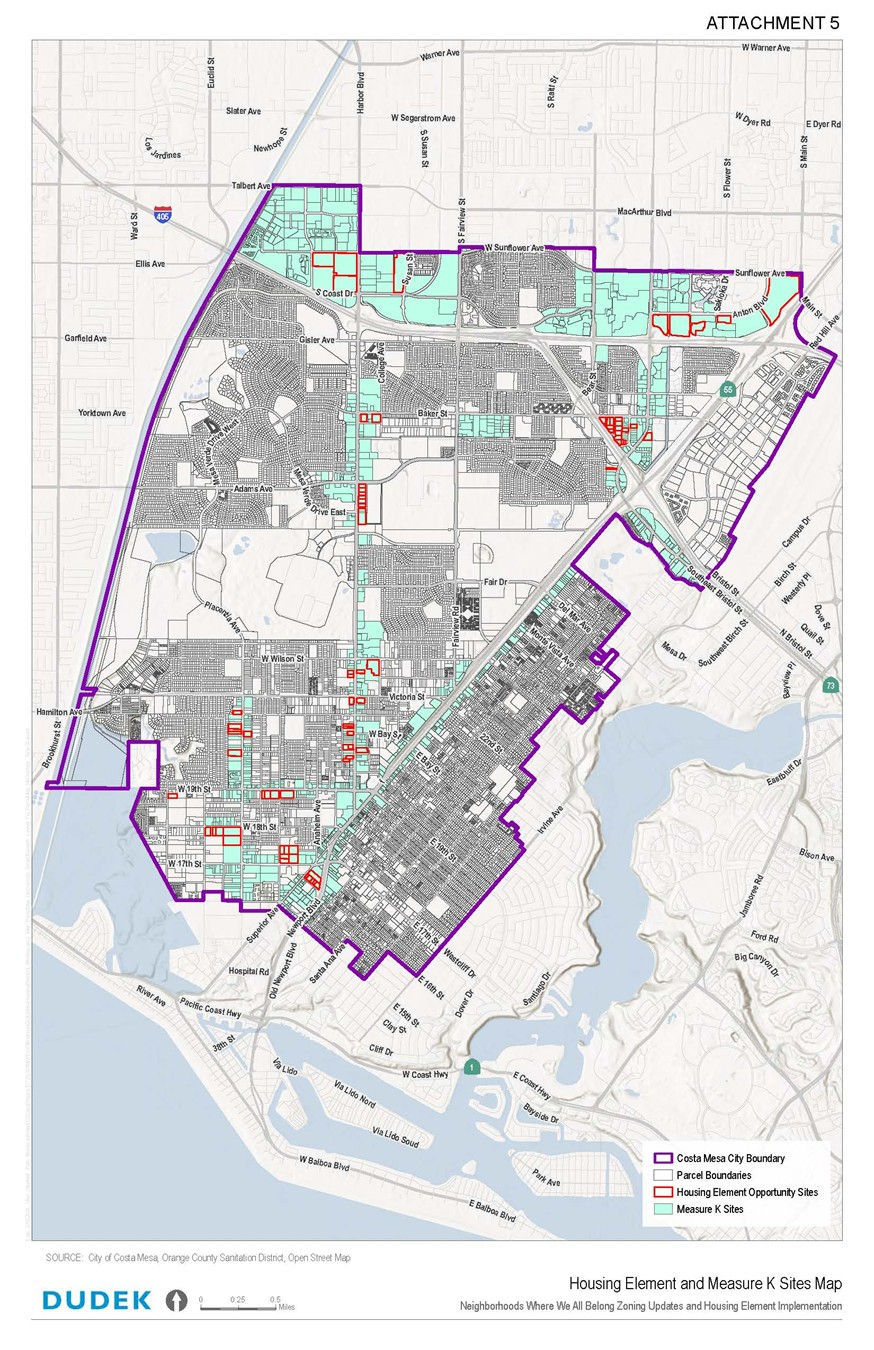
The proposal is intended to help the City satisfy its state housing obligations. Costa Mesa's Housing Element requires planning for 11,760 new housing units between 2021 and 2029, including 2,919 units for very-low-income households.
To accomplish this, the City would:
Expand the MUOD across eligible sites.
Amend the Zoning Code and Zoning Map.
Amend multiple elements of the General Plan.
Update the Newport Boulevard, North Costa Mesa, and One Metro West Specific Plans.
Adopt new citywide objective design standards for multifamily and mixed-use buildings of three or more stories.
Repeal four long-standing urban plans, including SoBECA, 19 West, Mesa West Bluffs, and Mesa West Bluffs Residential Ownership.
The goal is to create a more uniform, predictable development process that relies less on discretionary review and more on objective standards.
How much development are we talking about? The answer depends on location. The proposed development standards range from relatively modest densities in some areas to significantly higher intensities in others:
Mesa West Bluffs and 19 West: 20 to 30 dwelling units per acre (du/ac) and heights up to 60 feet.
Newport Boulevard and Harbor Boulevard corridors: 30 du/ac and heights up to 60 feet.
SoBECA: 40 du/ac and heights up to 60 feet.
North Costa Mesa: 60 du/ac and heights up to 72 feet.
Certain North Costa Mesa Housing Element sites: up to 90 du/ac and heights reaching 108 feet.
The City is also proposing new objective design standards intended to regulate building massing, architecture, setbacks, landscaping, lighting, open space, parking design, and transitions adjacent to lower-density neighborhoods.
Projects would generally require environmental, traffic, and noise studies. Commercial outdoor activity, including loading and deliveries, would be prohibited from 10 p.m. to 7 a.m. in MUOD projects. Larger commercial projects would also need publicly accessible open space, ranging from 2% to 5% of commercial floor area.
The airport issue. One of the most controversial aspects of the proposal involves the Orange County Airport Land Use Commission (ALUC).
ALUC determined that portions of the Measure K rezoning program are inconsistent with the John Wayne Airport Environs Land Use Plan.
Rather than revising the project to satisfy ALUC, the City is proposing to overrule that determination through a two-thirds vote of the City Council.
In response to ALUC's concerns, the City has already narrowed portions of the proposal by excluding many properties in airport safety zones and high-noise areas from the MUOD, including Westside properties like Cla-Val.
Even so, the City maintains that its existing noise standards, airport-disclosure requirements, acoustical studies, and FAA review procedures adequately protect future residents.
What does the Environmental Impact Report say? This is where things get especially interesting.
The Final Program Environmental Impact Report concludes that the proposal would result in significant and unavoidable cumulative impacts, even after mitigation measures are applied.
Those impacts include:
Aesthetics
Air quality
Greenhouse gas emissions
Biological resources
Cultural and tribal cultural resources
Geology and soils
Hazardous materials
Noise
Population and housing impacts
Recreation
Agricultural and forestry resources
The report identifies two environmentally superior alternatives:
Alternative A: No Project Alternative. This option would avoid many impacts but would not achieve the City's Measure K or Housing Element objectives.
Alternative B: Housing Element Sites Only Alternative. This is the alternative that deserves the closest attention.
According to the EIR, Alternative B would still allow Costa Mesa to satisfy its Regional Housing Needs Allocation (RHNA) requirements and continue implementing its certified Housing Element while substantially reducing environmental impacts compared to the proposed project.
In other words, the City's own environmental analysis concludes there is a middle-ground option that would still achieve state housing compliance while producing fewer environmental impacts than the project currently before the Council.
The Council is being asked to adopt a Statement of Overriding Considerations alongside EIR certification.
My Takeaway: This is not just another zoning amendment. It is arguably the most consequential land-use decision the City Council will make this year.
Supporters argue that the proposal is necessary to comply with state housing laws, maintain Housing Element certification, and create opportunities for new housing near jobs, transit corridors, and commercial centers.
Critics counter that the proposal creates capacity for far more housing than Costa Mesa's Regional Housing Needs Allocation (RHNA) requires, overrides long-standing planning documents, accepts significant and unavoidable environmental impacts, and proposes overruling the Orange County Airport Land Use Commission's findings regarding airport compatibility.
The key question is not whether Costa Mesa must comply with state housing law. It must.
The real question is whether the City has struck the right balance between meeting those obligations and protecting neighborhood character, infrastructure capacity, environmental quality, and local control. Notably, the Environmental Impact Report suggests there may be more than one path to compliance, and Tuesday's hearing will help determine which path Costa Mesa chooses.
Another significant aspect of the proposal is that it shifts many housing approvals from public hearings before elected and appointed officials to staff-level ministerial review. While this approach is intended to streamline housing development and comply with state law, it also means there will be fewer opportunities for residents to provide input on projects that may directly affect their neighborhoods and daily lives.
City officials emphasize that the goal is to add housing without broadly upzoning existing residential neighborhoods, instead directing growth to commercial and industrial properties where mixed-use development can be supported by existing services and infrastructure. However, the agenda report does not suggest that existing neighborhoods will be unaffected. To the contrary, the Environmental Impact Report identifies several significant impacts that cannot be fully mitigated, meaning the effects of these policy decisions could be felt throughout Costa Mesa.
Commentary: Will This Improve Housing Affordability? One question that remains largely unanswered is how this proposal will improve housing affordability for future homeowners.
When a property receives entitlements for greater density, its land value often increases because developers can build more units on the site. Higher land values can make projects more expensive to develop and may encourage builders to maximize density through large apartment projects rather than construct for-sale housing such as condominiums, townhomes, or stacked flats.
If most of the new housing created under these policies consists of rental units, how does that help young families and first-time buyers achieve homeownership? Without additional ownership opportunities, many residents may continue facing rising rents while having fewer opportunities to build personal wealth through homeownership.
There is also the broader question of whether increasing development capacity alone will reduce housing prices. Historically, new development has often coincided with rising property values in surrounding neighborhoods. Whether this proposal will meaningfully improve affordability for middle-income residents remains an open question that deserves careful discussion.
Where’s the Planning? Measure K was presented as a community-driven approach to accommodating growth while protecting Costa Mesa's neighborhoods, quality of life, and unique character. Residents were asked to give up voter approval of future development projects based on assurances that growth would be guided by transparent planning, meaningful community engagement, and thoughtful development standards.
Throughout the Measure K and Housing Element outreach process, residents consistently supported a vision that included diverse housing options, walkable neighborhoods, parks and open space, improved mobility, sustainable design, adequate parking, and development that respects surrounding neighborhoods. Just as importantly, residents emphasized transparency, public involvement, and preserving the character that makes Costa Mesa unique.
Yet those priorities are difficult to find in this proposal.
Costa Mesa already faces a shortage of public open space, yet no new parks are planned to serve the projected growth. Minimum parking requirements have largely been eliminated, and much of the new housing is expected to be apartment-style development. More than 51,000 additional residents will place increased demands on police, fire protection, roads, parks, utilities, and other city services, yet no comprehensive financial analysis has been prepared to estimate the costs of serving that growth or the long-term expenses associated with maintaining new infrastructure.
While every neighborhood will experience the impacts of this growth, there is little evidence of a broader plan to address or mitigate those effects. Instead, residents are being told that these impacts should simply be accepted because the housing is deemed necessary.
This is not the comprehensive planning process many residents believed Measure K was intended to deliver.
Housing Element Certification Remains Uncertain. It is also important to recognize that approval of this package does not automatically guarantee Housing Element certification.
In an August 21 letter, the California Department of Housing and Community Development (HCD) stated that Costa Mesa's Housing Element "can" be found in substantial compliance if specified issues are addressed. The letter did not state that certification will be granted.

Moreover, ongoing litigation involving both the State of California and Disability Rights California adds another layer of uncertainty. While City staff believes these actions will move Costa Mesa closer to compliance, the timeline and ultimate outcome of Housing Element certification remain unclear.
For that reason, Tuesday's vote is likely not the end of this process. Rather, it may be one of the most significant milestones in a larger debate about how Costa Mesa grows, where housing should be located, and what trade-offs residents are willing to accept in the years ahead.
🚨 Why This Matters. This vote is about much more than zoning maps and planning documents. The decisions made Tuesday night will influence how Costa Mesa grows for decades to come.
The proposal affects more than 1,000 properties citywide and creates capacity for approximately 22,441 housing units and more than 51,000 additional residents. It would establish the development rules that shape future projects along major corridors, in mixed-use areas, and on many of the sites identified in Measure K and the Housing Element.
The Council is also being asked to:
Overrule the Orange County Airport Land Use Commission's objections to portions of the plan.
Certify an Environmental Impact Report that identifies significant and unavoidable impacts.
Repeal several long-standing urban plans.
Shift many future housing approvals from public hearings to staff-level ministerial review, reducing future opportunities for public input.
Perhaps most importantly, the City's own Environmental Impact Report identifies an alternative that would still allow Costa Mesa to meet its state housing obligations while significantly reducing environmental impacts. The Council must decide whether to pursue the broader rezoning proposal or a more limited approach.
Regardless of where you stand on housing growth, this hearing will help determine the balance between housing production, neighborhood character, environmental impacts, infrastructure demands, public participation, and local control.
📢 Call to Action! If you care about the future of Costa Mesa, this is the meeting to attend.
Whether you support the proposal, oppose it, or simply want to better understand how it may affect your neighborhood, Tuesday's hearing is your opportunity to hear directly from City staff, ask questions, and make your voice heard before the Council votes on one of the most significant land-use decisions in recent city history.
Too often, major planning decisions attract attention only after new development projects are proposed. By then, many of the rules have already been established.
This is the meeting where those rules are being written.
The City Council needs to hear from residents before it decides how Costa Mesa will accommodate future growth, where that growth will occur, and what trade-offs the community is willing to accept.
🕰️ OLD BUSINESS: None.
🆕NEW BUSINESS: One Item, but it is related to Public Hearing 3 above.
1. Award Of The Fire Station No. 2 Reconstruction Project. Following the discussion of how to finance the new Fire Station No. 2, the City Council will also consider awarding the construction contract and approving several related agreements needed to move the project forward.
Staff is recommending that the City Council:
Adopt the project's plans, specifications, and working details.
Award a construction contract to AMG & Associates, Inc. for $14,821,000, plus a 10% contingency of $1,482,100, for a total authorized construction amount of $16,303,100, contingent upon approval of the bond financing.
Extend the agreement with PBK-WLC Architects through February 2030 for architectural and engineering support during construction.
Extend the agreement with Solis Group through April 2030 to administer the project's Community Workforce Agreement (CWA) at an estimated cost of $91,800.
Authorize the City Manager and City Clerk to execute the agreements and future amendments within the limits authorized by the City Council.
Why is the project needed? The existing Fire Station No. 2, located at 800 Baker Street, was built in 1966 and has exceeded its useful life. According to staff, the facility no longer meets modern operational, maintenance, accessibility, and service needs.

The replacement station would be a 9,445-square-foot LEED Gold-certified facility featuring:
Expanded gender-neutral living quarters;
A larger apparatus bay;
New utility, dining, medical, and storage spaces;
Improved parking and site circulation;
Modern communications, fire-safety, mechanical, electrical, and plumbing systems; and
Temporary facilities to ensure emergency services remain operational during construction.
Competitive bidding results. The City received 10 bids for the project. AMG & Associates submitted the lowest responsive bid, which came in approximately 17% below the engineer's estimate of $18 million and below the average bid of approximately $17.97 million.
Two competing bidders filed protests challenging AMG's bid. After review by staff and the City Attorney's Office, the City concluded that the issues raised were either minor irregularities or not applicable and denied both protests.
Staff advises against rejecting all bids and rebidding the project because doing so would likely increase costs and delay construction.
How will it be funded? The estimated project cost of $16.3 million, including contingency, is expected to be funded through a combination of:
Approximately $14 million in Lease Revenue Bond proceeds;
Approximately $1 million from existing capital funds; and
Approximately $1.4 million to be appropriated through the FY 2027-28 budget process.
The proposed financing plan assumes a 20-year bond term with an estimated 5% true interest cost and annual debt service of roughly $1.13 million. Interest payments would begin in April 2027, with principal payments beginning in October 2027.
My Takeaway: Unlike many items on the agenda, there appears to be broad agreement that Fire Station No. 2 needs to be replaced. The facility is nearly 60 years old, and modernization is difficult to argue against given today's operational, accessibility, and safety requirements.
The more interesting question is not whether the station should be rebuilt, but whether the City has managed the project and financing as effectively as possible.
On the positive side, receiving 10 bids and a winning proposal that came in significantly below the engineer's estimate suggests a competitive procurement process that may save taxpayers millions compared to initial expectations.
On the other hand, the project has been discussed for years while construction costs, labor costs, material prices, and interest rates continued to rise. What was once discussed as a roughly $12 million project has evolved into a financing package approaching $16 million, with taxpayers likely making debt payments for two decades after construction is complete.
Residents should also note that the City is moving forward with both the financing package and construction award at the same meeting, effectively committing the City to the project if both items are approved.
🚨 Why This Matters. This vote will determine whether Costa Mesa moves immediately into construction on one of its largest public infrastructure projects in recent years. The decision affects not only emergency services, but also the City's long-term financial commitments, as General Fund revenues will be used to repay the bonds through 2046.
🎤PUBLIC PARTICIPATION: Do not forget! You get three FREE minutes of public comment on anything not on the Agenda at the beginning of the meeting, and three FREE minutes on any of the agendized items.
📌 IMPORTANT! WRITTEN PUBLIC COMMENTS AND VISUAL PRESENTATIONS MUST BE SUBMITTED BY NOON TO BE REVIEWED AND PUBLISHED ON THE CITY’S WEBSITE.
🚨 SAVE THE DATE: NOVEMBER 17 COULD BE ONE OF THE MOST CONSEQUENTIAL CITY COUNCIL MEETINGS OF THE YEAR!
If you only attend one City Council meeting this fall, November 17 should be at the top of your list.
At the October 6 City Council meeting, City Attorney Kimberly Hall Barlow announced that the proposed Flock Automated License Plate Reader (ALPR) agreement amendment is now scheduled to come before the City Council on November 17. She explained that she had hoped to bring the item forward in October, but a heavy workload involving major City projects and ongoing litigation prevented it from meeting agenda deadlines.
Adding to the significance of the meeting, staff announced at this week's Fairview Park Steering Committee meeting that the long-awaited Fairview Park Master Plan Update is also scheduled to be considered by the City Council on November 17.
That's not all.
The Consolidated Master Fee Schedule, which has been postponed multiple times since August, is now expected to be heard that same evening. The item could affect a wide range of City fees and charges paid by residents, businesses, and property owners.
Taken together, these three items alone would make for a substantial meeting:
Flock ALPR contract amendment
Fairview Park Master Plan Update
Consolidated Master Fee Schedule
And, of course, additional public hearings and City business will almost certainly be added to the agenda before November 17 arrives.
What's missing? The Ethics Policy that Councilmembers Marr and Reynolds, along with the public, have been asking to be returned to the City Council for reconsideration and/or revision. It looks like the new City Council who will be sworn in on December 1st will need to address that item.

Comments